Gasoline prices threat to programs for seniors
Agencies concerned about future
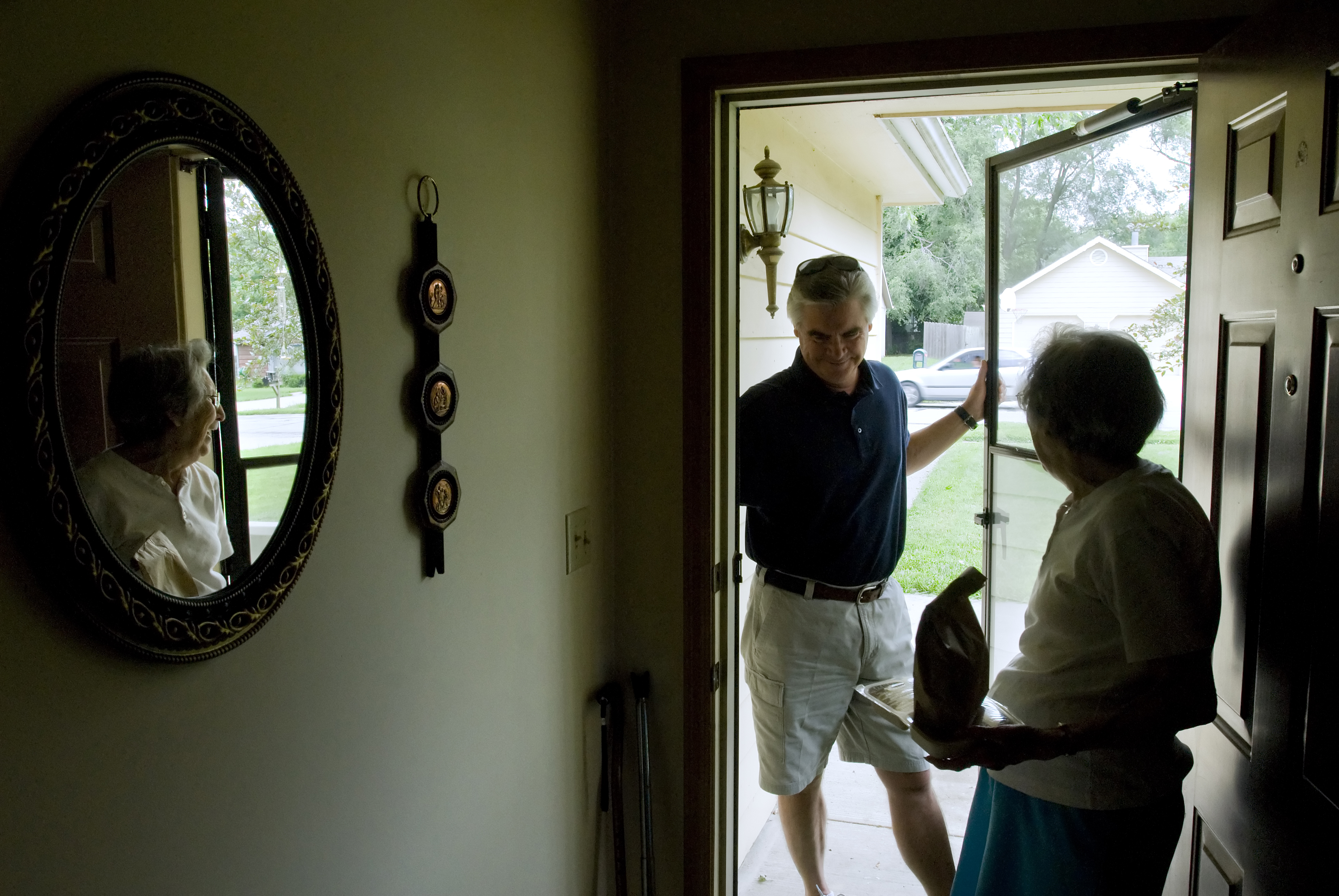
Volunteer Paul Schultz, of Lawrence, talks with Juanita Hunter after delivering a meal to her Thursday on his weekly route. Schultz, who picks up meals from the Lawrence Senior Center to be delivered to local elderly residents, said he would continue to volunteer for the service despite the rising cost of gasoline.
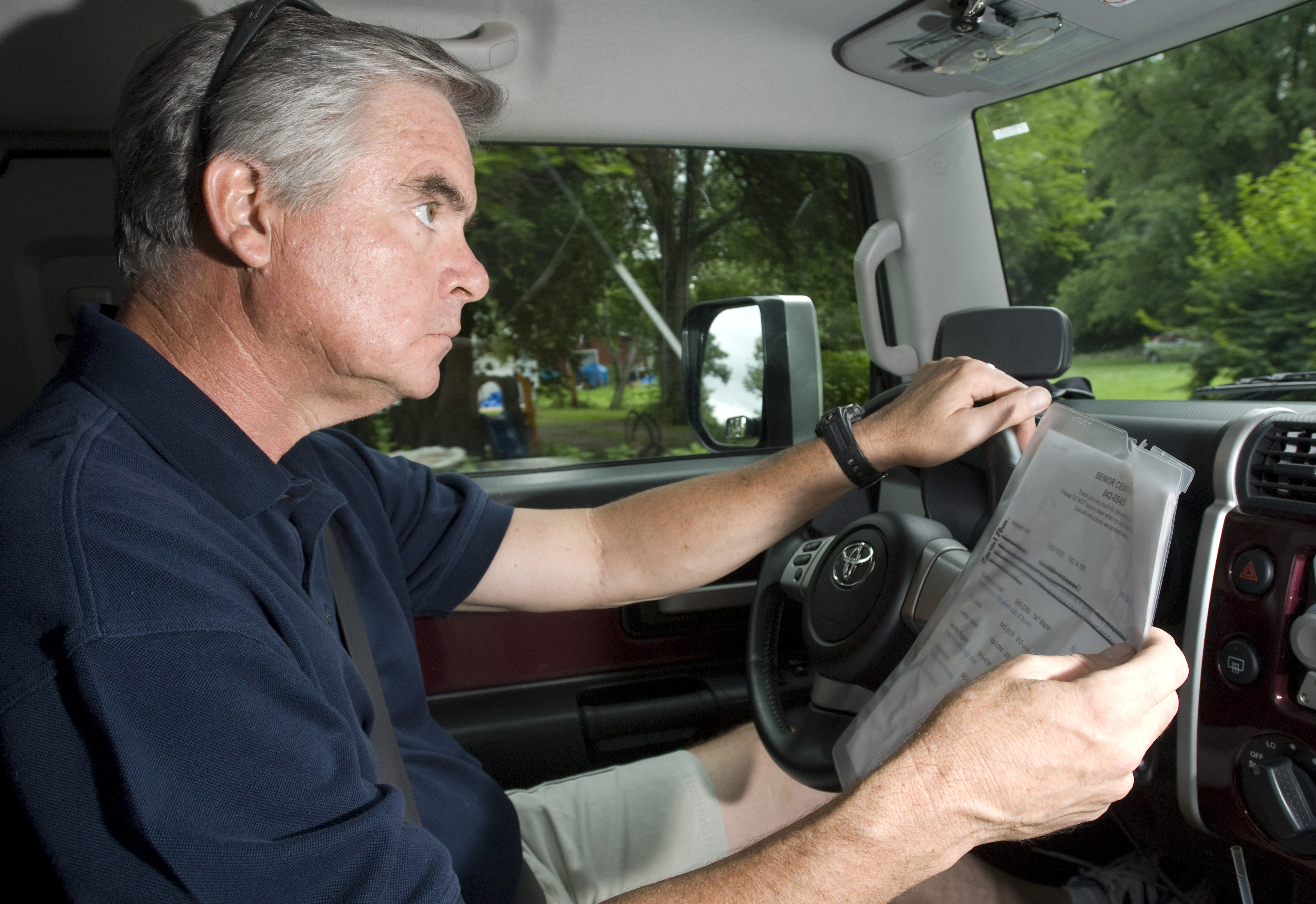
Retired Lawrence resident and volunteer Paul Schultz drives around North Lawrence on Thursday on his route delivering meals to local elderly residents.
Local agencies that help seniors have been hit hard by the rising cost of gasoline, which area directors say is draining budgets and deterring volunteers.
Kelly Evans, executive director of Trinity In-Home Care, said her organization spent $1,000 a month more on gas than it did a year ago.
The Douglas County Senior Center’s Senior Meals program is on pace to go over its fuel budget by $6,000.
Douglas County Visiting Nurses Association Rehabilitation & Hospice Care (VNA) is expecting to go over budget by $8,000, as it tries to ease the burden on its nursing staff.
Across the county, the tired tale of expensive gas is taking a toll on senior services.
“Our budget wasn’t prepared for that,” said Pattie Johnston, senior services director at the Lawrence Public Library. “It hurts just to see those numbers.”
Johnston runs the library’s senior outreach, which organizes off-site programs about 10 times a month, as well as the Bookmobile, which delivers books three times a week. So far, she said, no plans exist to cut services to seniors. But that could change.
“If we had to look at cutting our services, it would affect us quite a bit. We don’t have a lot,” she said. “It would hurt my heart.”
Rural areas could lose
Services in Douglas County are suffering in the same way as similar organizations across the country. A study by the National Association of Home Care & Hospice’s Foundation concluded that rising gas prices are threatening the ability of home-care specialists, who drive nearly 5 billion miles a year to provide service to homebound patients.
Even though senior service organizations don’t anticipate eliminating services, rural areas would suffer the most in a tight spot.
Judy Bellome, CEO of VNA, said VNA sometimes served people in Jefferson and Leavenworth counties, in addition to Douglas County. If the price of fuel continues to rise, those patients may lose out.
“If we get into a financial crunch, we may just have to care for people in Douglas County,” Bellome said.
The elderly in Baldwin City, Eudora and Lecompton served by Senior Meals have seen the frequency of service drop off. Kim Wittman, Senior Meals and transportation manager for Douglas County Senior Services, said volunteers drop off frozen meals once a week. And while she expected the services to remain intact, “We can’t change the distance we have to travel,” she said. “We can’t change the fact that Lawrence is growing and our home delivery within Lawrence is expanding.”
Evans, of Trinity In-Home Care, said a worst-case scenario would be dropping service in places like Eudora or Baldwin City.
“Right now, we still have people willing to bite the bullet. If it happens, we’ll just have to think outside the box,” she said.
While no organizations are expecting to cut back services, volunteers who deliver meals and home-care specialists are hurting the most.
New volunteers absent
Wittman said she has noticed a lack of new volunteers because of the gas crunch.
“We are not seeing new volunteers coming and offering to do this because of the commitment of using their own vehicles and, of course, burning their own gas,” she said.
Volunteers in the Senior Meals program drive about 67,000 miles a year, she said, while drivers in the transportation program, who drive seniors to various appointments, travel about 37,000 miles a year.
Wittman’s volunteers provide a free service for the elderly, but encourage donations to offset costs.
“We have always operated under the suggested contribution of $1 per ride,” Wittman said of the transportation program. “We are finding that is not feasible anymore.”
Wittman said Douglas County Senior Services volunteer corps is one-fifth smaller than it was a year ago.
Bellome said her organization recently raised mileage reimbursement from about 48 cents a mile to just more than 50 cents a mile, an expense that costs about $8,000. Trinity In-Home Care raised the mileage reimbursement a dime to 45 cents a mile.
“It’s just part of the cost of doing business,” Bellome said. Nurses and nurses’ aides, who drove more than 200,000 miles to Douglas County patients in 2006, depend on the reimbursement, she said.
Neither Senior Services nor Lawrence Meals on Wheels reimburses volunteers for gas mileage. Many volunteers choose to write off mileage on their taxes, “but that compensation doesn’t happen now,” said Kim Culliss, executive director of Lawrence Meals on Wheels.
She said her volunteers had suffered during the summer when Kansas University students were not available, driving more routes, causing delays in delivery. It’s one of several issues arising from the fuel costs.
“Sometimes (people) are getting their meals a little bit later,” Culliss said. She said more than 80 percent of Meals on Wheels customers need assistance to pay for the food, an all-time high. Culliss said the number was closer to 30 or 40 percent when she began her tenure in 2001.
She sees it as a butterfly effect, where gas prices influence everything.
“We’re starting to see with the rising costs of living, … people are beginning to have less and less expendable income,” she said. “Just as we’re needing more and more donations, people maybe have less to give.”
With no end in sight, Bellome said she was looking to increase the gas budget for 2009.
“Everything I’ve heard on financial forecasts (predicts) that this will be in place for the next couple of years,” she said. “We’ll budget as much as we can.”
Some relief is on the way, at least for Douglas County Senior Services volunteers. Wittman said Zarco 66 matched $500 in private donations to provide volunteers with $20 gas cards.
City Government

Developer seeks incentive from City of Lawrence to build 131 units of housing near Wakarusa and Queens

Lawrence city leaders will consider whether to keep Community Building open, make 2 other rec centers free to access
A STAR Bond application raises questions for city leaders about Costco and housing west of the SLT
Soccer gear honoring Lawrence history’s all-star team is now on sale as part of city’s public art exhibition
To honor public servants, Lawrence’s July 4 celebration will have a whole gallery of their photos on display; submissions open now