City leaders receive open meetings lesson
City Commission
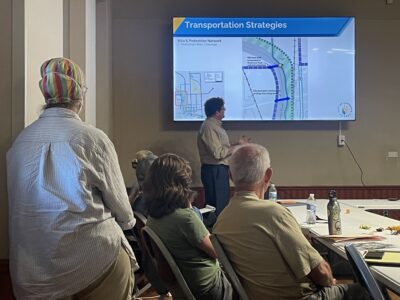
City commissioners on Tuesday were given their state-mandated lesson in the state’s open meetings law after the Kansas attorney general found commissioners violated it by holding an improper executive session.
Lesson No. 1: Openness is the best medicine for what ails many governments across the country.
“There is a sense out there that you (elected officials in general) are not inclined to act in the public’s interest but rather for special interests,” said Mike Kautsch, a Kansas University law professor who conducted a two-hour training session for city commissioners. “The Kansas Open Meetings Act is probably the best antidote for that perception.”
City commissioners agreed to participate in the training session as part of a settlement they reached with the Kansas attorney general. The attorney general in November found that the city violated portions of the Kansas Open Meetings Act when it held a closed-door executive session regarding an economic development incentives package for a start-up pharmaceuticals company that was considering a move out of the city.
Kautsch, who also is a former dean of KU’s School of Journalism, said elected officials needed to be particularly careful in how they use closed-door executive sessions.
“The worst thing that can happen is to use the executive session for subterfuge,” Kautsch said. “You probably think of yourself as never doing that, but the perception of subterfuge is easily entertained by the public.
“When you realize that perception is there, you should stop and take the discussion public.”
Some members of the public have alleged city commissioners did use the executive session as a way to avoid talking about new economic development incentives in public. The package of economic development incentives offered to Deciphera Pharmaceuticals included a never-before-used tax rebate provision. That tax rebate concept was never discussed in a public meeting by city commissioners.
The attorney general didn’t cite the city for talking about the tax rebate in the executive session, but rather said Lawrence Chamber of Commerce President and CEO Lavern Squier shouldn’t have been allowed to attend the meeting.
But commissioners said they took the need to discuss topics in public to heart.
“What I’m hearing and what I’ve believed is that the analysis and decision making must be done in open session,” City Commissioner Mike Amyx said. “And if you feel uncomfortable that it is not being handled that way, you should walk out of that room. That’s it in a nutshell.”
Some members of the public, though, said commissioners still had more work to do.
“I heard questions today that still make me think that commission members are trying to be secretive instead of coming from the other direction and asking how can we be transparent,” said Michael Johnson, a Lawrence resident who attended the training session.
In addition to all five city commissioners, all three members of the Douglas County Commission attended the training session. School board members Linda Robinson and Mary Loveland also attended, as did numerous city and county staff members.
City commissioners, as part of the legal settlement, agreed to personally pay for the training session, but Kautsch conducted it at no charge.
In addition to executive session matters, the training session also included the topic of the proper use of e-mail communication by commissioners. Kautsch said commissioners had to be wary of participating in e-mail discussions with other commissioners because such conversations can be construed as a meeting.
City Government

Developer seeks incentive from City of Lawrence to build 131 units of housing near Wakarusa and Queens

Lawrence city leaders will consider whether to keep Community Building open, make 2 other rec centers free to access
A STAR Bond application raises questions for city leaders about Costco and housing west of the SLT

Soccer gear honoring Lawrence history’s all-star team is now on sale as part of city’s public art exhibition
To honor public servants, Lawrence’s July 4 celebration will have a whole gallery of their photos on display; submissions open now