Sewer issue raises a stink
Speaker at real estate event urges city to build plant
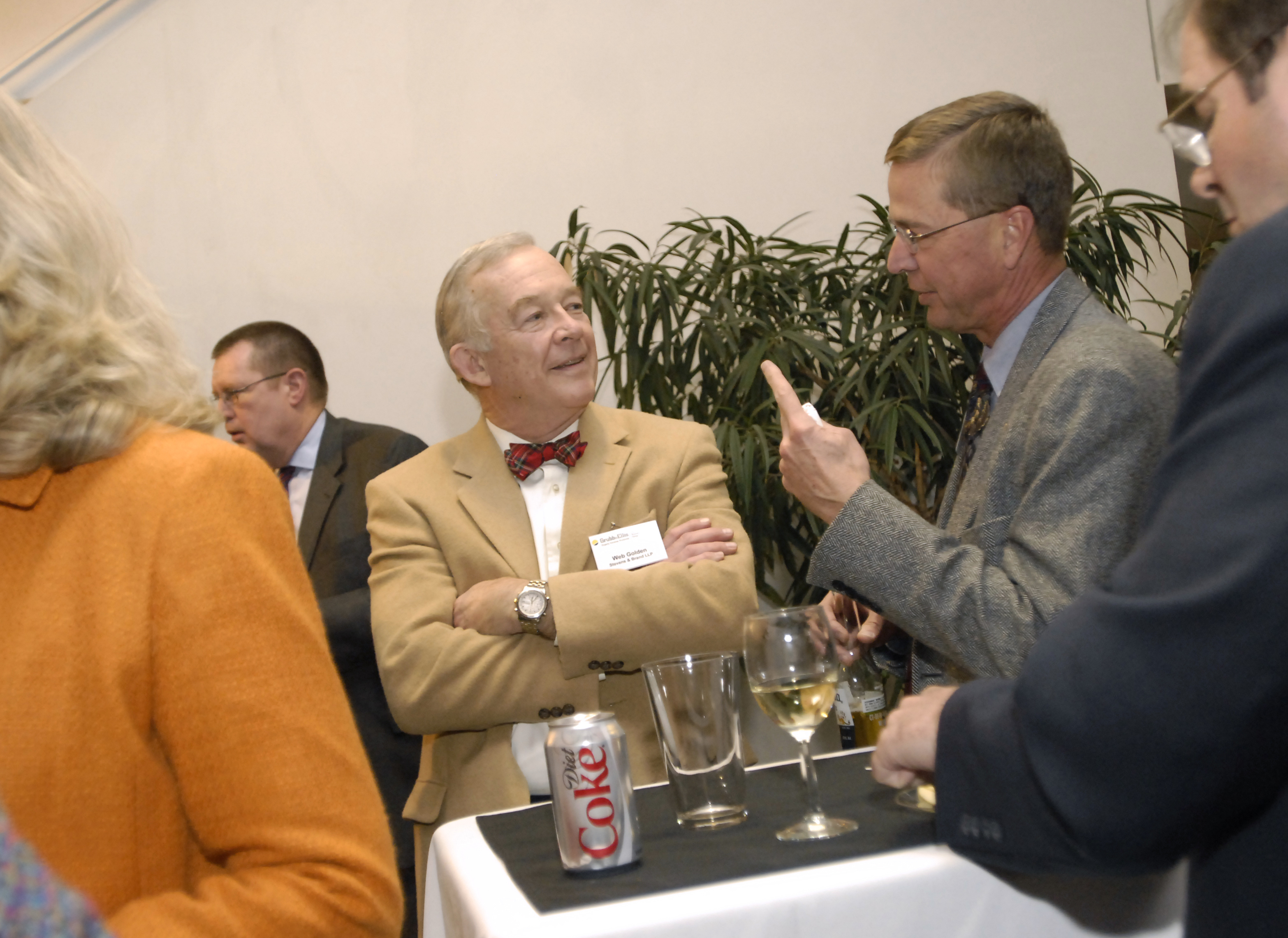
Web Golden, of Stevens & Brand, and David Bunker, vice president for Sunflower Bank, visit during the 2008 Lawrence Commercial Real Estate Forecast Event at the Lawrence Arts Center, 940 N.H. The event, presented by Grubb & Ellis | The Winbury Group, drew more than 110 bankers, attorneys, architects and other business and governmental personnel interested in the city's real estate prospects for the coming year.
If Lawrence wants to stay on the map for companies looking to expand, it certainly can’t keep flushing its plans down the toilet.
That’s the sense of Kelvin Heck, a commercial real estate broker who can’t understand why city officials are even thinking about postponing construction of an $88 million sewage treatment plant along the Wakarusa River.
“If there’s one thing that development needs – besides water – it’s sewer,” Heck said. “If you don’t build it, they surely won’t come, so let’s get on with it.”
Heck’s remarks came during the 2008 Lawrence Commercial Real Estate Forecast Event, conducted Thursday by Grubb & Ellis | The Winbury Group at the Lawrence Arts Center. More than 110 professionals and government officials crowded into the auditorium to see numbers flash up on the large presentation screen.
Yet while many of the community’s numbers didn’t change all that much – office vacancies dropped from 14 percent to 10 percent, while vacancies in industrial and retail spaces held steady in Lawrence during 2007 – it was a collective forecast of prospects for the future that gained much of the attention.
The sewer plant issue simply tops the list. Also of concern to Heck and fellow agency professionals Marilyn Bittenbender and Allison Vance Moore – who deal with the market each day on behalf of buyers, sellers and renters of commercial real estate in the Lawrence area – are a lack of new business parks and the ongoing pile of requirements developers must face when trying to bring projects to town.
Lawrence’s vacancy rate for industrial property finished last year at 3.4 percent, virtually unchanged from 2006 and well below the national average of nearly 8 percent, Bittenbender said.
“And 3 percent is pretty much gridlock,” she said, describing the ability to attract companies to town or make room for major expansions.
The city must make room for more industrial development, through land-use decisions and infrastructure investments, or else risk being passed over by projects that could bring needed jobs and investments.
She fears that site selectors and business leaders soon may grow weary of Lawrence’s relative inability to accommodate their needs.
“We’ll stop getting looks,” Bittenbender said.
Rob Chestnut, a Lawrence city commissioner who attended the presentations, said he understood people being worried about possible delays in the sewage plant project, which officials say could be delayed 12 to 18 months to account for slower-than-anticipated city growth.
But commissioners intend to study the situation closely, to ensure that the community will be making its investment in the best possible way.
“We have a responsibility to be efficient in what we are doing,” he said.
City Government
Developer seeks incentive from City of Lawrence to build 131 units of housing near Wakarusa and Queens

Lawrence city leaders will consider whether to keep Community Building open, make 2 other rec centers free to access
A STAR Bond application raises questions for city leaders about Costco and housing west of the SLT
Soccer gear honoring Lawrence history’s all-star team is now on sale as part of city’s public art exhibition
To honor public servants, Lawrence’s July 4 celebration will have a whole gallery of their photos on display; submissions open now