Coalition takes pay battle local
Proponents of higher state minimum wage look to cities to help workers
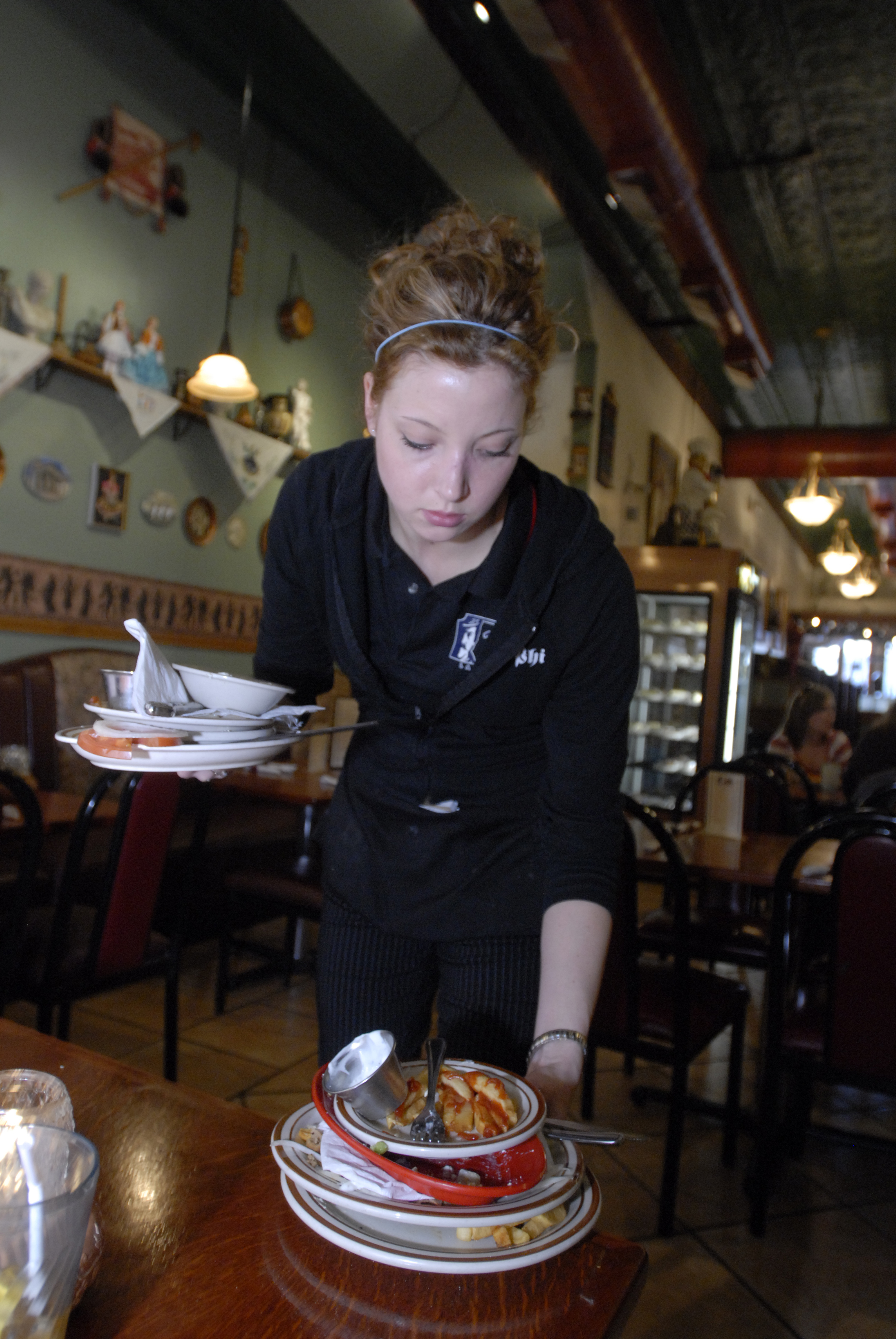
Laura Baker, a waitress at the Mad Greek, cleans a dirty table during her afternoon shift Monday at the downtown Lawrence restaurant. Baker earns minimum wage plus tips as a waitress. At .65 per hour, Kansas' state minimum wage is the lowest in the nation and hasn't increased in 20 years.
Topeka ? Advocates for the working poor are under no illusions.
They don’t expect much help from the Legislature in raising Kansas’ state minimum wage, which at $2.65 an hour is the lowest in the nation and hasn’t increased in 20 years.
Facing a seemingly unmovable Legislature, a coalition of workers’-rights and social-justice groups are on a city-by-city campaign to increase the state minimum wage.
“We are pursuing this local approach because of the inability to pass a wage increase at the state level year after year,” said Heidi Zeller, of Lawrence, who has organized Kansas Action Network’s “Raise the Wage” campaign.
Jake Lowen, political director of the Wichita-Hutchinson Labor Federation of Central Kansas AFL-CIO, said if the Legislature won’t approve a statewide increase “we will work to build a quilt” of cities with increased minimum wages.
For now, the coalition is working in Wichita, Topeka and Kansas City, Kan., to ensure that no workers in those cities are making less than the federal minimum wage of $5.85 an hour.
In the Legislature, the Senate Commerce Committee is considering a proposal that would make the state minimum wage stay on track with the federal minimum wage when it increases from $5.85 an hour to $6.55 an hour later this year and to $7.25 an hour in 2009.
Lowest state wages
Kansas’ state minimum wage of $2.65 an hour is at the bottom of the 45 states that have a state rate.
The state minimum wage affects about 19,000 workers, mostly in service or agricultural jobs, who aren’t covered by the federal minimum wage law, according to the U.S. Department of Labor.
Thirty-two states have state minimum wage rates that are more than the federal minimum wage, including Missouri and Colorado. Ten states have minimum wage rates that are the same as the federal rate, including Oklahoma and Nebraska.
Three states have lower rates than the federal rate, and that includes Kansas at $2.65 an hour, and Georgia and Wyoming, both at $5.15 an hour. Five states have no state minimum wage rate – Louisiana, Mississippi, Tennessee, Alabama and South Carolina.
Opposition to increasing rate
But efforts to increase the state rate have run into a wall of opposition from business organizations, such as the Kansas Restaurant and Hospitality Association, and the Kansas chapter of Americans for Prosperity.
Ron Hein, legislative counsel for the restaurant association, joked that he must “look like the ogre” when testifying against increasing the state minimum wage.
But Hein argues that increasing the minimum wage hurts low-paid unskilled workers by forcing employers to cut back on hiring.
Arthur Hall, executive director of the Center for Applied Economics at the Kansas University School of Business, agrees. Hall submitted testimony to the Commerce Committee that said employers adjust to increases in the minimum wage by not replacing workers when attrition occurs.
“The worst disemployment effects fall on people at the lowest skill level – typically, those holding minimum-wage jobs that have dropped out of school,” Hall said.
Low wage ‘ridiculous’
But advocates for an increased minimum wage argue that dire predictions of economic ruin prompted by increases in the minimum wage never come true.
“Overall, the economy gets a boost,” Zeller argued.
Workers benefit because they can better support their families, more money is pumped into the economy, and employers save through reduced employee turnover, she said.
Kansas University freshman Leigh Ann Stallbaumer makes $7.25 at a cafeteria on campus. She said her wages help her pay for school, and she sympathizes with those workers who make less than she does.
“It’s not fair considering other people work way harder and they don’t get paid that much,” she said.
As for the state rate, Stallbaumer laughs.
“That’s ridiculous,” she said. “Nobody can live off that. That needs to be raised for sure.”
State Sen. Roger Reitz, R-Manhattan, who has authored SB 466, said Kansas needs to get on board with the majority of other states.
But year after year, pro-business forces in Kansas have blocked the initiative.
Reitz said the fight has become almost a symbolic battle.
“We seem to be very comfortable in our setting, and that setting is unacceptable in 2008,” he said.
State Government
Candidates lean on their prominent supporters in District 2 race
TOPEKA — Democrat Don Coover and Republican Derek Schmidt stood with partisan allies as their congressional race ...
Funding for new Chiefs stadium moves forward, setting sales tax revenue district
TOPEKA — State officials answered a key question this week underpinning the complex financing of the Kansas City ...
Voters Guide: A look at the candidates seeking to become Kansas Insurance Commissioner
The Kansas Department of Insurance regulates insurance companies that sell policies in Kansas. Voters will decide ...
Voters Guide: A look at the candidates seeking the job of Kansas State Treasurer
In the Nov. 3 election, Republican Kansas Treasurer Steven Johnson faces two challengers for his job as the chief ...
What to know about amendment seeking to restrict noncitizen voting in Kansas