

Panel narrows anti-smoking bill
Topeka ? The Senate Judiciary Committee narrowed the scope Monday of a bill enacting new restrictions on smoking in public places.
The bill requires a vote Nov. 4 in each county on whether its residents want smoking banned in most public places, including restaurants, bars and casinos.
Public health advocates would like to impose a statewide ban, rather than leaving the issue to cities and counties. But senators who support the idea doubt it will pass, so they’ve compromised on a public vote.
Still, many bar and restaurant owners oppose the bill, fearing it will hurt their businesses.
On a voice vote, the Senate committee added exemptions from any county ban for cigar bars, tobacco shops and adult care homes that have indoor smoking areas for their residents.
But Sen. Phil Journey, a Haysville Republican, said if the Legislature is going to exempt some businesses that only adults are supposed to frequent, such as tobacco shops, it should exempt all of them, including bars.
The committee hoped to vote on the bill today.
Lobbying proposal
The House Federal and State Affairs Committee heard conflicting testimony about a bill that would require cities to report more information about their lobbying activities.
The measure would require cities to disclose how much they pay their lobbyists at the Statehouse and what they spend on dues to organizations that lobby state government.
Lobbyists representing cities now must report what they spend on hospitality for lawmakers and on advertising or newsletters designed to sway public opinion. But cities – like businesses, trade associations and interest groups – don’t have to report what they’re paying their lobbyists.
Supporters said the bill would promote open government.
“We consistently hear from our members how they oppose their tax dollars being used to pay to promote ideas and policies they disagree with,” said Alan Cobb, state director of Americans for Prosperity, which seeks to limit the growth in government spending.
But Erik Sartorius, a lobbyist for the city of Overland Park, said parts of the bill are so vague that it’s not workable. The city is neutral on the measure.
And Mark Tallman, who lobbies for the Kansas Association of School Boards, said: “We see no need to enact additional requirements.”
The committee took no action on the bill.
Juvenile justice
The House Appropriations Committee endorsed a budget for the juvenile justice system that largely mirrors one proposed by Gov. Kathleen Sebelius.
But the panel did postpone decisions on computers and employee pay raises.
The committee deleted about $1 million for longevity bonuses and pay raises, including a 2.5 percent increase for most workers. It’s doing that in all agencies’ budgets and will consider raises across state government later.
It also put off a decision on the Juvenile Justice Authority’s request for $380,000 for computer upgrades.
Under the committee’s plan, the juvenile justice system would be allowed to spend about $105.6 million during the fiscal year that begins July 1. That’s about $5.3 million, or 4.8 percent, less than its current budget.
Sebelius also proposed a decrease. Both proposals reflect that last year, federal officials required the state to make one-time improvements at mental health treatment centers for young offenders.
Ethics appointment
House Speaker Melvin Neufeld has filled a vacancy on the state Governmental Ethics Commission.
Neufeld’s appointee is Tecumseh resident John Reimer, a retired employee of a state agency that provides supplemental medical malpractice coverage for Kansas doctors. Reimer served in the House in 1977-81, as a Republican, then from Parsons.
The position has been vacant since 2003. State law limits who can serve on the commission, which enforces ethics, lobbying and campaign finance laws, so that people who are active as lobbyists or in politics and state government aren’t members.
Two of the commission’s nine members are appointed by the governor. One each is appointed by the attorney general, the secretary of state, the House speaker, the Senate president, the House and Senate minority leaders and the Kansas Supreme Court’s chief justice.
State Government
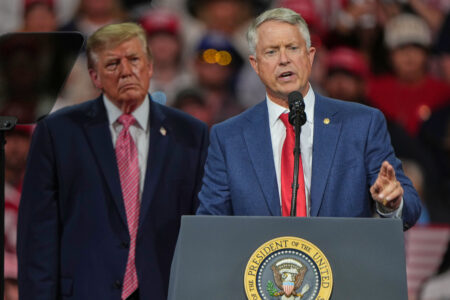
GOP’s highest profile figures are on rescue mission in once-reliable Kansas
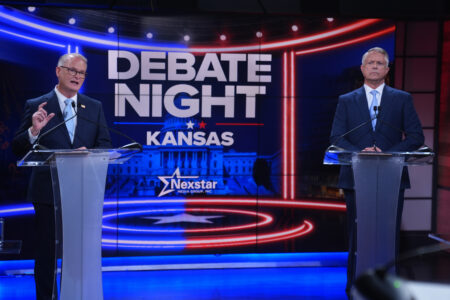
In debate, Marshall says the Ukraine war, not the Iran war, has caused high diesel prices
Candidates lean on their prominent supporters in District 2 race
TOPEKA — Democrat Don Coover and Republican Derek Schmidt stood with partisan allies as their congressional race ...
Funding for new Chiefs stadium moves forward, setting sales tax revenue district
TOPEKA — State officials answered a key question this week underpinning the complex financing of the Kansas City ...
Voters Guide: A look at the candidates seeking to become Kansas Insurance Commissioner
The Kansas Department of Insurance regulates insurance companies that sell policies in Kansas. Voters will decide ...
Voters Guide: A look at the candidates seeking the job of Kansas State Treasurer
In the Nov. 3 election, Republican Kansas Treasurer Steven Johnson faces two challengers for his job as the chief ...