Taking their work (vehicles) home with them
Key government employees on call for official business
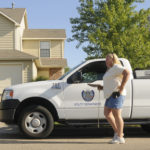
Ann House, who works in the city Utilities Department, is one of several city employees who have a city vehicle in their possession at all times. House responded to a customer's call on a waterline concern on Thursday.
Government vehicles
This is Lawrence’s other public transit system.
Sure, everyone knows the city operates the T, a system of buses that travel around the city from stop to stop. And yes, the city operates a para-transit service that provides door-to-door service for the elderly and disabled.
But city taxpayers also are paying the bill for a third system, albeit a much smaller and more exclusive one. It is powered by trucks and sedans, has 33 riders a day and takes city employees from home to work.
It is the city’s take-home-vehicle system.
The city allows 33 of the 235 vehicles in its fleet – not counting dump trucks and such – to be taken home on a daily basis by employees. And just as the city’s real public transit system has experienced a big increase in operating costs because of fuel prices, the cost for a city employee to drive a vehicle home also has jumped.
According to a 2006 city report, take-home vehicles cost the city, on average, $1,056 per year, per vehicle in 2006. Using the same set of assumptions the city used in 2006 – except accounting for an increase in fuel costs from $2.10 per gallon in ’06 to about $3.50 today – a Journal-World analysis estimates the city is spending $1,396 annually for each take-home vehicle, a total of $46,068.
And city leaders have taken notice.
The city has cut the number of employees who are allowed to take home vehicles from 65 in 2006 to 33 today.
“We’re not finished looking at it yet, either,” City Manager David Corliss said. “But we feel like we have made progress on it.”
Case-by-case
With gasoline prices soaring, having a company vehicle is a nice benefit for employees.
But Corliss said the city doesn’t assign take-home vehicles as an employment perk. Instead, he said employees who have take-home vehicles generally fall into the category of those who are called in after hours or those who can show some other type of obvious efficiency by having a vehicle.
“The reality is that the community has a high expectation for service, and there are some types of issues they expect a quick response,” Corliss said. Corliss does not take a city vehicle home but does have a $5,000 annual vehicle stipend in his contract.
The city weighs the cost of providing employees take-home vehicles versus paying employees mileage to drive back to work after-hours.
But unlike some communities, the city doesn’t have a specific policy that spells out what criteria must be met to receive a take-home vehicle.
“I have decided to look at the departments on a case-by-case basis,” Corliss said.
City staff members in 2006 – at the direction of the previous City Commission – did create a draft take-home vehicle policy. But the policy was never adopted.
Under that policy, take-home vehicles would have been limited to employees who live in the city limits, although the city manager could grant an exception.
Corliss said some employees who live both in rural Douglas County and in neighboring counties take city vehicles home. Exact numbers weren’t immediately available for this year, but according to the 2006 report, some city employees drove upward of 20 miles one way from home to work. In one case, one public works employee who drove nearly 15 miles one way was driving a vehicle that averaged 5 miles per gallon.
Corliss said he’s now exploring a guideline that would require take-home vehicles be assigned to employees who live within a certain distance of the city.
The 2006 proposed policy also had language stating that employees generally should not receive take-home vehicles unless they were called in after-hours at least once every two weeks. It would have required department heads to keep a monthly log of how often take-home vehicles were called into action.
Corliss said the frequency of call-backs was part of the decision-making process in assigning take-home vehicles, but he said a formal report system hadn’t been developed for all departments.
Corliss said the policy was not put back in front of commissioners for adoption because he believed commissioners were comfortable with him making management decisions about how to use take-home vehicles. He said creating a one-size-fits-all policy would be difficult given the variety of tasks city employees are responsible for.
“My general policy has been to try to reduce the use of take-home vehicles when it really was for more of an administrative function, but to still allow it when it was for an after-hours work issue or emergency response question.”
“If we weren’t making any progress in reducing the numbers, I would be more concerned about not having a written policy,” Corliss said.
City commissioners also expressed support for how managers were handling take-home vehicles. Commissioner Rob Chestnut said he wasn’t aware of any abuses, but said he was open to residents calling him with specific situations they are aware of.
“I would take any of those and vet them through the city manager to get an explanation,” Chestnut said.
Commissioner Boog Highberger said the vehicle issue is not one he hears much about anymore.
“The last report I saw indicated that the problem had been taken care of, if there was a problem,” said Highberger, who said he might be interested in putting a limit on how far a take-home vehicle could be driven. “But basically, I think it pretty much is under control.”
City Government

Developer seeks incentive from City of Lawrence to build 131 units of housing near Wakarusa and Queens

Lawrence city leaders will consider whether to keep Community Building open, make 2 other rec centers free to access
A STAR Bond application raises questions for city leaders about Costco and housing west of the SLT

Soccer gear honoring Lawrence history’s all-star team is now on sale as part of city’s public art exhibition
To honor public servants, Lawrence’s July 4 celebration will have a whole gallery of their photos on display; submissions open now