KU delivering expertise on global level
Business school forming partnerships with competitive corporations
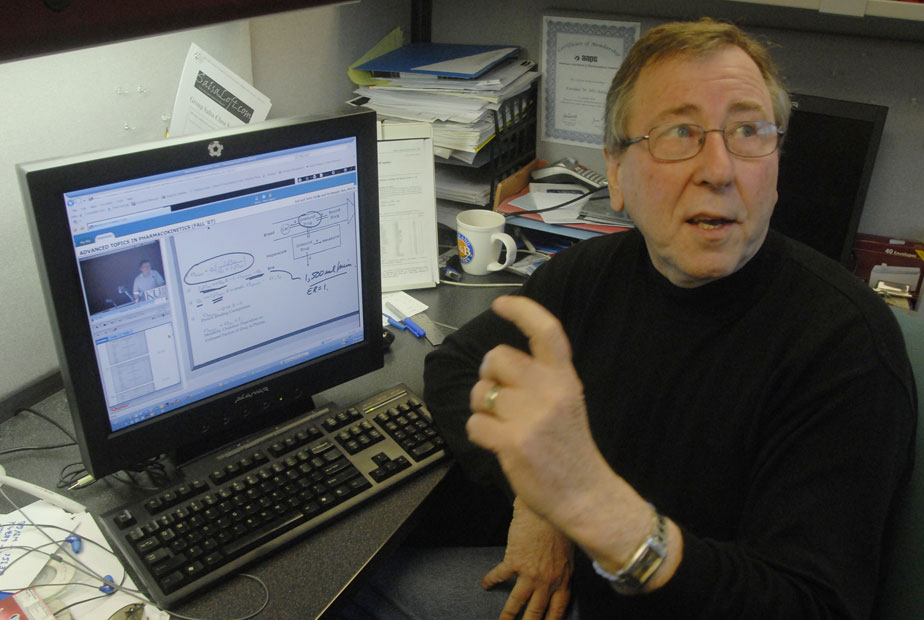
Val Stella, a distinguished professor of pharmaceutical chemistry at Kansas University, taught a distance-learning course last fall to a dozen students at four remote U.S. sites.
Some academic leaders at Kansas University aren’t waiting around for some of the world’s most eligible students to find Mount Oread.
They’re taking the knowledge directly to employers, whether it’s a maker of prescription pet foods just up the road in Topeka or a contract pharmaceuticals operation a half-world away in India.
When the global economy demands the expertise of Jayhawks, KU is poised to deliver.
“This is the first of its kind in the country,” said Bob Walker, spokesman for Shawnee-based Bayer Animal Health, which is working with the KU’s School of Business to offer a master of business administration program focused on animal health. “For Bayer, we’re targeting using this program to attract scientific talent into Bayer that will help us manage our business, from both a scientific and a business perspective. This gives them the tools to do that.
“We have some very strong aspirations for this program.”
From the animal-health MBA to a distance-learning master’s program in pharmaceutical chemistry, KU leaders are learning to answer the needs of businesses that long have come to rely on the expertise, knowledge and experience of the university’s graduates.
Only now, the learning no longer is limited to classrooms or labs on Mount Oread. The knowledge can find the students, through employers who may be more than willing to contribute their time, financial resources and technical capabilities to help boost performance of promising employees.
That’s the case for the department of pharmaceutical chemistry, where a grant from industry heavyweight Amgen helped get a distance-learning project going. A handful of students are taking master’s-level courses at sites literally from coast to coast: Thousand Oaks and San Francisco in California, and Cambridge in Massachusetts.
Industry connections
The students connect with campus through a video feed, communicate with professors through the Internet and coordinate research through a supervisor at work, who works closely with faculty in Lawrence.
“We got into this because a couple companies in the U.S. suggested it would be really nice for their employees to work on a master’s degree and still remain employees,” said Howard Rytting, developer and director of the department’s distance-learning master’s program. “It helps them retain them, too. Most of these individuals have bachelor’s degrees, but can see that if they really want to progress, they need an advanced degree.
“This provides them with an opportunity to maintain their employment, take courses and (get ahead). It’s also a research degree, which helps the company because they do research for the company.”
Rytting expects more than 50 students to be enrolled in the three-year program within as little as five years. Work is ongoing to extend the program outside the U.S. borders and into markets such as India and China, where demand for such expertise – from companies and potential students alike – is on the rise.
“The department has a very good international reputation,” said Christian Schneich, chairman of KU’s department of pharmaceutical chemistry. “Students sign up with this program because it’s a degree from KU. They’re getting a very highly appreciated degree.
“Companies are very interested in partnering with us in this program. We are just trying to see the best way to administer it.”
Val Stella, a KU distinguished professor of pharmaceutical chemistry, is certain that demand for such education only will increase, especially as the pharmaceuticals industry continues to generate promising startups – such as Deciphera and CritiTech, right here in Lawrence – and contract operations throughout the world, filling necessary niches.
“The big guys are getting bigger, and the little guys are filling in the gaps,” said Stella, who taught a distance-learning course last fall to a dozen students at four remote U.S. sites. “We have to continue to evolve to fill in the needs.”
Business approach
At the School of Business, leaders are taking a similar focus while staying closer to home. The animal-health MBA, a two-year program, is conducted on campus and this year added four companies to its roster of participants in the program.
In addition to Bayer Animal Health, which helped launch the program, the program now includes Hills Pet Nutrition Inc., Ceva Biomune, Boehringer Ingelheim Vetmedica Inc. and Fort Dodge Animal Health.
With the region awash in animal-health expertise and investment – Kansas City-area companies account for nearly a third of total sales in the $15.2 billion global animal health market, according to the Kansas City Area Development Council – officials are counting on the program to pay off for years to come, whether it’s through providing educational expertise or helping drive economic-development initiatives.
“This program is designed to help develop management talent in the Animal Health Corridor, which will be good for both companies already in the region as well as those relocating to the region,” said Bill Fuerst, dean of business, in announcing the addition of corporate participants earlier this year.
Officials intend to enroll 12 to 14 students each semester in the two-year MBA program.
Bayer’s plan for using the program: Hire participants – all veterinarians and research scientists – on three-year contracts, then have them take classes at KU while rotating through scheduled stops in Bayer’s own departments.
After earning the MBA and gaining experience in sales, new business development, accounting and other tasks at Bayer, participants will meet with company officials to see where they might fit in with the operation.
“Because our industry is growing rapidly, we need to identify the next generation of business leaders who can take companies like ours to the next level,” said Joerg Ohle, president and general manager of Bayer Animal Health. “This program is key to filling the pipeline with tomorrow’s industry leaders. In addition, this program is tangible evidence that the corridor is bringing value to the industries and to the companies who locate here.”
City Government

City Commission to consider nearly $1M contract for final design of Fire Station 6

Through Aug. 21, you can get credit for traffic fines in Municipal Court by donating school supplies
After tense start, meeting ends with many agreeing that city, county homelessness plan deserves closer review
In Lawrence Transit survey, majority say they don’t feel safe at downtown bus stop across from library

With city leaders’ approval, Lawrence Public Library’s outdoor pavilion should soon be under construction