City making plans for next census count
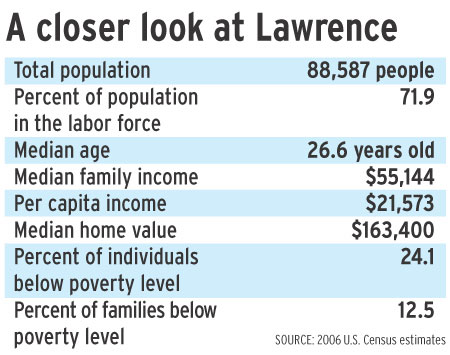
The nationwide count of the U.S. population is two years away, but Lawrence city staff has already begun to prepare the 2010 Census.
“It’s a fairly massive undertaking that we’re involved in,” the city’s GIS planner, David Guntert, said of an effort to review and update the Census Bureau’s database of local residential addresses.
The 2010 count will establish a new baseline of data for the entire country.
The data, which will be collected in short-form questionnaires, is important for all communities. It is used to distribute congressional seats and determine how much federal funding, such as community development block grants, goes to cities.
“We’re talking about $300 billion a year in money that goes out,” said David McMahon, U.S. Census Bureau spokesman. “It translates into highways and schools and hospitals and things like that.”
In Lawrence – where officials challenged the 2005 and 2006 census estimates – city staff members have already begun efforts to ensure the count is as accurate as possible.
The city is participating in the Local Update of Census Address program. Staff members are reviewing the federal agency’s database of local addresses and correcting and updating the information – no small feat in a community with thousands of apartment units that must be treated separately.
“It’s very important,” Guntert said. “We want to make sure that they have as complete a record as possible for doing the census.”
Student population
Like other university communities, Lawrence faces a challenge of getting an accurate count on its student population. The Census gathers numbers on households as of Census Day, which is April 1.
If people do not respond to the mailed questionnaire, a census employee will follow up with a visit. Those visits, usually a few weeks after the April 1 count, come at a time when many students are completing the semester and moving or taking off for the summer, Guntert said.
“It becomes a real challenge to know how many people were residing in that dwelling at the April 1 date,” Guntert said.
The city will steer Census employees to the areas where students live in an effort to make sure they’re counted early in the process and before the students move, he said.
The efforts could pay off by providing a more complete picture of the community and its inhabitants.
“It helps us determine accurately how we are growing and where we are growing,” Lawrence long-range planner Amy Miller said of the decennial census data. “It gives us a few more demographic details on the population – income, housing information.”
The city’s development services division, for example, looks to such data as median family income in various neighborhoods for its efforts to administer community housing block grants.
The decennial census relies on different measures than the estimate counts released annually, which have been disputed by the city in recent years.
Adjusted numbers
In the latest correction, the Census Bureau in November upped Lawrence’s 2006 population estimate by more than 500 people and added more than 400 people to the Douglas County total. The correction followed the city’s challenge of the original figures. A challenge of the 2005 estimate also led to a correction. That one added about 9,000 people to the county’s overall 2005 estimated population.
Miller explained that the annual estimates used a top-down method rather than looking at building permit data or new residences in a particular area.
“They figure out the national estimate,” she said. “Then they figure out the state estimate. And from the state estimate, different counties get an allocation and from there local municipalities get an allocation.”
Meanwhile, Miller said, the city looks at building permit data and double-checks its data with water billing records. Challenges are not uncommon.
“They pretty much rely on the local municipalities to challenge,” she said.
The decennial census, with its surveys to sample the population, is a more reliable measure that the city is less likely to dispute.
“We feel pretty confident in those,” Miller said. “I know that a lot of communities that are university towns like we are have voiced concerns over the years because of how the students are counted, but I just think that that’s an ongoing debate.”
City Government
Developer seeks incentive from City of Lawrence to build 131 units of housing near Wakarusa and Queens

Lawrence city leaders will consider whether to keep Community Building open, make 2 other rec centers free to access
A STAR Bond application raises questions for city leaders about Costco and housing west of the SLT
Soccer gear honoring Lawrence history’s all-star team is now on sale as part of city’s public art exhibition
To honor public servants, Lawrence’s July 4 celebration will have a whole gallery of their photos on display; submissions open now