Students receive lesson on voting
Relevance of math emphasized
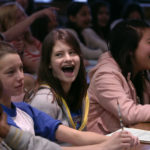
Hillcrest School sixth-grader Grace Miller, center, smiles across the room as she and her female classmates try to out-muscle the males for votes during a mock election for a leader of the European Union on Wednesday at Kansas University's Snow Hall. The sixth-graders participated in a presentation by the math department linking math and voting.
Room 306 of Kansas University’s Snow Hall turned into election central Wednesday, and students from Hillcrest Elementary were weighing their options on who should be the Lord of Europe.
Candidates made lots of promises to members of the European Union, as portrayed by Hillcrest’s sixth-grade class. Jon Delgado promised boys would get pizza every day and new cars; girls could earn money. Lynne Yengulalp vowed to give $300 to every girl, and boys would receive a pink Hello Kitty backpack and would each escort a girl to a ball.
EU voters elected Yengulalp, 34 votes to 26, but Delgado took the lordship after the electoral college results swung the pendulum his way. A coin flip broke the deadlock, after representatives from Greece were split on which candidate to back, and boys who voted for Delgado cheered wildly.
The election is fictional, of course, and it was part of Kansas University’s annual Math Awareness Month events. This year’s theme links math and voting.
On Wednesday, Hillcrest’s sixth-graders learned how voting and mathematics are essential to each other. Graduate students from KU’s math department, including Delgado and Yengulalp, showed the students how math is relevant to real events, like on the television program “Dancing with the Stars” and in making group decisions.
“They wanted to have the kids understand how voting is important to the real world, and how one vote can make a difference, and how, mathematically, that rate is huge,” said Katie Mullins, a Hillcrest math teacher.
Yengulalp, a graduate student from Avon Lake, Ohio, said the scenario she devised with Delgado would give the students insight into how popular voting works with an electoral college.
“We thought we were going to get more girls than boys,” she said, and they expected the children to vote along gender lines. So they fixed the voting so the popular vote would lose against the electoral college results. In the end, the kids saw a scenario similar to the one that played out during the 2000 U.S. presidential race.
Students got the message.
“When I was in fourth and third grade, I’m always thinking, ‘Why do we have to go to math? I mean, we’re not going to use this when we grow up,'” said student Mark Stevens, 12. “But you don’t ever realize you’re using it every day, so whenever you learn something new, you’re going to use it and you don’t even realize it.”
That’s precisely the response educators hoped for.
“One of the state standards is how students are able to take the information from the math class and understand how they’re going to be able to use it in the real world,” Mullins said. “We try to make them understand that every single job in the world will use some kind of math.”
City Government

Developer seeks incentive from City of Lawrence to build 131 units of housing near Wakarusa and Queens

Lawrence city leaders will consider whether to keep Community Building open, make 2 other rec centers free to access
A STAR Bond application raises questions for city leaders about Costco and housing west of the SLT

Soccer gear honoring Lawrence history’s all-star team is now on sale as part of city’s public art exhibition
To honor public servants, Lawrence’s July 4 celebration will have a whole gallery of their photos on display; submissions open now