Helpful hints will keep your food safe to eat
September is National Food Safety Education Month, so many of the questions that will be addressed this month will focus on “Foodborne Pathogens: Your Family’s Health is in Your Hands.”
Here are some helpful hints for keeping food safe.
¢ Clean: Everything that touches food should be clean. Cleanliness is a major factor in preventing foodborne illness. Even with food safety inspection and monitoring at federal, state and local government facilities, the consumer’s role is to make sure food is handled safely after it is purchased.
¢ Separate: Fight cross-contamination. Cross-contamination is the transfer of harmful bacteria to food from other foods, cutting boards and utensils. An example of cross-contamination is cutting raw meat, poultry or fish on a cutting board and then slicing salad vegetables on the same cutting board without washing the cutting board between uses.
¢ Cook: Use a food thermometer in cooking. Using a food thermometer is the only way to tell if food has reached a high enough temperature to destroy harmful bacteria. Use a food thermometer to measure the internal temperature of foods, such as meat, hamburgers, poultry, egg casseroles and any combination dishes.
¢ Chill: Make sure the temperature in the refrigerator is 40 degrees or below and zero degrees or below in the freezer. Use a refrigerator/freezer thermometer to check the temperature. Harmful bacteria grow most rapidly in the danger zone – the unsafe temperatures between 40 and 140 degrees – so it’s important to keep food out of this temperature range.
Q: What exactly is a foodborne illness?
A: Foodborne illness, the accurate term for “food poisoning,” comes from eating a contaminated food or drinking a contaminated beverage. Many types of pathogens can be foodborne and lead to illness. Toxins or chemicals may also contaminate foods and cause illness as well. More than 250 different foodborne diseases have been identified. Because these foodborne microorganisms enter the body through the gastrointestinal tract, the first symptoms are often nausea, vomiting, abdominal cramps and diarrhea.
Although many cases of foodborne illness are not reported, the Centers for Disease Control and Prevention (CDC) estimates there are 76 million illnesses, 325,000 hospitalizations and 5,000 deaths in the United States each year. Unfortunately, anyone may contract a foodborne illness. However, certain populations, such as pregnant women, older adults, young children and those with a weakened immune system, are at greater risk for experiencing a lengthier illness, hospitalization or even death should they contract a foodborne illness.
Q: What are pathogens?
A: A pathogen is any microorganism that is infectious or toxicogenic. Pathogens include harmful bacteria, viruses, parasites and some fungi/yeasts. Contamination can occur during growing, harvesting, processing, storing, shipping or final preparation. Poor manufacturing processes or poor food preparation can allow microbes to grow in food and subsequently infect you.
Harmful bacteria are the most common cause of foodborne illnesses. Some bacteria and other pathogens may be present on foods when you purchase them. Raw foods are the most common source of foodborne illnesses because they are not sterile; examples include raw meat and poultry that may have become contaminated during slaughter. Seafood may become contaminated during harvest or through processing. One in 10,000 eggs may be contaminated with salmonella inside the egg shell. Produce such as spinach, lettuce, tomatoes, sprouts and melons can become contaminated with salmonella, shigella or Escherichia coli (E. coli) O157:H7.
Escherichia coli (E. coli) bacteria sometimes persist in food products such as undercooked hamburger meat and unpasteurized fruit juice. These bacteria can have deadly consequences in vulnerable people, especially children and the elderly. Sources of produce contamination are varied as these foods are grown in soil and can become contaminated during growth or through processing and distribution. Contamination may also occur during food preparation in a restaurant or a home kitchen. The most common form of contamination from handled foods is the calcivirus, also called the Norwalk-like virus.
When food is cooked and left out for more than two hours at room temperature, or one hour in temperatures exceeding 90 degrees, bacteria can multiply quickly. Most bacteria grow undetected because they don’t produce a bad odor or change the color, texture or taste of the food. Freezing food slows or stops bacteria’s growth, but it does not destroy the bacteria. The microbes can become reactivated when the food is thawed.
Refrigeration also can slow the growth of some bacteria. Thorough cooking is needed to destroy the bacteria. Using a food thermometer is the best method to determine whether a food product has been cooked to a safe minimum internal temperature.
Q: Are the types of foodborne diseases changing?
A: According to the CDC, the spectrum of foodborne diseases is constantly changing. A century ago, typhoid fever, tuberculosis and cholera were common foodborne diseases. Improvements in food safety, such as pasteurization of milk, safe canning and disinfection of water supplies have conquered those diseases.
Today other foodborne infections have taken their place, including some that have only recently been discovered. For example, in 1996, the parasite cyclospora suddenly appeared as a cause of diarrheal illness related to Guatemalan raspberries. These berries had just started to be grown commercially in Guatemala and somehow became contaminated in the field there with this unusual parasite. In the future, other diseases whose origins are currently unknown may turn out be related to foodborne infections.
– Susan Krumm is an Extension agent in family and consumer sciences with K-State Research and Extension-Douglas County, 2110 Harper St. She can be reached at 843-7058.
Food

David Tamarkin’s recipe for Greens, Grains and Fried Egg works for any meal
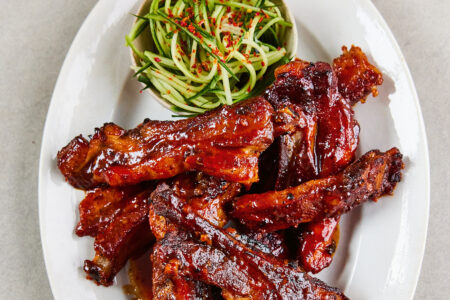
Slow-cooked, sticky-glazed pork ribs go with cucumber slaw in Sam Way’s recipe