Wild cat roundup aims to control population
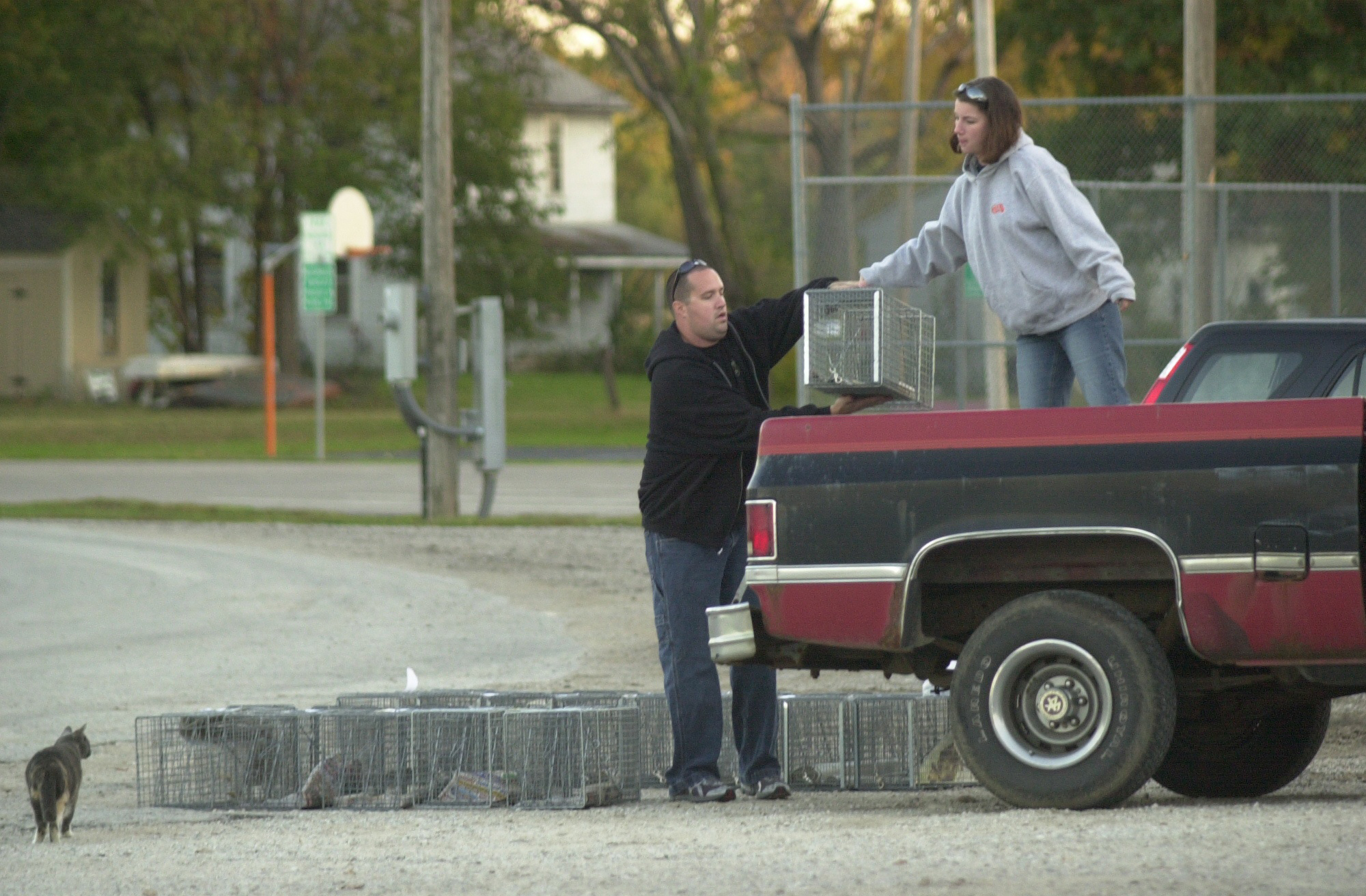
A curious cat checks out traps used to catch feral cats as Terry Gwin, left, and his wife, Sam, unload more Saturday evening in De Soto. The Gwins, of Olathe, are part of a group that aims to catch, sterilize and release feral cats as a way of controlling their populations.
Cats were rubbing against Sam Gwin’s leg soon after she arrived Saturday evening at Jim’s Garage in De Soto.
The Olathe woman and her husband, Terry, who volunteer for No More Homeless Pets Kansas City, were in De Soto to trap the feral cats living near the garage and neighboring De Soto Feed and Garden.
Taking note of the cats’ friendliness toward his wife, Terry made a quick assessment of the work ahead for the couple and fellow volunteer Gail Bennett, of De Soto.
“This is going to be easy,” he said.
Maybe not that easy, Bennett said. The four friendliest cats were pets Jim Boney kept at his garage. The leery and hard-to-approach cats were the ones that needed to be caught.
As a customer at the garage, Bennett noticed a “colony” of an estimated 20 feral cats living around the garage and feed store north of De Soto’s Miller Park.
“I have four spayed and neutered cats at the garage,” Boney said. “I got a reputation as a cat-lover, and I think people started dumping them here. Then two or three of them started having kittens.
“It’s really gotten out of hand.”
The three volunteers were part of a weekend metropolitan cat round up, Bennett said. Their goal was to trap as many cats as possible in the 20 cages they brought to De Soto so the animals could be spayed and neutered.
The idea isn’t to find new homes for the newly sterilized cats but to release them back where they were caught, Bennett said.
“They’re feral cats,” she said. “They really wouldn’t make good pets.”
“Feral fix” events like the one last weekend help bring the population in check because the newly spayed and neutered cats are territorial and will chase off cats attempting to invade their area, said Kathy Rodriguez, co-director of Feral Friends for No More Homeless Pets Kansas City.
“Cats are very territorial,” she said. “They may appear to be homeless, but to them, that’s a pretty safe place to call home. With the feed store, there’s probably a good food source. They are taking care of the vermin around there.
“What we’re trying to do with trap, neuter and return is get the colony stabilized and stop growing. Reducing the number of reproductive cats is successful in doing that.”
To entice cats into traps, the Gwins baited the cages with two healthy spoonfuls of tuna. They then placed the 10-inch-wide and 2-foot-long traps around the feed store’s outbuildings.
Cats would enter the traps to eat the tuna, trip the spring to the front door and settle in for a catnap.
“If it’s not covered they go crazy,” Sam said as she spread a towel over a trap. “When it’s covered, they stay quiet.”
Ten cats were trapped. Those and three Bennett collected earlier were taken to the Greater Kansas City, Mo., Humane Society Shelter, where Sunday they were spayed or neutered, given distemper and rabies shots, and wormed with cats collected at other sites around the metropolitan area, Bennett said.
It was the largest clinic yet for No More Homeless Pets, she said.
“They had five veterinarians there volunteering and 118 cats,” Bennett said. “That’s about 20 surgeries for each veterinarian. They were doing a surgery once about every 20 minutes.”
It may be the last clinic the organization does outside its own because No More Homeless Pets is about to get a new home. The organization is remodeling a building in Merriam into a “high-volume, low-cost” spay and neutering clinic, Rodriguez said.
With a planned December opening, the clinic will serve shelters and rescue groups, low-income pet owners and free-roaming cats, Rodriguez said. The goal is to spay or neuter 6,000 animals the first year the clinic is open, 10,000 in the second year and then sustain 16,000 surgeries annually, she said.
Through outreach to low-income pet owners and sterilization of homeless animals, the organization’s members believe the number of dogs and cats put down each year can be drastically reduced, Rodriguez said.
To learn more about No More Homeless Pets or make a donation, visit the organization’s Web site at nmhpkc.org or call (816) 333-PETS.
City Government

Developer seeks incentive from City of Lawrence to build 131 units of housing near Wakarusa and Queens

Lawrence city leaders will consider whether to keep Community Building open, make 2 other rec centers free to access
A STAR Bond application raises questions for city leaders about Costco and housing west of the SLT
Soccer gear honoring Lawrence history’s all-star team is now on sale as part of city’s public art exhibition
To honor public servants, Lawrence’s July 4 celebration will have a whole gallery of their photos on display; submissions open now