Higher fines suggested to ease downtown parking
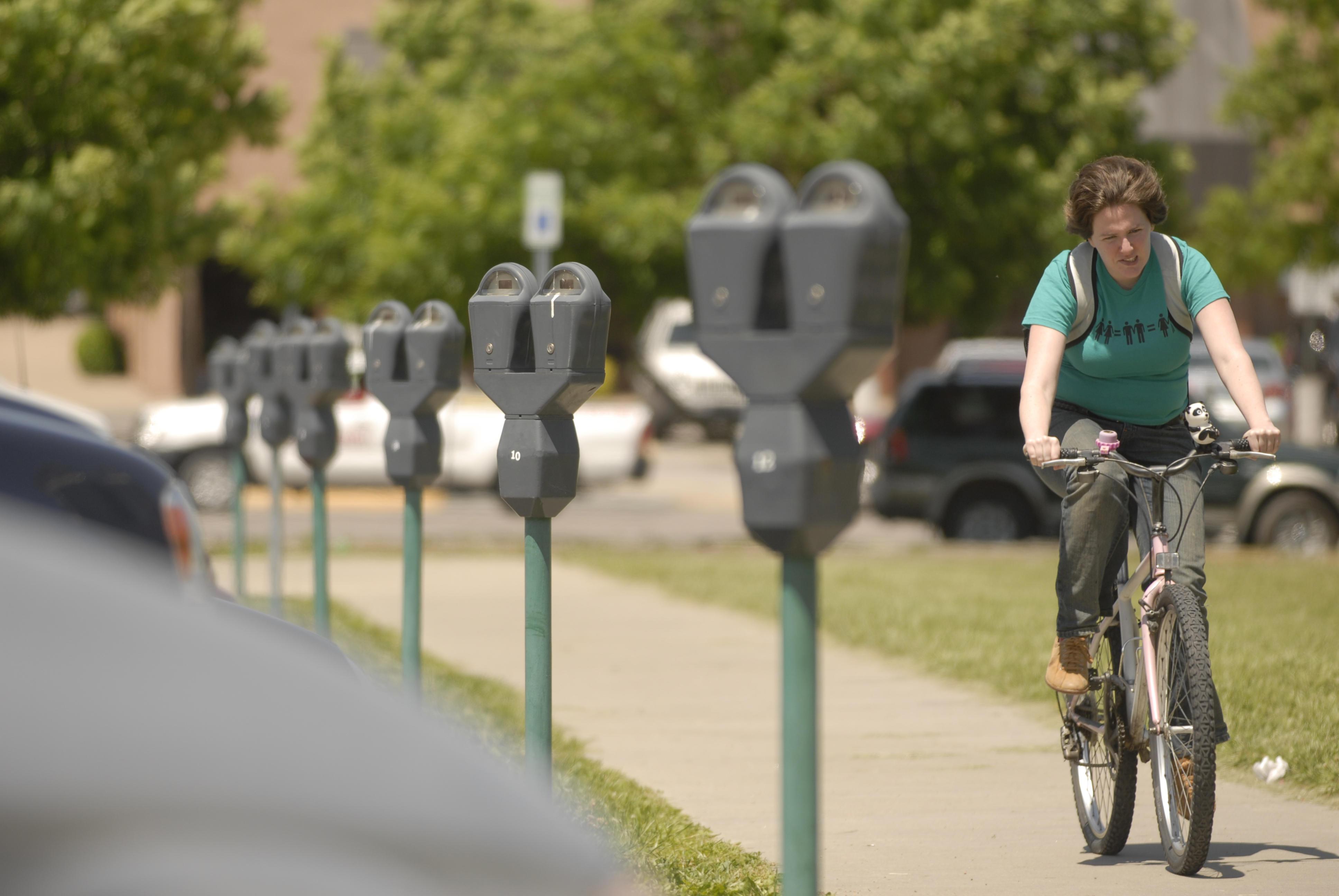
Thad Allender/Journal-World Photo A line of parking meters frame bicyclist Taryn McMahon as she commutes around town. Although the immediate fine for over parking in Lawrence is $2, the price jumps five-fold if the fine goes unpaid.
How we stack up
Lawrence charges $2 for overparking in downtown Lawrence, although the fine goes to $10 if it is not paid within 10 days. Here’s what a few other Kansas communities charge for overtime parking:¢ Topeka: $8 ¢ Manhattan: $5¢ Wichita: $15¢ Olathe: $10¢ Kansas City, Kan.: $20¢ Kansas University: $10 at meters
Bill Dennis will tell you Massachusetts Street is downtown Lawrence’s version of a casino. Shoppers roll the dice every time they drive down the street searching for a parking spot.
The problem, according to Dennis – a planning consultant who studied Lawrence earlier this year as part of the PlaceMakers Consulting group – is that motorists are coming up snake eyes.
“It needs to be like a successful casino,” Dennis said. “People need to feel like they are winning enough to keep them coming back.”
The way to do that, Dennis said, may not be extremely popular: Increase parking fines.
Dennis said he was amazed to learn that Lawrence charges a $2 fine for overparking – $10 to $15 less than many communities he has studied. He said it is particularly low for communities, like Lawrence, that have destination-type downtowns.
He said the low fine is good for people lucky enough to get a Massachusetts Street parking spot, but is bad for those who are left looking. The $2 fine, he said, isn’t enough to dissuade people from taking a Massachusetts Street spot and leaving their vehicle parked there all day.
“You do want to use a carrot-and-stick-approach, but Lawrence has no stick,” Dennis said.
Fee fears
Some longtime downtown merchants, however, said they feared increasing downtown parking fines would do more harm than good.
“I don’t think that would do anything to help the perception of downtown,” said Ernie Cummings, owner of Kizer-Cummings Jewelers, 833 Mass.
Cummings said a $2 fine may seem cheap to people who are more accustomed to parking on the East or West coasts, but he thought it was still enough money to serve as a disincentive here in the heartland.
“I don’t think anybody who comes downtown very often wants to get a parking ticket,” Cummings said. “Even if it is just $2, if you do that very often, it is still pretty expensive parking.”
The city last raised parking fines in 2004, increasing them by $1. City Manager David Corliss said his staff is not contemplating recommending an increase in the fines.
“I can guarantee you that there are still citizens who are very chagrined that they’ve received a $2 ticket,” Corliss said.
Rick Marquez, executive director of Downtown Lawrence Inc., said the idea of higher fines hasn’t prompted any talk among his members. He said the issue of fines is a balancing act: Merchants want the spaces on Massachusetts Street to turn over, but they don’t want to leave shoppers with a negative impression of downtown by giving them a $10 or $15 ticket.
Instead, Marquez said his group has been discussing ways to improve the city’s network of signs that direct motorists to underused parking lots, such as the parking on the roof of the city-owned garage near Ninth and New Hampshire streets.
“I would guess that 80 percent of the spots on that roof are open at almost any time,” Marquez said of the lot, where this summer the city is allowing people to park for free.
Friendly fees
Dennis, though, urged the city and merchants to give a fee increase some additional thought because both groups have a lot to gain. He said numerous retail experts have estimated that a parking space by a retailer’s front door is worth $200,000 a year in sales. But the key, he said, is that it must be a well-managed space.
“If you increased the fees, over time people would see that they have a greater likelihood of getting parking on the street,” Dennis said. “Everybody would feel better about that.”
Ideally, Dennis said, people should think they have at least a 50-50 chance of getting a parking spot on Massachusetts Street during peak hours.
When tickets are given out, Dennis said, it doesn’t have to be done in a draconian way. He said technology that the city already has would allow parking enforcement officers to know whether an overparked vehicle is a first-time offender by entering the vehicle’s tag number.
The city could adopt a policy of printing a warning to first-time offenders, Dennis said. The warning also could have a coupon for downtown shops on the back.
“You could make it a good experience instead of punishing someone for coming downtown for the first time,” Dennis said.
Dennis said downtown merchants also could try to take more control of the city’s parking policies. He said many successful downtowns form business improvement districts. Those districts, rather than the city, employ the ticket enforcement officers and control parking policy. That, for example, would give a merchant board the ability to create parking policies that are friendly to shoppers.
A merchant board also could share tag numbers of their stores’ employees with parking ticket enforcement officers. That way, the merchant board could keep track of whether their employees are parking in the Massachusetts Street spots, and take appropriate action.
City Government
Developer seeks incentive from City of Lawrence to build 131 units of housing near Wakarusa and Queens

Lawrence city leaders will consider whether to keep Community Building open, make 2 other rec centers free to access
A STAR Bond application raises questions for city leaders about Costco and housing west of the SLT

Soccer gear honoring Lawrence history’s all-star team is now on sale as part of city’s public art exhibition
To honor public servants, Lawrence’s July 4 celebration will have a whole gallery of their photos on display; submissions open now