Wheat decisions await
Farmers face financial losses after freeze damages crops
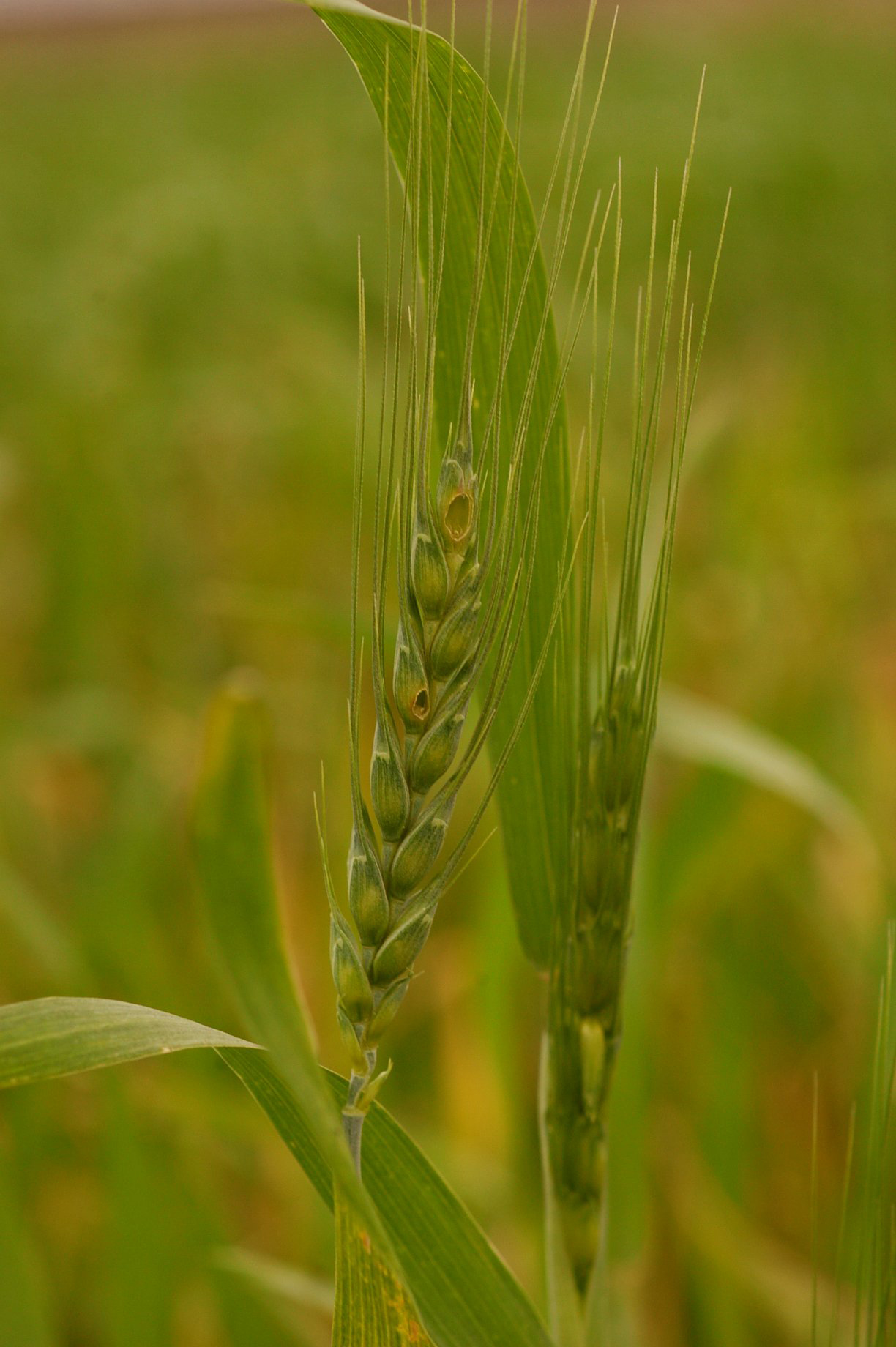
This wheat plant, pictured this week in a field northeast of Lawrence, appears to have weathered an early-April freeze better than most, said Bill Wood, agriculture agent for K-State Research and Extension in Douglas County. Other than a couple holes that insects have chewed into the head, he said, the plant is healthy. But continued cool, wet weather could usher in leaf diseases - leaf rust or powdery mildew or tan spot - that could cut into yields.
All this rain doesn’t bother Mark Wulfkuhle so much.
“You take it when you can get it,” he said.
But the Douglas County farmer could do without the subfreezing temperatures a month ago that left much of his more than 500 acres of wheat struggling to regain what had been a bountiful footing only a few days earlier.
Now – with patches of his wheat near Stull showing little hope for recovery – the farmer who has been nurturing crops for more than 20 years already knows that he’s going to take a financial hit.
The only questions now are where to cut his losses, and how he will negotiate a complex confluence of crop insurance, contract payments and harvesting costs.
What is certain: A crop that had offered potential for $50,000 to $75,000 in profits now looks to actually cost him $50,000 to $75,000 in additional expenses, depending on how things go until harvest arrives this summer.
A crop that was on target for more than 60 bushels an acre in late March, he said, now will be expected to yield, at best, 10 to 30 bushels an acre.
“It’s just farming,” Wulfkuhle said Thursday, stuck working in his shop because of yet another rainy day. “I like to say most farmers don’t go to Las Vegas, because they sit right here at home and gamble. And this is one of the times you rolled out the craps dice and had snake eyes.”
While the effects of a harsh freeze that iced central and eastern Kansas during Easter weekend still are being assessed, decision time is fast approaching for farmers who know their crops have suffered damage.
Farmers could plow under their wheat, or choose to bale it as hay for feed, in preparation for planting another crop, said Bill Wood, agriculture agent for K-State Research and Extension in Douglas County. Farmers typically like to have their corn in the ground by May 15; soybeans will be up next, going in late this month through early June; and milo plantings usually begin during the first week of June.
Farmers also could decide to stick with the wheat, hoping to see it recover enough to pay off.
“You never count wheat out,” Wood said. “It’s the comeback king.”
Another note on the freeze’s impact: Douglas County farmers planted 11,000 acres of wheat for this year, up from 5,000 a year earlier and 4,300 acres for 2005.
Wulfkuhle planted more wheat this year than he ever had before, hoping that last fall’s higher prices would pay off.
This spring’s early weather conditions had given him hope, as strong, healthy plants came out of the ground and fed optimism for a bountiful harvest.
Now, he’s left waiting to see how it all plays out.
“I’ve never had wheat look as lush and good as it did,” Wulfkuhle said. “Now, I’ve never had wheat look as bad as it does. :
“It’s just farming.”
City Government
Developer seeks incentive from City of Lawrence to build 131 units of housing near Wakarusa and Queens

Lawrence city leaders will consider whether to keep Community Building open, make 2 other rec centers free to access

A STAR Bond application raises questions for city leaders about Costco and housing west of the SLT

Soccer gear honoring Lawrence history’s all-star team is now on sale as part of city’s public art exhibition

To honor public servants, Lawrence’s July 4 celebration will have a whole gallery of their photos on display; submissions open now