Savvy commuters bypass highway-collapse problems
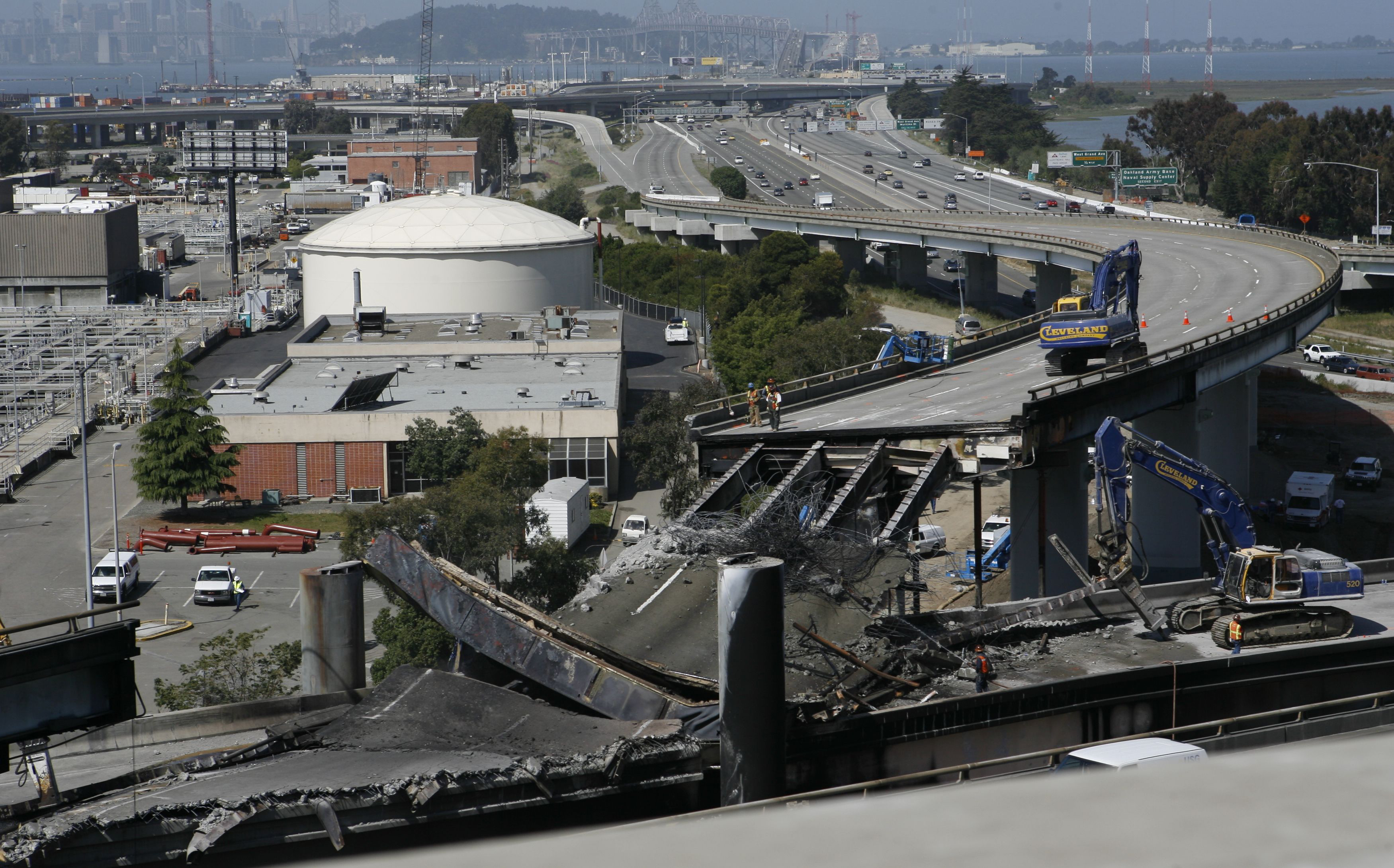
Workers demolish a section of Interstate 580 in Oakland, Calif., that was damaged after a tanker carrying gasoline exploded Sunday. Many commuters who normally would have driven Monday on the interstate to work used free public transit or stayed home, averting massive gridlock that transportation officials had feared.
Oakland, Calif. ? Bay Area commuters skirted the wreckage of a collapsed section of freeway Monday as crews began hauling away the charred debris that had been a vital link between San Francisco and its eastern suburbs.
City officials called for a review of the rules that allowed a driver with a criminal background to haul the 8,000 gallons of gasoline that burned and weakened the overpass early Sunday, causing it to crumple onto another below.
The snarled highways envisioned for the region didn’t materialize Monday, as many commuters seized on free public transportation, avoided rush hour or just stayed home.
Officials had worried the afternoon drive in particular would create headaches as traffic leaving San Francisco was diverted away from the collapsed eastbound segment. But Monday afternoon was like a normal weekday commute, California Highway Patrol officials said.
Authorities predicted that overall the crash would cause the worst disruption for commuters since the 1989 Loma Prieta earthquake damaged the Bay Bridge itself. The sight of the soaring freeway twisted into a fractured mass of steel and concrete was reminiscent of that quake’s damage.
Originally built in the 1950s, the collapsed roadway was retrofitted in the late 1990s to withstand earthquake damage. Rather than rebuild the ramp to existing blueprints, however, engineers will likely overhaul the interchange to conform to today’s more stringent seismic standards.
Some 80,000 vehicles used the damaged portion of the road every day. But because the accident occurred where three highways converge, authorities said it could cause problems for hundreds of thousands of commuters. State transportation officials said 280,000 commuters take the Bay Bridge into San Francisco each day.
To encourage motorists to switch to public transit, Gov. Arnold Schwarzenegger authorized free passage Monday on ferries, buses and the Bay Area Rapid Transit rail system. Extra trains were added and bus and ferry operators also expanded service.
State officials promised to move swiftly on repairing the damaged interchange, and observers said the span could be rebuilt in a matter of months.
The investigation was still under way, but the California Highway Patrol believes the driver, James Mosqueda, 51, may have been speeding. Investigators do not suspect drugs or alcohol were involved, Officer Les Bishop said.
Mosqueda has a history of criminal activity, including drug and burglary arrests, and served two years and eight months in prison following a 1996 arrest for heroin possession, court records show.
The state’s vehicle code allows convicted felons who have served their sentences to get commercial driver’s licenses so long as they have clear driving records, Highway Patrol Chief Steve Vaughn said.
National
Man pleads guilty to killing a top Minnesota Democrat and her husband
New tornadoes outside Chicago as severe storms pummel the Midwest
Feds won’t seek death penalty in plea deal with man accused of killing top Minnesota Democrat
NASA unveils astronauts to test tech for future moon landing
Social Security’ fund faces shortfall one year earlier than expected
WASHINGTON (AP) — Social Security 's retirement trust fund is projected to face a funding shortfall in 2032, a ...