Archive for Monday, March 26, 2007
Organization helps Kenyan children stay in school
March 26, 2007
Advertisement
Kenyan education
If primary school students score high enough on the Kenya Comprehensive Primary Examination, they have a chance to attend secondary school, almost all of which are boarding schools far from rural areas.
Teach My Kenyan Children provides student scholarships at approximately $400 per child per year. So far this year, the organization has sponsored 26 students on scholarships. For more information, go to www.tmkc.org.
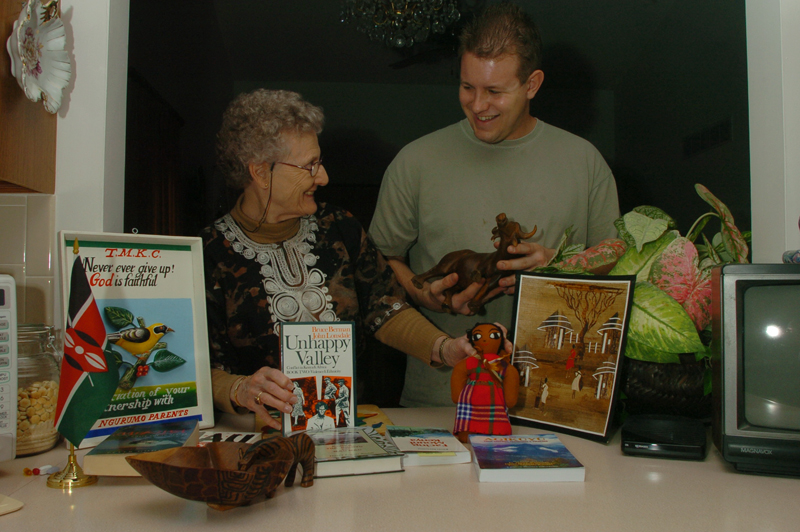
The education of children in Kenya has become a passion for Gloria Follett and John Randtke, who talk about some of the items they've brought back from visits to the East African country. They are members of a organization called Teach My Kenyan Children.
Either miss lunch for school, or miss school for lunch.
Many primary-school students in rural Kenya face this choice daily. They often travel long distances and beg or work for meals.
A Lawrence organization called Teach My Kenyan Children provides another solution. It established a "Lunch and Learn" program in September 2003 so students could eat lunches at schools instead of leaving for home.
"Now that they can go to school and eat, there's more incentive to stay," said John Randtke, Kansas University senior and a board member for the organization. "We're trying to take out all the obstacles that are keeping kids from their school."
Besides lunches, the nonprofit organization assists the education of students in rural Kenya by providing classroom materials, professional development, assistance with buildings and facilities, and scholarships for secondary school.
"In America, it's understood that children will go to secondary school," said Gloria M. Follett, the organization's president. "In Kenya, that's not a given. There is no government assistance, and parents have to pay all the fees. And they're simply too poor to do that."
Follett, a longtime Lawrence school psychologist, co-founded the organization in 2001 with Peter Gitau, a Kenyan who completed his doctorate in higher education at KU.
The organization launched its first partnership with Ngurumo Village Primary School, which Gitau attended. It has expanded to support two more schools, the Kambie and Thirikwa primary schools.
Randtke said the organization faced its greatest challenge in assigning priorities to Kenyan needs.
Many schools have applied for assistance, he said, but the organization is limited by lack of funding.
"Our growth in Kenya is limited primarily by our growth in America," he said.
When the Kenyan government mandated free primary education in 2003, Follett said, about 1.6 million children attended schools without any increase in teachers or educational materials.
"It has just been absolutely chaotic," she said, adding that many rural schools had no textbooks, pencils, running water or electricity.
"In many instances, it would be like we lived in this country, out in the Midwest, in the 1800s."
Follett left Wednesday for Kenya and will provide professional training for teachers until May.
In addition to an autism conference in Nairobi, the organization also hopes to complete several projects during the summer, including the drilling of a well for Ngurumo's school.
Despite the obstacles, Follett said, the organization has grown rapidly. It established a school library at Ngurumo and financed the construction of a dining hall, which also serves as a community center.
The organization is a nondenominational Christian missions initiative that bases its work upon biblical principles, Follett said.
"We believe that as God's children, he wants everybody to be able to read and write," she said, "or he wouldn't have given us the Bible."
The organization gives English Bibles to students in standard four, the Kenyan equivalent of fourth grade.
"The child's Bible may be the only book that the family has," Follett said.
Religious education is part of the Kenyan national curriculum. About 80 percent of Kenyans are Christians, according to the U.S. Department of State.
Randtke said the organization works in partnership with the Kenyan government to improve education.
"I hear a lot of people saying missionaries are going over to these countries and trying to Americanize them," he said. "That isn't the case at all. We're working with the Kenyan people to develop their schools in the way they think they should go."
- Journal-World intern Shanxi Upsdell can be reached at 832-7148.
More like this
- KU senior plans to teach in Kenya this fall March 26, 2007
- Kenyan kinship: Lawrence resident makes connections during African trip 1 comment / June 30, 2008
- Journal-World copy editor Shanxi Upsdell recounts her experience in Kenya with the Lawrence-based or June 30, 2008
- Private schools growing, expanding September 26, 2000
- Area private schools growing, expanding April 6, 2001
Top ads RSS
- Utilization Review Specialist Elizabeth Layton Center has part-time opening for ...
- KU Office of Institutional Research & Planning
- Factory Outlet $1800/Mo. Starting Pay Its the holidays and we ...
- COLLISION REPAIR TECHS Quality oriented techs needed for busy collision ...
- St. Francis Health Center - NAS Recruitment
Marketplace
Arts & Entertainment · Bars · Theatres · Restaurants · Coffeehouses · Libraries · Antiques · Services
- KU task force to focus on retaining students November 8, 2009 · 9 comments
- Blog: Dillons, Hyvee, And Checkers — I'Ve Shopped And Compared. See The Results. November 8, 2009 · 67 comments
- Repossessions up amid downturn November 8, 2009 · 8 comments
- House narrowly passes health care bill November 7, 2009 · 53 comments
- Blog: Tacos: What's In It For You? November 6, 2009 · 59 comments
- Former House speaker has vital message for America November 7, 2009 · 28 comments
- Poll: Would you vote the same way today as you did for president in 2008? November 6, 2009 · 71 comments
- Blog: I Am A Stripper. November 3, 2009 · 322 comments
- Something ‘didn’t seem right’ about suspect November 8, 2009 · 2 comments
- Crumbling of Berlin Wall still worth celebrating November 8, 2009 · 8 comments
- Away we grow: Sweet potatoes simple, versatile garden crop November 8, 2009
- American heritage: KU contributes to new Native galleries at Nelson-Atkins November 8, 2009
- Consultant: I communicate with animals November 8, 2009
- Baldwin City resident finds his voice through karaoke ‘hobby’ November 8, 2009
- Young students help battle cancer after classmate with leukemia dies November 3, 2009
- KU task force to focus on retaining students November 8, 2009
- If the shoe fits: Finding the right kids’ shoes doesn’t have to be difficult November 2, 2009
- KU women defeat Emporia State, 85-48, in exhibition finale November 8, 2009
- New, legal, drug has law enforcement concerned — and it's already on a Lawrence store's shelves November 4, 2009
- High School Dropouts, by Molly Fister November 8, 2009


26 March 2007
at 7:52 a.m.
Suggest removal
Permalink
mommaeffortx2 (Anonymous) says…
sounds like a plan.
26 March 2007
at 8:05 a.m.
Suggest removal
Permalink
Marion (Marion Lynn) says…
That's nice.
Now what about the kids in the USA who cannot read?
What about the kids in the USA who are short on school supplies?
What about the kids in the USA who miss school because there is no father and the older must take care of the younger ones?
Why must these people go to freaking KENYA to find students in need?
The answer?
It is not “feel good” enough to take care of our own first; tha's why!
Taking care of poverty stricken students in Lawrence (And there are!) just doesn't read or sound as good as “Taking care of poor folks in KENYA!”.
Couple that with the Christian penchant for “ingathering” and missionary work and we neglect our own!
Thanks.
Marion.
26 March 2007
at 8:21 a.m.
Suggest removal
Permalink
opinion (Anonymous) says…
Marion,
I guess that is the difference between your thought process and mine. I see an article like this and say to myself, “if Gloria can go halfway around the world to help people, I ought to be able to at least help my neighbor”.
Maybe, just maybe, Gloria and others like her recognize, that there are plenty of available resources here and that if people would just get off their behind, no US child would want for anything. Maybe, just maybe, Gloria does not see those same resources elsewhere and realizes that there a few that can do what she can do. And maybe, just maybe, Gloria walks and not just talks.
26 March 2007
at 9:30 a.m.
Suggest removal
Permalink
common_cents (Anonymous) says…
opinion,
I guess that is the difference between your thought process and mine. I see an article like this and say to myself, “My wife and I and our friends go and help out or local schools quite freqently, taking off work in many instances to help children with projects and such. Why can't people who have the means to go halfway around the world to help others, just go down the block and do the same?”
Maybe, just maybe, if Gloria and others like her would do just that, go down the block and help the local school children, others would follow her example, get off their behind and help those in our own neighborhoods, creating people who know what it is like to be helped by people you know and see everyday - possibly perpetuating the same acts throughout generations. Mabye, just maybe, Gloria doesn't think our own neighborhood children need help, because she's too busy looking elsewhere.
It all starts at home. Unfortunately, she didn't start it at her home.
26 March 2007
at 9:48 a.m.
Suggest removal
Permalink
opinion (Anonymous) says…
common_cents
First, the many months Gloria is here, she is always busy helping local kids. Second, you and your family are the exact resources I was talking about when I said we already have the resources here to handle issues. Bless you for loving your neighbor. If you are like my family though, we are not in a position to take on the sacrafice that Gloria is undertaking. I thank God she is able to do it because, again we have an over abundance of resources that are able to help out here (they just choose not to) while we have just a limited number of people that can go elsewhere. It is not like we have to choose who to help, we can help all, if people mobilized.
It seems to me, that instead of criticizing someone willing to help, we should be encouraging others to get into the game.
26 March 2007
at 10:34 a.m.
Suggest removal
Permalink
randtke (John Randtke) says…
First off, Gloria has spent a large part of her life helping kids in Lawrence. Its not my place to tell her story for her, but she definitely understands the need schools have in America.
Secondly, Peter Gitau is helping out at home. He and Gloria started the group when he asked her to help him with schools back in his home country.
There is a big difference between poverty stricken kids in Lawrence and poverty stricken kids in Kenya. The first time I went to take pictures of the students, the students would share there shoes with each other so that they could look “smart” in their picture, even if they didn't own their own pair. Shoes are superficial compared to all the other needs they have there.
The literacy rate in Kenya is around 85%, and in America it is over 99%. TMKC is focused on helping in the rural areas where literacy is typically lower.
There is need in America, and there is need in Kenya. I would argue that the need is greater in Kenya, but that is where I feel called towards. There shouldn't be a debate between helping kids here and helping kids there. We live in a global society, we should be helping kids everywhere.
If anyone has questions about TMKC, I'll try to answer them here, or you can send an email to johnrandtke@gmail.com
26 March 2007
at 10:41 a.m.
Suggest removal
Permalink
opinion (Anonymous) says…
“There shouldn't be a debate between helping kids here and helping kids there. We live in a global society, we should be helping kids everywhere.”
Thanks John. Keep up the Good work.
26 March 2007
at 10:45 a.m.
Suggest removal
Permalink
Marion (Marion Lynn) says…
Group hug!
Ya know, I'm really sorry about the plight of the Kenyans and I am.
Feel “called” to Kenya?
Get on a plane!
We can squander our efforts by spreading them too thinly or we can take care of ourselves so that we can better help out others.
You are correct: There should be no debate on this matter.
The USA should come first.
Thanks.
Marion.
26 March 2007
at 12:01 p.m.
Suggest removal
Permalink
randtke (John Randtke) says…
Do Americans deserve education more than Kenyans?
26 March 2007
at 1 p.m.
Suggest removal
Permalink
Confrontation (Anonymous) says…
I don't think this has anything to do with educating Kenyans in anything other than Bible obsession. Americans are sick of having these make believe stories shoved in their faces, so people like Gloria have to target those who don't know any better. If they truly cared about the real education part, then they wouldn't have to force their religion down the Kenyans' throats at the same time.
26 March 2007
at 1:28 p.m.
Suggest removal
Permalink
randtke (John Randtke) says…
No one is forcing religion down anyone's throat. The Bible is already a standard text book in their high schools. Within the cultural context, we are giving them text books when we give them Bibles; and as a Christian organization, we are more than happy to supply Bibles. We also provide math, english, kiswahili, science, history, and many other text books.
Students over there are required by the government to learn about Christianity, Islam, and Hinduism in schools. As they get older, they learn to have more respect for other people, than many of us here. We aren't going over there and starting “Christian Schools,” we're working with the secular government and improving the public school system. If we teach them about the Bible, it will help them out when it comes to their National Exams.
What do you mean by “those who don't know any better”?
26 March 2007
at 1:45 p.m.
Suggest removal
Permalink
Confrontation (Anonymous) says…
You can sugarcoat it any way you like. You base your work on biblical principles. What about the 20% of Kenyans who aren't Christian? If education were the main goal, then your work would be based on educational principles. These students have no other choice, and they must endure religious preachings in order to get an education. Hopefully, they may just get enough education to decipher BS from ED.
26 March 2007
at 2:03 p.m.
Suggest removal
Permalink
Marion (Marion Lynn) says…
Missionaries are people who delight in bringing The Word to folks who are happier than they are.
I am absolutely sick and tired to exhaustion of reading about how Americans are constantly taking off for one hinterland or the other to “help the poor”, leaving americans who are in trouble to fend for themselves.
“Charity begins at home, but should not end there.”
Thomas Fuller, English Clergyman.
Yep, fix the HOME first and THEN go out into the world but the Christians get it all wrong because there is nothing touchy-feely about helping some kid in lawrence, kansas!
Just doesn't have the same ring to it as “Helping Mzumu in KENYA!”
The cost FLIGHT for one person over there would feed a family for a YEAR or pay college tuition for several kids!
Oh, ya might even find a kid who needs help in baldwin!
or Bill Town
or Eudora
or Vinland
Nope!
None of those names ring like “KENYA”!
Those names just haven't got that “special feel”!
Thanks.
Marion.
26 March 2007
at 2:34 p.m.
Suggest removal
Permalink
randtke (John Randtke) says…
I'm not trying to sugarcoat anything. We have Biblical principles for our work in Kenya, I think we're pretty open about that. When we preach, it is usually in a Church somewhere, not in the classroom. If people want to listen to us there, maybe it is because they have respect for what we're doing.
What do you mean by educational principles? What are the principles of education that tell you to go to foreign countries to help people in need?
The 80% of Kenyans who are Christian have to study Islam, the 10% of Kenyans who Muslims have to study Christianity, and both Christians and Muslims are supposed to learn about Hinduism. This is a great example of respect.
I personally (not speaking for TMKC) am against having the Pledge of Allegiance and teacher led prayer in school.
However, I think Americans would be a lot more open minded and understanding of other cultures if students were required to study the religions of the world. I think that all elementary students in America should be required to learn about Islam, Buddhism, Hinduism, Judaism, Shintoism, and the various sects of Christianity.
26 March 2007
at 3:12 p.m.
Suggest removal
Permalink
randtke (John Randtke) says…
Show me a student in Lawrence who doesn't have shoes and has to walk 3 miles a day to school, and I'll buy him a pair of shoes.
Show me a school in Lawrence that doesn't have electricity, phone, or water, and I'll chip in on their utility bills.
Show me a student in Lawrence who's parents can't afford lunch and he isn't getting a free one at school, and I'll go buy him a cheeseburger.
With all the criticism of our schools in America, we often forget how much our government provides for us. Most people in America, don't understand what real poverty is like. The average working wage in the village where we started is a little over a dollar a day. This income is partially supplemented by having small farms (or large gardens) and raising goats or cows for milk. Almost none of the parents in Ngurumo can afford to send their kids to secondary school, and their government isn't able to help out.
The price of an airplane ticket could feed a family for a year; let me know if anyone is interested in feeding a family for a year and I'll make the arrangements. This was actually a big debate for me before I went the first time. Gloria Follett and Peter Gitau both do training seminars for teachers, so they both need to be there in person. It was hard to for me to see what good I could possibly do there. The most important thing I did my first year was probably taking pictures, and those pictures helped start the Lunch and Learn program. Most of our board members still haven't gone to Kenya yet, but it is necessary for some of us to go.
26 March 2007
at 4:19 p.m.
Suggest removal
Permalink
randtke (John Randtke) says…
Feeding a family for a year doesn't actually solve any long term problems. By educating the children, we have hope that when they get older they are able to feed their families and help their kids with school expenses. Providing free food without education only serves to prolong the cycle of poverty they are living in.
And we do teach the students Christian principles, such as helping people in need. You can make arguments against Christianity, but are we teaching anyone a bad principle. I hope that all the students who graduate from TMKC assisted schools will come back and help out their own schools as well as others. We are trying to make sure that we are helping these people in permanent ways.
Poverty is a cyclic generational phenomenon. The only way to get rid of poverty in Africa is to reverse the cycle, in essence, to prime the pump. By strategic investment in the education of the next generation, we are able to make changes in their economy that will continue to spread even after we're gone.
26 March 2007
at 6:14 p.m.
Suggest removal
Permalink
moo (Anonymous) says…
Here, here. That was beautifully stated, John. Helping poor people at home is absolutely important, but so is helping people abroad. We need groups doing both, one is not necessarily at the expense of the other. Like confrontation, I am also worried about forcing religion on people, but much of that damage was done a couple hundred years ago. What worries me far more than religious groups who are doing good work in areas that need help is the way that our government blackmails groups who are trying to help people into conforming to Bush's (and others') narrow interpretations of Christianity. For example the gag rule placed on sexual education groups in areas like Africa is absolutely absurd and incredibly dangerous.
26 March 2007
at 9:42 p.m.
Suggest removal
Permalink
kugrad (Anonymous) says…
Marion, Gloria Follett dedicated her professional life to helping children here in Kansas. I think she is entitled to spend her retirement years helping children in Kenya without any complaints from a stone-hearted font of negativity.
26 March 2007
at 9:53 p.m.
Suggest removal
Permalink
Marion (Marion Lynn) says…
Kugrad:
She can do whatevertheh+++ she wants.
I am not required to approve of it.
Thanks.
Marion.
26 March 2007
at 10:18 p.m.
Suggest removal
Permalink
languagerights (Anonymous) says…
I am pleased to read that many of you have devoted your time and energy to helping the child down the street, and/or the child around the world. While I read in a few of your messages frustration over the lack of basic needs that many of our American students still experience here in the U.S., I am still enthused that as a group, we are collectively helping others.
Yet, there is more to be done.
American students, for the most part, have more than students in the poorest nations in the world. I had the opportunity to travel to Juarez, Mexico with a non-profit organization and interview students, teachers, and administrators. The dire need for books, pencils, chairs (in some classrooms, the students are sharing chairs) is so great!
However, Lawrence is a remarkably well-educated, booming community that may not fully reflect the true state of American schools. We may have the funds to provide an excellent education for all of our students, but we still have drop-out rates and unequal funding (i.e., more money goes to wealthy districts while poorer schools receive less funding) on par with SOME developing countries. Poor, low-income students, or students with disabilities are often mistreated or discouraged, or even encouraged to drop-out or to pursue a GED instead of completing high school. Well, sure, some education is better than nothing, but each child has the right to receive a quality education.
The stark difference is that while students in other nations do not have pencils, or as noted in the Lawrence Journal World article, must beg for their school lunch, what we continue to see in schools throughout the United States, is disparate treatment.
We should continue helping poor students in other nations. They need our expertise and our money.
On the other hand, we must continue to lobby our government for education policies that benefit our students. Here in the U.S., it is not always about money, but about how our students are treated.
If you would like to read a report about mistreatment of students in New York City and Los Angeles schools, follow this link:
http://www.nesri.org/Deprived%20of%20…
Or, go to www.nesri.org and read the report.
Cheers to all of you who keep the needs of children forever in your hearts!
26 March 2007
at 10:32 p.m.
Suggest removal
Permalink
Marion (Marion Lynn) says…
Oh, crap.
Thanks.
Marion.
26 March 2007
at 11:22 p.m.
Suggest removal
Permalink
languagerights (Anonymous) says…
Marion, I don't understand you. You say that we should help students in the United States.
When I agree that we SHOULD help students in the United States, you call my statement crap?
26 March 2007
at 11:46 p.m.
Suggest removal
Permalink
Marion (Marion Lynn) says…
Languagerights wrote:
“We should continue helping poor students in other nations. They need our expertise and our money.”
Marion writes:
Not nearly as badly as our own American children do!
Take care of our OWN first, THEN worry about Kenya!
You make a nice statement then you waffle!
Thanks.
Marion.
27 March 2007
at 12:46 a.m.
Suggest removal
Permalink
randtke (John Randtke) says…
“Not nearly as badly as our own American children do!”
If you think American children are in greater need than children in third world countries, there is no point in debating with you.
27 March 2007
at 3:44 p.m.
Suggest removal
Permalink
randtke (John Randtke) says…
I just read an article about Oprah and what she's doing over in Africa. I hadn't heard about the criticisms she was getting, and I don't know if her story had influenced anyone's opinion of what we are doing. I don't want to be critical of her efforts, but I would like to point out some differences between what she's doing and what we're doing.
We are not working with nearly the same amount of money, and we are not starting new schools. We use local resources to every extent possible. A major part of our work is getting the community involved with the school, the exact same thing that should be going on here. It is really a cultural exchange program of sorts. We have matched teachers in Kenya with teachers in America as penpals so that they are able to share their experiences and learn from each other. We do the same for students, so that they can learn about other cultures.
One thing that is very important about our group is that it isn't all about the money. Everyone who works with TMKC is a volunteer, and the board members often take care of overhead costs themselves. The relationships created are more important than anything else, and we usually learn about as much from them as they learn from us.
27 March 2007
at 7:01 p.m.
Suggest removal
Permalink
crazyks (Anonymous) says…
Oprah may have more money to work with, but as far as I know she is also doing it without pushing a religious agenda.
That may not be the case with your group, but I tend to be suspicious of any group that talks about improving conditions and education for people in other countries, and in the same breath mentions God. If you truly want to help people in other countries, you should be doing it for THEIR sake, and not your own. You should be doing it regardless of religion, or not involving your religion in it at all.
You can't pave your way to heaven with good works, you know. Especially when you get publicity for it. I don't think God will bother to pat you on the back for it, when you are apparently too busy already patting each other on the backs.
27 March 2007
at 10:38 p.m.
Suggest removal
Permalink
randtke (John Randtke) says…
You are exactly right in your last point:
“Beware of practicing your righteousness before other people in order to be seen by them, for then you will have no reward from your Father who is in heaven. Thus, when you give to the needy, sound no trumpet before you, as the hypocrites do in the synagogues and in the streets, that they may be praised by others. Truly, I say to you, they have received their reward.” - Matthew 6:1-2
“For by grace you have been saved through faith. And this is not your own doing; it is the gift of God, not a result of works, so that no one may boast.” - Ephesians 2:8-9
The purpose of any sort of publicity is merely to encourage other people to get involved. There is a great need over there (I'm not trying to dismiss the needs we have here) and there are many ways in which people can help. When the Journal World wanted to do an article, it seemed like a good way to get some information to the public.
I have a lot of respect for secular philanthropists, I think that Oprah, Bill Gates, Bono, and countless other people are sincerely trying to help people out. However, people have needs that are not entirely physical.
You also have to remember that 80% of Kenya is nominally Christian, slightly higher than America. The truth is that if we went as atheists, many of them would be trying to convert us to Christianity. So in many places, having a common faith with them helps to establish a cross cultural bond.
27 March 2007
at 11:06 p.m.
Suggest removal
Permalink
Marion (Marion Lynn) says…
randtke:
As far as I am concerned the needs of American children come first.
I'm really very sorry about the plight of children in the Tird Wordl but the reality (i know; you don;t like that word and most likely don't even have a passing familiarity with it.) is that there is really very little that we can do for those folks.
We should take care of our own first, THEN we can expend our efforts on taking care of the others.
As long as there is one American child in need, we should concetrate our efforts on our own.
Africa is in turmoil and will remain so.
Zimbabwe for example, is in the midst of famine and things will only get worse there and there is nothing that anyone can do about it.
We can concentrate our efforts and be really successful or squander resources and efforts by scattergunning and ending up being really effective nowhere.
We must make reasonable and rational choices regarding who we can help and who we can't, just as in medical triage.
I do strongly believe in the notion of “America First” and believe that although what these people are doing is a nice gesture, they should be here at home, helping our own.
Thanks.
Marion.
28 March 2007
at 12:42 a.m.
Suggest removal
Permalink
crazyks (Anonymous) says…
People may have needs that aren't physical, randtke, but unless those physical needs are met first, then they aren't going to be much interested in anything else, or even if they are they probably won't be successful at anything else.
Including education…if a child is going to bed hungry at night, then what they will be able to accomplish at school the next day is going to be impaired.
I'm sure you've heard of Maslow's hierarchy of needs. To me, it holds pretty true. It's difficult to think about education, or what you want to be in life, or things like that, until your physical needs for food, water, and shelter are met first.
Until those physical needs are met, your mind is going to be busy worrying about where the next meal is coming from, or where you're going to sleep tonight…you won't be thinking about education, believe me.
People have been donating time and money to feed, clothe, and educate children in Africa and other countries for decades now. I sure would have appreciated some of that same help when I was a child. But I didn't get it.
I grew up poor as dirt. Oh, yeah, there was welfare and food stamps when I was a kid, but most of the time we didn't have that. Either not eligible for one reason or another, or my parents were too damn proud to get assistance.
I went to school many a day hungry. Back in those years, there was no such thing as breakfast at school, or free meals at school. I sat outside in misery more than one day while my classmates were eating lunch, because I didn't have the money for it. No money for a sack lunch, either.
Free lunches didn't come around until I was in high school, and although I was eligible, sometimes I didn't bother getting lunch even then. You see, they made the kids who got free lunches go to a different line, and so everyone knew who you were, and they made fun of you because of it.
My clothes were all old hand-me-downs. Neat and clean as my mother could make them, but they didn't always fit properly and definitely weren't in style. Again, a reason for the other kids to make fun of me. I frequently had holes in my shoes because there wasn't the money for a new pair.
If this was happening to kids in this country in the 70s, you can bet it's still happening now. And probably right in good old Lawrence.
Maybe you need to look harder…and right here at home.
28 March 2007
at 1:13 a.m.
Suggest removal
Permalink
randtke (John Randtke) says…
The reality is that there is a lot we can do for these people. We do have a responsibility to our children and schools in America first, but we have enough resources in America to help else where as well. I would never refer to helping elementary education as “squandering resources.” As Americans, we squander resources in a variety of different ways. There are many things we consider necessities that are really luxuries, I count myself as guilty in this as well.
The living conditions in Ngurumo have improved since we have created the partnership with the community. As the students graduate high school and go to college or the work force, the living conditions will continue to improve over the next 10 and 20 years. If the students listen to what we tell them about helping other people and follow the example we have tried to set for them, then the living conditions will exponentially grow throughout the country. There are over 250 students at that school, and we've made it clear to them that we expect them to help out when they get older. I really believe these kids are going to make a difference.
Africa will remain in turmoil if no one does anything to help. It can be discouraging when looking at the magnitude of the problem, but you have to start somewhere.
28 March 2007
at 1:58 a.m.
Suggest removal
Permalink
randtke (John Randtke) says…
Crazyks:
You're right about the hierarchy of needs, that is the key reason we started the lunch program. All kids at Ngurumo Primary School get a free lunch, and the student population increased by about 50 when that happened. We are also going to get milk goats for all the families this year, hopefully that will help the students nutritionally. I'm sure there are still students going to bed or waking up hungry, I really wish we could do more to help in the immediate future.
Culturally, clothing and shoes aren't as important as they are over here. The kids have a school uniform, and for many of them its the only clothes they probably own (and often its a hand me down.) Shoes aren't actually considered necessary unless they end up going to high school.
It is often a hard balance between immediate and long term needs. High school scholarships are a huge priority, because once a student can get through high school that will help them for the rest of their life. But at the same time, we have to make sure that there are always enough funds to keep the lunch program going. Anything that we're doing “religiously” isn't taking away from either of those.
I'm sorry to hear about your school years. If it is any encouragement at all, things were better at LHS when I was there (in 2003). I knew some guys on the free or discounted lunch, but I wouldn't have known if they hadn't told me.
I hope things have improved here since the 70's; but you are right, there are still many schools in America with serious problems that need to be addressed. Someone should form a group to get past all the government bureaucracy we have going on here.