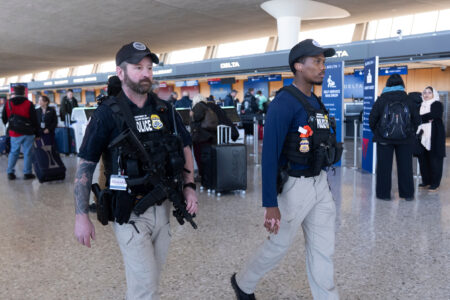
Armed and dangerous
Some states put untrained law officers on the street
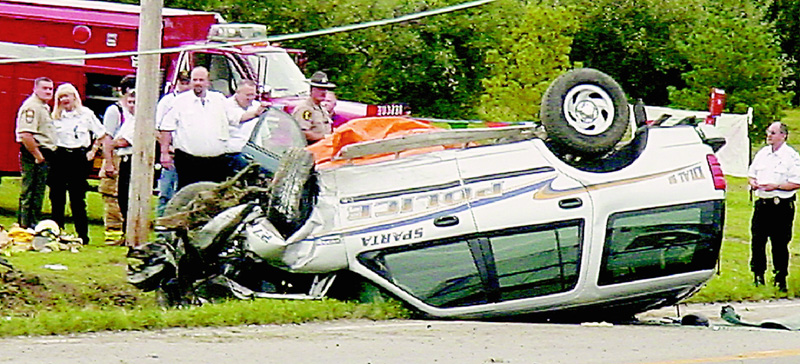
Officials look over the scene in Sparta, Ill., where 58-year-old nurse Janice Cole died when a police SUV driven by Sparta Police Officer Misty McPherson slammed into Cole's car during a chase. The accident, which happened in 2004, occurred before McPherson had attended police training.
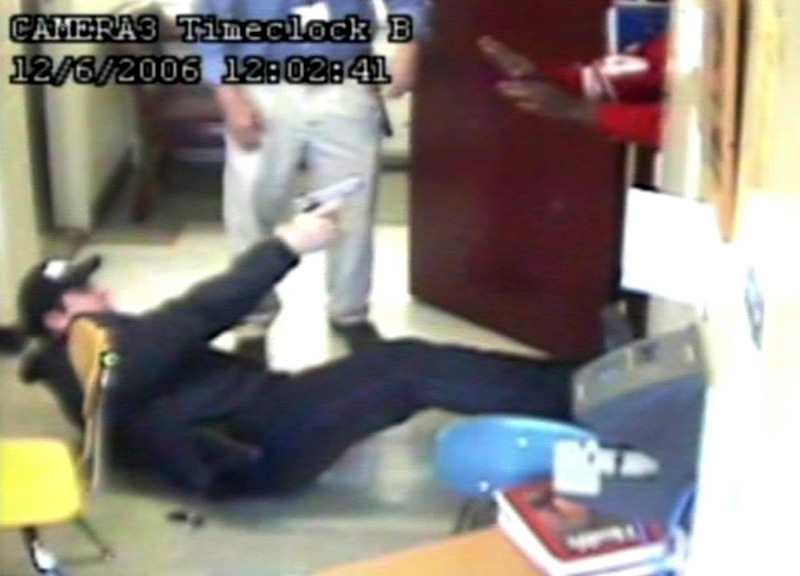
In this image taken from a Greenwood, Miss., high school security videotape, police officer Casey Wiggins, left, is seen holding a gun on an unarmed teen on Dec. 6, 2006. Wiggins was just four months into his job.
Kansas rules
To become a police officer in the state of Kansas, a candidate must complete a 14-week, 560-hour course with the Kansas Law Enforcement Training Center near Hutchinson. To maintain certification, they must obtain 40 hours of continuing education in law enforcement-related subjects each year.
Four months into his job, a police officer in Mississippi holds a gun to the head of an unarmed teenager and puts him in a chokehold. A rookie officer in Illinois gets into a car chase that kills a driver. And a new campus policeman in Indiana shoots an unarmed student to death.
Some are blaming these harrowing episodes on what an Associated Press survey found is a common practice across the country: At least 30 states let some newly hired local law enforcement officers hit the streets with a gun, a badge and little or no training.
These states allow a certain grace period – six months or a year in most cases, two years in Mississippi and Wisconsin – before rookies must be sent to a police academy. In many cases, these recruits are supposed to be supervised by a full-fledged officer, but that does not always happen.
The risks, some say, are high.
“You wouldn’t want a brain surgeon who isn’t properly trained. Someone shouldn’t be out there carrying a badge and a gun unless they are qualified to be out there,” said Jeremy Spratt, program manager of the Missouri Peace Officer Standards and Training Program.
Small-town practice
No one seems to know how many untrained recruits are on the streets. But the practice appears to be most common among small-town police forces and sheriff’s departments.
Many police chiefs interviewed for this story said that for years, they have used less-than-fully-trained officers without problems, and they strongly defended the practice for reasons of money and manpower.
It allows departments to put new hires on the streets right away, without waiting for them to go through police academy training, which is usually a weeks- or monthslong exercise during which the officer is not on duty but still on the payroll.
Also, some police forces see the grace period as a tryout, during which the department can decide whether the officer is going to work out before it invests thousands of dollars in police academy training.
“It lets the officer work for the department for an amount of time to make sure that’s what they want to do and make sure that’s the right person for the job,” said Batesville, Miss., Police Chief Gerald Legge. “We get some people that work a few weeks and say, ‘This isn’t what it was like on TV and this is not for me.”‘
‘Asking for trouble’
In 2003, Robert Duplain, a 24-year-old rookie police officer at Ball State University in Indiana, fatally shot a student – three rounds in the chest and one in the head. The officer is facing a wrongful-death lawsuit.
Duplain had taken only a 40-hour “pre-basic course” consisting of mostly online classes and firearms training, said Rusty Goodpaster, director of Indiana’s police academy. Indiana law allows new hires up to one year to go through the police academy, but they can take on enforcement duties before then if they take the pre-basic course, Goodpaster said.
Police said the victim, Michael McKinney, 21, had lunged at the officer, who was responding to a burglary call. McKinney’s family said he had gone to the wrong home after a night of drinking.
“When someone’s put in a situation where they’re given a firearm and they’re not trained as they should be, you’re asking for trouble,” said Tim McKinney, the student’s father.
In Illinois, Janice Cole, a 58-year-old nurse, died in 2004 when a police SUV driven by Sparta Police Officer Misty McPherson slammed into Cole’s car during a chase.
Charles Chapman, the lawyer who helped Cole’s family win $5.4 million in a lawsuit, said a policy that allows officers up to six months to enroll in the academy contributed to the woman’s death. McPherson had not even started basic training.
“She didn’t even know how to turn the sirens on,” Chapman said.
Sparta’s police chief did not return a call for comment.
In Mississippi, Greenwood Police Officer Casey Wiggins was captured by surveillance cameras at a high school in the Mississippi Delta in December, pointing his weapon at an unarmed student, 17-year-old James Marshall. Marshall, who was not disciplined by the school or charged with a crime, is suing for $2 million.
Police recruits in Mississippi have two years to get trained, during which time they are supposed to be supervised by a full-fledged officer. But no other officer was visible in the surveillance tapes during the confrontation.
Wiggins, through his attorney, has said that he did no wrong and that Marshall resisted when the officer approached a group of students to see what they were up to. A hearing is set for March to determine whether the officer should face charges.
National

Man pleads guilty to killing a top Minnesota Democrat and her husband
New tornadoes outside Chicago as severe storms pummel the Midwest

Feds won’t seek death penalty in plea deal with man accused of killing top Minnesota Democrat

NASA unveils astronauts to test tech for future moon landing
Social Security’ fund faces shortfall one year earlier than expected
WASHINGTON (AP) — Social Security 's retirement trust fund is projected to face a funding shortfall in 2032, a ...