Cool aid: Students, parents learn about loans for college
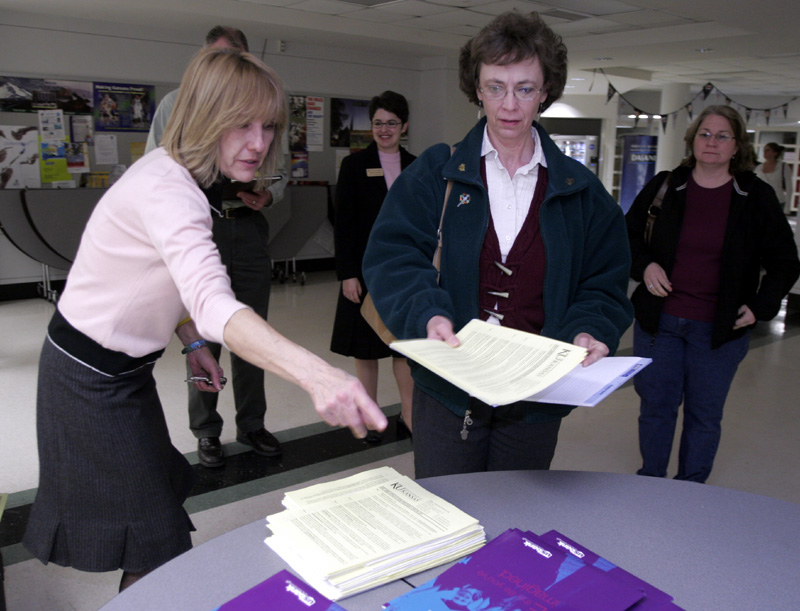
LHS counselor Linda Allen identifies the forms Marilyn Binns, Lawrence, will need for the financial aid application process. Although Binns helped her older son apply for financial aid a decade earlier, she attended the orientation to learn about the online application process she will use when her younger son applies to college this fall.
Kim Bohmann held up her right hand and crossed her fingers.
“Yes, one way or another,” she said – she thinks money is out there to help send both of her sons to Kansas University next fall.
“I think we’re going to try to keep the loans to a minimum and work on scholarships,” Bohmann said.
The Lawrence woman was among about 200 parents and high school seniors who gathered Thursday at Lawrence High School, like prospectors looking for gold, to find out how to get financial aid for college – grants, scholarships, work study and loans.
And they went away armed with a better understanding of how the financial aid system works.
“It seems a lot less scary,” Bohmann said.
At the meeting, Mandy Peterson, assistant director of Kansas University’s financial aid office, alleviated a lot of fears about the costs of college with a 40-minute presentation.
Peterson gave step-by-step instructions on filling out a piece of paperwork required by all colleges to receive any kind of scholarship or low-interest loan – the Free Application for Federal Student Aid, or FAFSA.
She also took questions from the audience for about 30 minutes, then met with individual parents one-on-one who had a wide range of questions.
“A lot of the questions have to do with ‘How can I maximize my resources?'” Peterson said. “It’s just a complicated process overall.”
The first time parents and students have to go through filling out a FAFSA, then applying for a variety of scholarships and loans can be confusing, she said.
Crunch time
Financial aid glossary
Here are some financial aid terms put together by the Center for Student Opportunity, a nonprofit group that supports first-generation and underserved college-bound students:
¢ FAFSA. A standard form from the Department of Education that determines eligibility for state and federal grants. Generally, you must fill this out before a college can begin processing your request for financial aid. They are usually available in November, but most require current tax information.
¢ CSS Profile. A secondary financial aid form that the colleges use to help them determine if the student is eligible for their own money. These should be filed early, along with the FAFSA, to receive early information regarding your status for financial aid.
¢ EFC (Expected Family Contribution). This term refers to the results from the FAFSA that shows what your family can contribute financially for educational expenses. In many instances, the EFC is calculated without taking into consideration any unexpected changes in income (not shown by the results from taxes) or other emergencies.
¢ Federal Stafford Loan Program. Government-subsidized loans that are adjusted by need. No repayment is required while the student is in school.
¢ Financial Aid Package. An offer of money for a student from a college. It usually consists of several kinds of aid, including loans, grants, campus jobs, and may or may not include scholarships. This package fills the gap between parent’s contribution and the total cost of college.
¢ Merit Scholarships. Money given to students on the basis of demonstrated ability – academic, performance, service, athletics, etc. It is not based on need, and does not need to be repaid. Most scholarships come from colleges themselves and vary widely from institution to institution.
¢ PLUS Loans. Government-subsidized loans that are limited to the cost of education. Parents do not need to demonstrate need. Interest rates can vary.
¢ Pell Grants. These government grants are given to students who need a great deal of financial aid. They do not need to be repaid.
¢ Unsubsidized Stafford Loans. Loans that do not require demonstration of need, and for which interest must be paid while the student is in college. Repayment of the principal begins after graduation.
¢ Work Study. A campus job that may be offered as part of a financial aid package. These usually require 15-20 hours a week on campus and usually allow the student to do some studying while working. An example might include working at a library desk.
“But they find that once they go through it once, it’s like the first time you file your taxes – the next time you get better at it,” she said.
Linda Allen, an LHS counselor, said her office has been busy in the last week with students seeking information about financial aid and scholarships.
“It’s a lot of work for parents and students this time of year, getting it all together,” Allen said.
The FAFSA is what most colleges use for determining a student’s eligibility for financial aid, but individual colleges may ask for additional information, Allen said.
Getting applications in early for financial aid is important, she said.
“It’s kind of first-come, first-served,” Allen said. “Once the federal money has been distributed, it’s gone. So if you apply late, even if you qualify, you may be out of luck at any particular school. You may have to wait until somebody decides to drop out of school so you can get their money.”
Allen said she encourages parents to get their FAFSA applications filled out online by Feb. 1 so they can be in the first round of applicants seeking financial aid.
The FAFSA asks for income information from federal tax returns to help determine a student’s eligibility to receive federal grants and loans and how much parents are expected to pay.
“It’s a scramble for parents, because lots of them don’t have their W-2s (or W-4s) yet, their earnings statements,” Allen said.
Deadlines
Peterson said college-bound students and their parents should mark two dates on their calendar:
¢ Feb. 11 is College Goal Sunday, when students can get help from financial aid offices in filling out the FAFSA forms and get personal information about financial aid. The event takes place at 20 sites across Kansas. In Lawrence, the event will be from 2 p.m. to 4 p.m. at KU’s Eaton Hall at 15th Street and Naismith Drive. Two $500 scholarship drawings will be made at the end of the event, which is sponsored by the Kansas Association of Student Financial Aid Administrators.
¢ March 1 is KU’s priority deadline for submitting a FAFSA, which can be done online at www.fafsa.ed.gov, Peterson said. Applications received by March 1 will get priority consideration for limited financial aid funds. Students may continue to submit their financial information after that date, but the chances of receiving aid from some programs will be reduced.
Grants and loans
After submitting their FAFSA forms, students usually receive their Student Aid Report within two to three weeks in the mail, or in five to seven days by e-mail if they provided an e-mail address.
The report tells the expected family contribution and the amount of federal financial aid a student is eligible to receive.
If scholarships and grants don’t cover the expenses, the financial aid package might include a student loan.
Students should then continue to work with their high school counselors in applying for different scholarships that might be available through local clubs or churches, she said.
Even if a student does not qualify for a grant or scholarship based on financial need, many low-interest educational loans are available to families, Peterson said.
“Your family could make $1 million a year and you could still qualify for a student loan at a lower interest rate,” Peterson said.
Many students also are eligible for work study, which are federally subsidized on-campus jobs.
To see numerous Kansas scholarships that are available, go to www.kansasregents.org.
Peterson said there are a few new types of grant programs this year, such as the Academic Competitiveness Grant for students who meet certain academic requirements, and SMART Grants for students majoring in physical, life or computer sciences, mathematics, technology or engineering or in a foreign language determined critical to national security.
“Extra money is available that wasn’t available last year,” Peterson said.
KU costs
The Kansas Board of Regents will decide in June how much to raise tuition and fees for the 2007-2008 academic year for Kansas universities.
At KU, the current academic year for an in-state student costs $16,238, she said. That includes tuition and fees for 30 hours of credit, room and board, books, supplies and transportation, Peterson said.

Mary Brooks, Lawrence, reviews a FAFSA (Free Application for Federal Student Aid) worksheet during an orientation seminar Thursday night at Lawrence High School. Brooks and her husband, Karl, at left, have two children who will be attending college in the fall.
More about those figures can be found online at www.tuition.ku.edu, she said.
“We’re actually a very good buy as far as the Fiske Guide is concerned,” she said, referring to the yearly publication that compares the costs at the nation’s colleges and universities.
“If you compare us to Nebraska, Colorado and Missouri, we will come out on the bottom, as far as our cost of attendance,” Peterson said.
City Government

Developer seeks incentive from City of Lawrence to build 131 units of housing near Wakarusa and Queens

Lawrence city leaders will consider whether to keep Community Building open, make 2 other rec centers free to access
A STAR Bond application raises questions for city leaders about Costco and housing west of the SLT

Soccer gear honoring Lawrence history’s all-star team is now on sale as part of city’s public art exhibition

To honor public servants, Lawrence’s July 4 celebration will have a whole gallery of their photos on display; submissions open now