Freight traffic causing Amtrak delays, passenger headaches
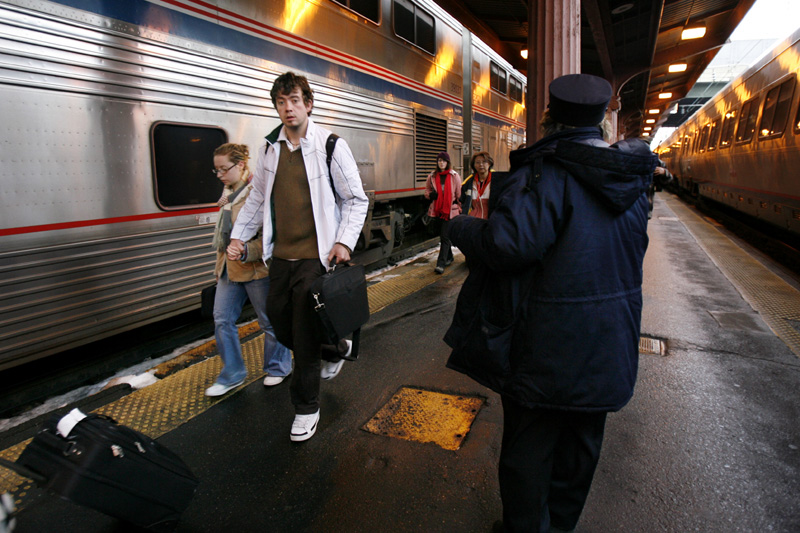
Passengers exit the Capitol Limited Amtrak train after a late arrival Feb. 20 in Washington, D.C., from Chicago. The train was 3 1/2 hours late. The 764-mile Chicago to Washington route is among Amtrak's most dismal performers, with just 11 percent of trains arriving within 30 minutes of their scheduled time last year.
Washington ? The Capitol Limited, an Amtrak train from Chicago, is scheduled to arrive in Washington every day at 1:30 p.m. But frequent rider Edda Ramos knows better than to make plans for the afternoon or evening.
She knows a late arrival – sometimes by an hour or two, sometimes by seven or eight – “is the one thing you can count on.”
The 764-mile route is among Amtrak’s most dismal performers, with just 11 percent of trains arriving within 30 minutes of their scheduled time last year. But the problem exists to one degree or another on the majority of Amtrak routes.
The main reason: In most of the country, the national passenger railroad operates on tracks owned by freight railroads, and the tracks are badly congested.
With freight traffic soaring in recent years, Amtrak’s never-stellar on-time performance declined to an average of 68 percent last year, its worst showing since the 1970s. When the routes where Amtrak owns the tracks are excluded, the on-time performance last year fell to 61 percent.
Even the lawmakers who vote on Amtrak’s subsidies of more than $1 billion annually have become caught in the holdups. Earlier this month, House Democrats traveling to a retreat in Williamsburg, Va., arrived two hours late after getting stuck behind a CSX freight train with engine trouble.
Alex Kummant, who took over as Amtrak’s president in September, has made improving on-time performance a priority. A former executive at Union Pacific Corp. – a freight railroad long considered hostile to Amtrak – he says the relationship between Amtrak and the freight railroads is inherently complicated.
“It is an intersection of a subsidized structure with a truly private-sector structure, so how do you coexist?” he said.
Kummant doesn’t blame the freight railroads for most delays, saying they need government help to make the capital investments necessary to cope with soaring volumes.
But passenger advocates and others accuse the freight railroads of failing to live up to their end of a bargain struck in 1970, when Congress agreed to let the railroads unload the passenger service they said was dragging them down.
In exchange, the railroads were required to give priority on their tracks to trains run by a new national passenger railroad. Amtrak pays modest fees for use of the tracks.
National
Man pleads guilty to killing a top Minnesota Democrat and her husband
New tornadoes outside Chicago as severe storms pummel the Midwest
Feds won’t seek death penalty in plea deal with man accused of killing top Minnesota Democrat
NASA unveils astronauts to test tech for future moon landing
Social Security’ fund faces shortfall one year earlier than expected
WASHINGTON (AP) — Social Security 's retirement trust fund is projected to face a funding shortfall in 2032, a ...