Students experience ‘Life in the ER’
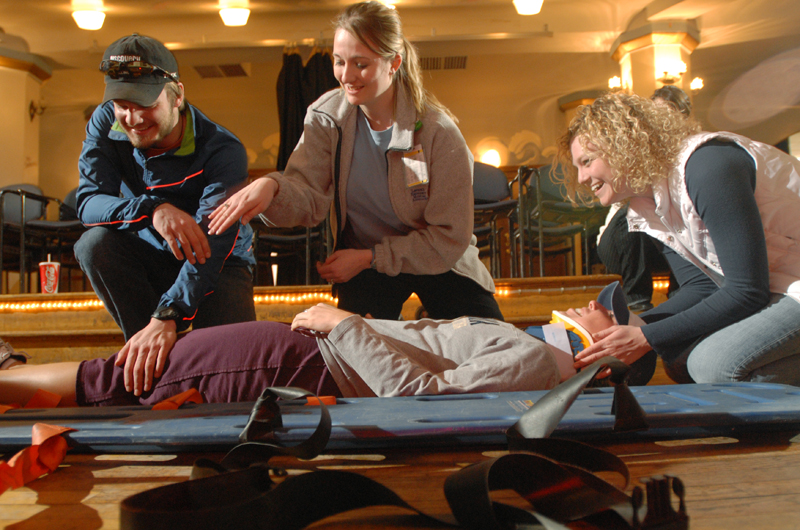
Kyle Doherty, a Kansas University sophomore, from left, Kelly Shapp, a licensed practical nurse in the emergency department at Lawrence Memorial Hospital, and Kristi Hansen, a KU senior, tend to victim Alexis Boston, a KU senior, during a spinal immobilization demonstration. Shapp and other LMH emergency department employees were offering demonstrations for junior high students during Wednesday's after-school event at Liberty Hall.
The pen jutted several inches through the stabbing victim’s soft skin.
Aaron Hiatt needed to secure the writing-instrument-turned-weapon so it wouldn’t move. The 13-year-old West Junior High student started taping the pen in place.
“Ow! Ow! What are you doing, man?” John Drees cried out loudly.
Drees wasn’t really hurt – the impaled “abdomen” was really a grapefruit.
But Drees, a former nurse who is now part of the community education program at Lawrence Memorial Hospital, was providing some drama for the activity, called “Trauma: Life in the ER.”
The mock emergency room program was part of this week’s W@LH activity, held after school on Wednesdays at Liberty Hall.
The focus of the ER activity was to teach students steps to take if an ambulance isn’t immediately available, Drees said.
“For instance, if we win the national basketball championship or if we have a tornado and all the ambulances are busy, people are going to have to be able to respond and do things,” Drees said. “So that’s what we’re doing: simple, basic first-aid.”
Terri Woodson, a registered nurse in the LMH emergency department, said her idea for the penetrating-wound section was to give students real emergency steps to take if someone falls on a pen or pencil or goes through a glass window.
“When most people see blood, it has a tendency to take over everything,” Woodson said. “They need to have some idea of what to do.”
For example, Drees told students that if a person is shot or stabbed in the chest, they might have to deal with a “sucking chest wound.”
“When they take a breath, you hear air going in and out of there, like another mouth. It’s really weird,” Drees told a student, explaining that the hole could be sealed with cellophane or plastic.
Other volunteers taught students how to bandage wounds, splint broken bones and prepare victims with a spinal injury for transporting.
And, they even learned what to do if someone’s abdomen was slashed open and his intestines were exposed.
In that demonstration, candy Gummi Bears doubled as intestines. Drees dumped them onto an absorbent cloth, then poured water on them, then showed how to cover them and tape them into place.
“You want to keep them moist. Basically, we don’t want them sloshing around,” Drees told Brogan Sievers, a West Junior High seventh-grader.
“It was pretty interesting,” Brogan said shortly after going through the penetrating-wound station.
“When I was in Cub Scouts I didn’t learn any of that,” the 12-year-old said. “I thought it was cool with the grapefruit with the pen through it and putting the tape on it.”
After learning how to immobilize a victim of a head trauma, Aaron said the event was “pretty cool and a good experience.”
“It was a lot of fun,” the eighth-grader said. “And now I’ll probably be prepared if somebody gets injured in the spine, (or is) pierced, cut or bleeding in the head.”
K-12 Education

Lawrence school district names interim principal of Lawrence High School and leader of early childhood programs
Lawrence school district reveals first details of new flexible curriculum for Centennial Choice Campus

Lawrence school board members to consider increases to school meal prices for 2026-2027

Federal judge orders Lawrence school district to pay attorney fees to students in Gaggle case

Lawrence school district’s spokesperson departing after less than a year