Blind student shows independence in Braille Challenge
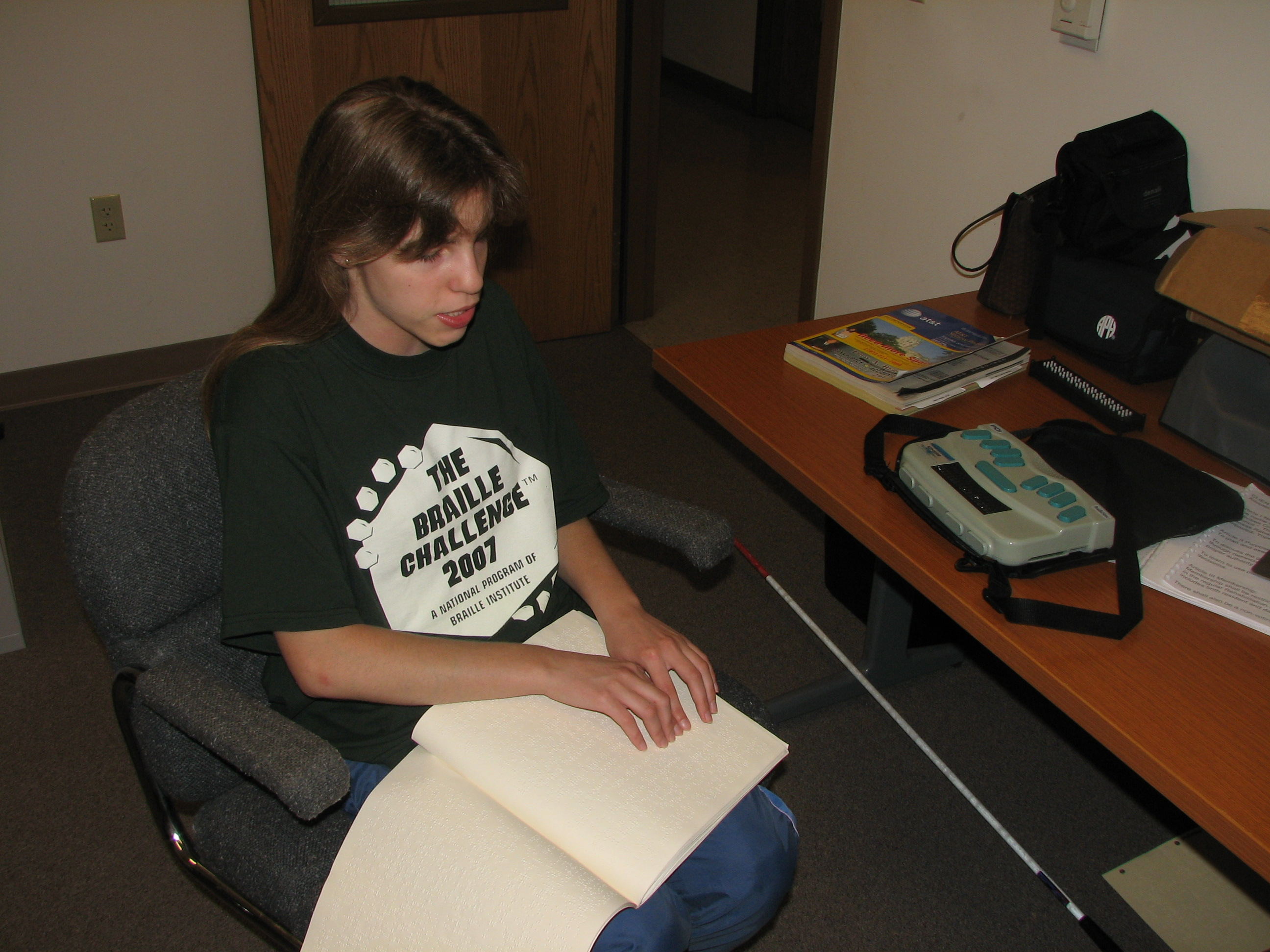
Genevieve Smith, a recent Basehor-Linwood High School graduate, has been blind since infancy. Smith said she gets through life just fine despite the disability.
Genevieve Smith sees the world through her ears and her hands.
The recent Basehor-Linwood High School graduate can identify a coin just by the sound it makes hitting the floor and can read a book using only her fingertips just as fast or faster than many of her sighted peers.
The 18-year-old has been blind since infancy.
“I just have to figure out a different way of doing things,” Smith said.
Smith said she has never let her blindness stand in the way of her independence. She learned how to get around her home, school and town through a process called mental mapping and memorizing. She does not know the concept of color, but learned to dress herself and do her own laundry by placing safety pins on the tags of all of her dark pieces of clothing. A white cane and her acute sense of hearing help her orient herself to a new place.
Instilling and maintaining that independence is one of the reasons her father, Rodney Smith, said he chose to take her out of a school for the blind and enroll her in public school at a young age.
“I just wanted her to be with her peers,” he said. “I didn’t want her growing up depending on other people doing everything for her.”
Even with her independent nature, Smith said she often still feels the pressures that go along with being different.
“It can be frustrating because there are more expectations put on us,” she said. “Like, if you mismatch your clothes, people don’t think it’s because of your personality. It’s because you’re blind and you don’t know how to dress.”
Smith has found her niche by focusing on the things she loves and excels at, such as reading and writing. She took creative writing three times in high school because she wanted to, she said, and aspires to become a creative writing teacher and published author.
She was on the newspaper staff all four years of high school and an editor her last semester. Using a device called a BrailleNote, which allows her to translate type into Braille, she caught the typos and grammatical errors of other students by feeling them rather than seeing them.
Noticing her gift for reading and writing Braille, one of Smith’s visual aid teachers put her onto The Braille Challenge competition sponsored by The Braille Institute. Smith entered the varsity level of the Missouri Regional Braille Challenge in February and won the top spot in her age group, and that earned her a chance to go to the national competition in June in Los Angeles.
Competing with several other top blind and visually impaired students from across the United States and Canada, Smith completed four tests at the national Braille Challenge. The first was transcribing or listening to a recording and writing the verbal passages down in Braille using a Braille Writer, which Smith said is the Braille equivalent of a typewriter.
The other tests included reading comprehension or reading a Braille passage and answering questions about it, reading charts and graphs and answering questions about them, and proofreading. On the proofreading portion, Smith said there were four sentences and competitors had to pick which one was written correctly.
On June 23, Smith found out she had placed second at the national competition and received a trophy as well as a $2,500 savings bond.
Rodney Smith said he knew his daughter was an excellent reader and writer.
“It was no surprise to me,” he said of her success. “This was her first competition and she pulled off second place. I was really proud of her, but I didn’t have any doubts.”
Smith said she plans on competing next year as well, and credits her success to her love of reading and writing.
“I’m a writer and I write a lot of short stories and prose, but I also love to read,” she said. “I read a lot. I think my love of English has helped me a lot, too.”
Reading is just one of the ways she spends her spare time this summer while taking classes at the Rehabilitation Center for the Blind and Visually Impaired in Topeka. The program is a way for her to explore the world after high school, prepare to live on her own and continue to learn to become more self-sufficient.
She will also continue her education this month with a second-year senior program through the Kansas State School for the Blind in Kansas City, Kan. The next school year will be spent taking classes at Kansas City, Kan., Community College and researching universities to determine where she will attend college.
“I think college will be very interesting and challenging because I’m going to now be responsible for asking for what I need,” she said. “I’ll probably go for a smaller college and definitely something that offers disability services. I think it would be cool to go out of state.”
City Government
Developer seeks incentive from City of Lawrence to build 131 units of housing near Wakarusa and Queens

Lawrence city leaders will consider whether to keep Community Building open, make 2 other rec centers free to access
A STAR Bond application raises questions for city leaders about Costco and housing west of the SLT
Soccer gear honoring Lawrence history’s all-star team is now on sale as part of city’s public art exhibition
To honor public servants, Lawrence’s July 4 celebration will have a whole gallery of their photos on display; submissions open now