Yeltsin leaves legacy of accomplishment, failure
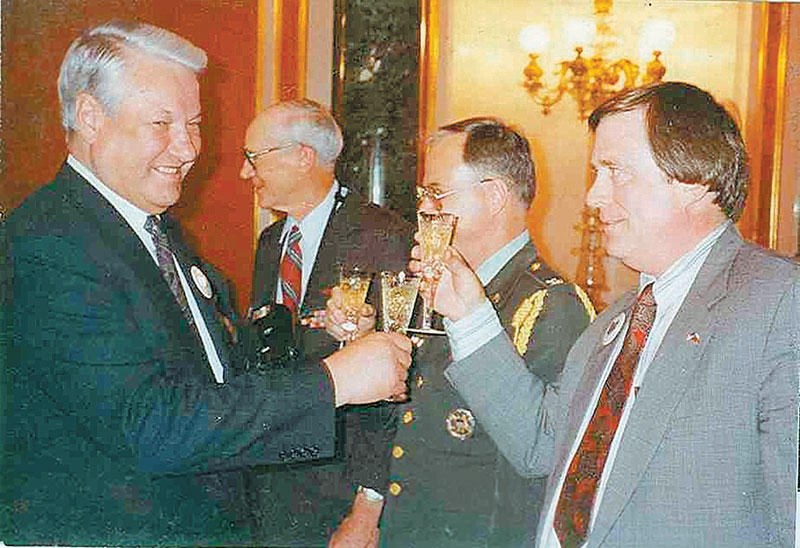
Boris Yeltsin, left, shares a drink with Lawrence resident Bob Swan, who organized visits to Kansas for Russian citizens and leaders.
Lawrence Russian experts said Boris Yeltsin, who died Monday, will leave a legacy of accomplishment and abject failure.
As the first democratically elected president of Russia, he made a visit to Wichita in 1992 and helped spur the death of the Soviet Union, but he also oversaw the looting of Russian industry to the benefit of a select few individuals.
He prevented a possible coup by famously climbing on a tank, but he also was known for ridiculous acts and heavy drinking, said Ray Finch, assistant to the director of the Center for Russian, East European and Eurasian Studies at Kansas University.
“He inherited massive problems and challenges in turning a command economy into a market economy,” Finch said. “I’m not sure anyone could do it, even with, say, George Washington at the helm.”
Finch, who met Yeltsin during his Wichita trip, said the most enduring mistake that will affect Yeltsin’s legacy is his decision to go into Chechnya and the subsequent violence there.
“I think history will eventually judge him fondly, but it will take awhile,” he said.
Bob Swan, a Lawrence resident who helped organize U.S. visits for several Russian citizens and leaders, said Yeltsin played a critically important role in stabilizing Russia during a time of flux.
Swan met Yeltsin in 1993 at the Kremlin.
“He had a critical role in bringing about change in Russia,” he said. “Even symbolically, he’s a very important person.”
Swan said Yeltsin’s legacy likely will be marred by his drinking, which many suspect played at least a part in his surprise Dec. 31, 1999, resignation and in some of his more memorable campaign appearances.
Erik Herron, director of KU’s Center for Russian, East European and Eurasian Studies, said one of Yeltsin’s most enduring legacies will be his successor. When Yeltsin resigned in 1999, he already had selected Vladimir Putin as his anointed successor.
While Putin initially was met with praise and gratitude for his work ethic, his recent efforts to curtail the media and privatization have been met with mixed reviews.
Herron said he expected the Russian state – led by Putin – and average Russian citizens to react to Yeltsin’s passing in much the same way as America and Americans reacted to the death of Ronald Reagan.
Both leaders led their countries as the Cold War ended, and both contributed greatly to the demise of the Soviet Union.
“There will be positive remembrances of him in general,” Herron said. “On the side of the state, there will be a highly visible and formal effort to honor Yeltsin.”
City Government

Developer seeks incentive from City of Lawrence to build 131 units of housing near Wakarusa and Queens

Lawrence city leaders will consider whether to keep Community Building open, make 2 other rec centers free to access
A STAR Bond application raises questions for city leaders about Costco and housing west of the SLT

Soccer gear honoring Lawrence history’s all-star team is now on sale as part of city’s public art exhibition
To honor public servants, Lawrence’s July 4 celebration will have a whole gallery of their photos on display; submissions open now