Military contracts creating new jobs at brisk pace
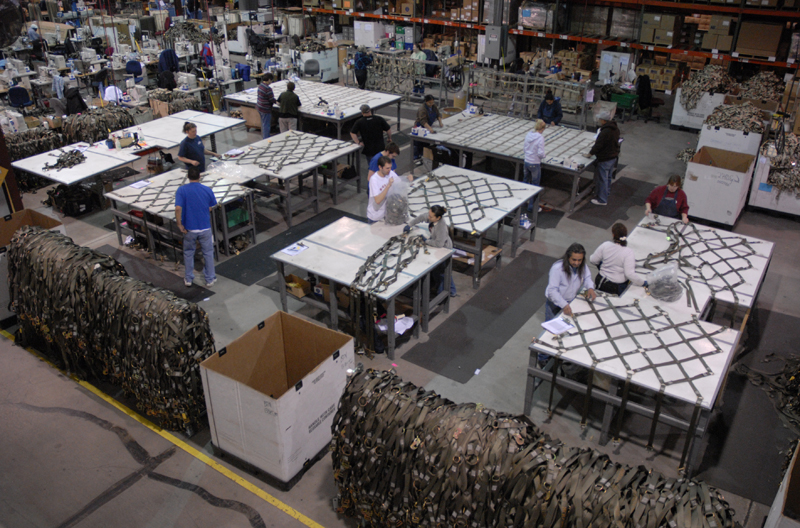
Kinedyne Corp. employees are shown working at the company's site in the East Hills Business Park, 3701 Greenway Circle, in this January 2007 photo. The company is keeping up with rising demand for cargo nets made for the U.S. Air Force. Kinedyne is one of several Lawrence businesses meeting needs of recent U.S. military contracts.
GPW & Associates Inc., a design and construction firm, has to find a bigger office.
Military contracts have been the majority of the firm’s business for the past three years, and Gina Pacumbaba-Watson, the firm’s president, has tripled her staff to meet the demand. She’s even planning to hire 10 more specialized engineers after recently signing a second contract with the U.S. Army Corps of Engineers Kansas City District that she said will be “fast and furious.”
Revenue for GPW & Associates, 10 E. Ninth St., has jumped from $350,000 to $2.5 million in five years, and Pacumbaba-Watson has set a goal for $4 million this year. The contracts are for building renovations at Fort Leavenworth.
“We’re going to put Lawrence on the map here in the next couple of years because of the amount of money coming from the military,” she said.
For a business, contracting with the military guarantees steady work, dependable pay and name recognition, said Dewayne Long, a representative for Kansas City-based Heartland Procurement Technical Assistance Center in Kansas City, which helps businesses find contracts. For the community where the contracts are awarded, Long said it’s a great enhancement to the economy because it pumps tax dollars into the economic base.
Long said the military’s main mission is to provide protection to the U.S., but they have legitimate business needs as well and look to industries and small businesses to assist them.
Government contracts
Other Lawrence businesses servicing the military are growing, too. According to 2005 data from the U.S. Department of Defense, Kansas has 1,841 defense contracts, and 59 are based in Lawrence.
Brian Schall is the program manager for KalScott, 811 E. 28th St., a small engineering company with research and development contracts focused on flight sciences related to unmanned aircraft. Their clients include the U.S. Navy Space and Naval Warfare Command, NASA Dryden and the U.S. Department of Energy.
He said about 80 percent of their work is government-contracted and they are increasingly being approached by other nonmilitary groups.
“The commercial work is clearly a spinoff of military work,” he said.
The unmanned aircraft they test must be flown in unrestricted air space so they utilize agreements with either the Smoky Hill Air National Guard Range in Salina or the NASA Dryden flight research center in California, Schall said. He said there is a big push from the Kansas Air National Guard and the Kansas UAV Consortium for them to fly aircraft in Salina to keep business in Kansas.
War’s impact
For two Lawrence companies, the war in Iraq has meant more business. Military movements and troop surges often dictate the workload for employees at Cottonwood Inc. and Kinedyne Corp. Both companies supply the military with specialized cargo tie-down straps for aircraft carriers or flatbed trucks.
Cottonwood Inc., 2801 W. 31st St., is a nonprofit organization that employs individuals with disabilities. They are in the middle of a second five-year $50 million contract with the Department of Defense.
J.R. Condra, director of work services, said in 2001 they saw a 20 percent increase in staff. Now, an average of 30 to 35 out of their 130 employees are working on the cargo net contract.
“The fact that all our people are Douglas County citizens and being employed by Cottonwood Inc. means that’s less tax dollars needed to support them,” he said.
Condra said it’s also meaningful for the individuals with disabilities because it provides work with value. And at the rate they are going, with six consecutive gold medals on their shelves for their quality and on-time deliveries, there is no sign of it slowing down. Condra said he would expect a third five-year contract.
In March, Kinedyne will start a second shift increasing their staff to more than 90 employees after signing a five-year contract with the U.S. Air Force. Currently, they are making 9,000 cargo nets a month, and by May 1 they will be making 11,000.
Job security
Terry Albin, operations manager for Kansas, said military contracts provide a tremendous opportunity because they provide job security and overtime opportunities for employees.
“I would expect contracts to continue,” Albin said. “This is a commodity the military will continue to use. We’ve been trying to do any improvements to it we can, but I can’t see how they can stop using them.”
Rita Higgins, government contract manager, said the military is good to Lawrence and Kansas because it has kept a lot of larger contracts here that would otherwise go to other states such as California and Florida.
Specialized science companies like Flint Hills Scientific LLC and Pinnacle Technologies benefit from military contracts, but not all of them want to expand.
Mark Frei, managing director of Flint Hills Scientific, 5020 Bob Billings Parkway, said the company has had five and 10 employees for the past decade, even though the company has received more than $2 million in federal grants to develop a device to warn people of epileptic seizures.
Pinnacle Technologies President Donna Johnson is optimistic that her staff of nine will double in the next year to help with one of their several projects – the redesign of a flight simulator for the joint strike fighter for the Navy. Johnson recruits from Kansas University and said most of her employees for the company, 2721 Ore., were students working part-time. She said the contracts they bid for are competitive, but their reputation precedes them, which makes it easier to win bids.
She said the state is trying to encourage new business especially because of the Kansas Bioscience Authority, but she said what’s needed is support for businesses already committed to Kansas.
“I think there is a huge potential for other companies to go after government contracts,” Johnson said. “The government is probably one of your biggest purchasers of anything – look at Cottonwood doing straps, companies like ourselves and others doing very high-tech research, I think you’ve got the gamut. You have a lot of companies here that have government contracts and a lot that could.”
City Government

Developer seeks incentive from City of Lawrence to build 131 units of housing near Wakarusa and Queens

Lawrence city leaders will consider whether to keep Community Building open, make 2 other rec centers free to access
A STAR Bond application raises questions for city leaders about Costco and housing west of the SLT
Soccer gear honoring Lawrence history’s all-star team is now on sale as part of city’s public art exhibition
To honor public servants, Lawrence’s July 4 celebration will have a whole gallery of their photos on display; submissions open now