NASA decides to launch today
Cape Canaveral, Fla. ? Caught in a scheduling squeeze, NASA decided to try to launch space shuttle Atlantis today without replacing a troublesome electrical component.
Today had been the last launch day available before the U.S. space agency ran into a scheduling conflict with the Russian space agency. But NASA managers now believe they can try Saturday, if needed, and they were finalizing negotiations with the Russians.
There was a 30 percent chance that bad weather would interfere with today’s 10:40 a.m. CDT launch time.
On Thursday, NASA decided not to change out an electricity-generating fuel cell whose coolant pump had given erratic readings, causing a scrub a day earlier. Replacing the 250-pound pump could have delayed any launch attempt by several weeks and might have been riskier than leaving it in place, said Steve Poulos, shuttle orbiter projects manager.
The most likely cause of the erratic reading was thinning wires on a motor that hadn’t been used in seven years, Poulos said.
“Pulling out a 250-pound piece of hardware and getting it in and out … and at the end of the day not having a problem, well there’s just risk associated with that,” Poulos said. “It became a very easy recommendation for me … to say ‘We’re good to go fly.”‘
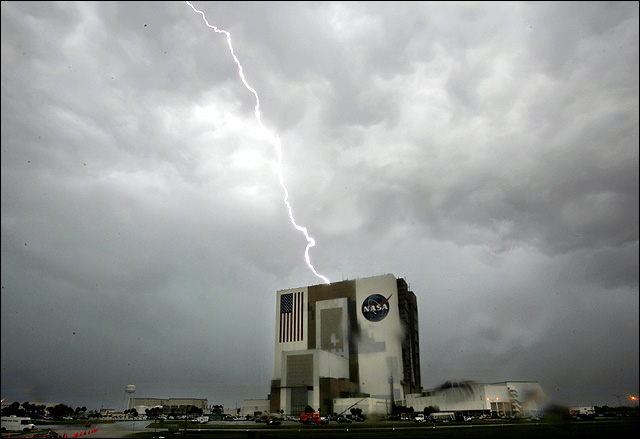
A lightning strike hits the 525-foot-tall Vehicle Assembly Building as a thunderstorm passes over the Kennedy Space Center on Thursday afternoon in Cape Canaveral, Fla. The space shuttle Atlantis remains on Pad 39B. After reviewing data related to a malfunctioning fuel cell aboard the orbiter that caused Wednesday's launch cancellation, NASA management has given the go-ahead for a launch attempt today.
The decision to try a launch today wasn’t unanimous. Officials in NASA’s safety office felt the fuel cell should be changed out not because of a safety issue, but they were concerned about whether the mission could be carried out successfully. The fuel cell’s manufacturer, UTC Power, wanting NASA to use a pristine unit, also recommended against flying until it was swapped out, said Wayne Hale, space shuttle program manager.
But late Thursday night, the company said it was fine with the decision to fly.
“We’re very comfortable with flying,” said Henry DeRonck, general manager for space at UTC Power. “There is very low risk of anything getting further worse.”
After this weekend, the next daylight launch opportunity is not until the end of October. NASA rules say Atlantis must lift off in daylight so that its big external fuel tank can be photographed for any signs of broken-off foam of the sort that destroyed Columbia 3 1/2 years ago.
If Atlantis does not get off the ground today, NASA officials had two options they were reluctant to exercise that would permit a launch attempt before the end of October: Try on Saturday, or relax the daylight-launch rule.
Atlantis’ astronauts will restart construction on the half-built international space station for the first time since the Columbia disaster.
National

Man pleads guilty to killing a top Minnesota Democrat and her husband

New tornadoes outside Chicago as severe storms pummel the Midwest

Feds won’t seek death penalty in plea deal with man accused of killing top Minnesota Democrat

NASA unveils astronauts to test tech for future moon landing
Social Security’ fund faces shortfall one year earlier than expected
WASHINGTON (AP) — Social Security 's retirement trust fund is projected to face a funding shortfall in 2032, a ...