Doctors to retreat to Lecompton to install smoke alarms
When a group of family practice physicians in the Kansas University Medical Center’s residency program puts on its annual retreat this month, the physicians won’t be sailing, climbing ropes or running through obstacle courses as they have in the past.
Instead, they will be doing volunteer work.
“A bunch of doctors are going to get in their cars and drive to Lecompton and install smoke alarms in the homes of people who need them,” said Bruce Liese, a family practice physician at the medical center’s Kansas City, Kan., hospital and a KU professor in the School of Medicine.
Liese, who also is a Lecompton city councilman, said he had made an “off-the-wall” comment to the group of nearly 25 residency doctors about doing a town project.
“Unanimously they agreed that this would be a rewarding thing they could do,” Liese said.
The group has obtained a few smoke alarms from the Lecompton Fire Department, plus about 250 alarms through a grant program managed by the Kansas Department of Health and Environment. The KDHE alarms are powered by a lithium battery that lasts 10 years, Liese said.
Installation day will be Oct. 13.
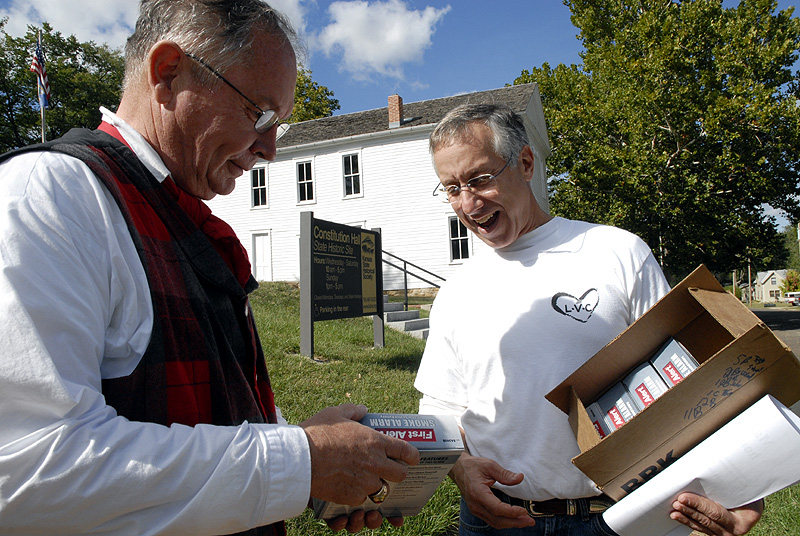
Paul Bahnmaier, president of Lecompton Historical Society, left, and Bruce Liese, Lecompton city councilman and professor at Kansas University Medical Center, view one of the 250 smoke alarms that KU Med Center residency doctors and the Lecompton Volunteer Corps will distribute to homes in the community. The smoke alarms were received through a state grant.
Working with the doctors will be a group of community volunteers who a few months ago formed the Lecompton Volunteer Corps. The volunteers now are signing up residents who want the alarms. The deadline for getting on the list is Monday.
The purpose of the retreat is to help the doctors build group cohesion and have some fun, Liese said.
“They work long, long hours, and they are on call most of the time,” Liese said. “They rarely see each other because they are on different rotations. This is an opportunity for them to bond and recoup.”
About 50 people had signed up to have the smoke alarms installed in their houses as of Friday.
The deadline for getting on the list is Monday. To sign up, call Lecompton City Hall, 887-6407.
Liese also is the director of the Volunteer Corps, a group of about 10 people who have been involved in community projects since it formed about nine months ago.
Members meet once a month to discuss projects over a potluck dinner. They have participated in a tire cleanup, cleaned up after the annual Territorial Days celebration and are planning a town trash pickup Oct. 14.
Bonny Fugett, a semi-retired Lecompton teacher, said she became involved with the group because she saw it as a way to help in a variety of ways.
“It seemed like a good way to do some worthwhile and helpful things around the community and not just be affiliated with one entity,” Fugett said. “You can help fill in wherever needs arise.”
Eventually, the Volunteer Corps plans to train in emergency preparedness through the Douglas County Emergency Management Department.
“I see that as something we will always be able to use, although hopefully we won’t need to,” Fugett said.
The volunteers will end the year by decorating the city park for Christmas. The group also has its own Web site at www.lecomptonvolunteercorps.org.
Smoke detectors
There are two types of smoke alarms that work in different ways.
Photoelectric:
¢ Typical cost: about $20
¢ Requires more energy and often is hard-wired into a home
¢ Uses a light beam to detect products of combustion
¢ Best suited for living rooms, bedrooms and kitchens – rooms containing large pieces of furniture that will burn slowly and create more smoldering smoke than flames
¢ Found in a 2001 study to react between 12 and 30 minutes faster to smoldering fires, compared with ionization detectors.
Ionization:
¢ Typical cost: about $10
¢ Commonly runs on 9v battery
¢ Uses a small amount of radioactive material to sense changes in the air
¢ Best suited for rooms containing “highly combustible materials” that can create flaming fires, such as flammable liquids or papers.
Source: 2006 report by Ontario, Canada fire marshal; 2001 Study by U.S. National Institute of Standards and Technology
City Government
Developer seeks incentive from City of Lawrence to build 131 units of housing near Wakarusa and Queens

Lawrence city leaders will consider whether to keep Community Building open, make 2 other rec centers free to access
A STAR Bond application raises questions for city leaders about Costco and housing west of the SLT

Soccer gear honoring Lawrence history’s all-star team is now on sale as part of city’s public art exhibition
To honor public servants, Lawrence’s July 4 celebration will have a whole gallery of their photos on display; submissions open now