Caring for the caregivers
250,000 Kansans look after elders, others
Earl Nehring’s life changed in moments.
The moment when, driving along a dark road through the mountains of Colorado, a phone call made his wife, Harriet, panic.
The moment while on vacation in Turkey when he had to tell a group at a hostel where their children worked because Harriet couldn’t quite remember.
The moment when he realized he was cooking the meals and cleaning the house instead of his wife, as she had done for more than 40 years.
“It’s upsetting. It’s hard to deal with,” Nehring said.
During the past 10 years, Nehring has held a job he never applied for, one that sinks in slowly and, day by day, strains the body and heart.
After decades of being a husband, a father, an equal in a lifelong relationship, Nehring became a caretaker.
He is one of more than 250,000 family caregivers in Kansas. According to a study by the National Family Caregivers Association, Kansans spend 275 million hours a year caring for older relatives, neighbors and friends. The value of that care exceeds $2.4 billion.
Twice every month, Nehring and dozens of other Lawrence caretakers meet in a library room on the first floor of the Lawrence Senior Center, 745 Vt.
At the support group meetings, they share their stories. Tears fall. Laughter breaks waves of hurt.
“It’s an emotional hour and a half when we have those meetings,” said Janet Ikenberry, the senior center director who has facilitated the gatherings on and off for 14 years. “They’re brutally honest with each other.”
When a husband, wife, mother or father suddenly loses the ability to care for him- or herself, it’s often these meetings that keep their loved ones sane and capable.
Demand for the meetings is high, and, as the baby-boom generation ages, will likely continue to grow. This week, the center will begin offering two monthly night classes.
Life together
For most of the people who attend the senior center support group, Alzheimer’s slowly paralyzes those they care for. It’s a disease Joyce Lathrom didn’t see coming when she first met Clovis while slinging drinks at the VFW Hall.
Her mother probably had Alzheimer’s, she said, but back then doctors didn’t know to call it that. Senility, they called it. Or clogged arteries.
But those years were far behind her when Clovis announced to his friends in the VFW that he would one day marry the bartender. It was 1986, years after both Clovis and Lathrom’s first marriages ended because of their spouses’ illnesses.
“We traveled a bunch. We did whatever we wanted to do,” Lathrom, 75, said of her and Clovis’ early years together.
Cruising around in a Chrysler Fifth Avenue, the two would travel from Illinois to Las Vegas, visiting her two adult sons. She’d drive and, as always, Clovis would admire the American countryside from the quiet comfort of the seat beside her.
Just like family
The next eight years passed quietly, but then little questions hinted at the early stages of Alzheimer’s: What was I going to tell you? Why can’t I remember what I was just doing?
It was around 1993 or 1994, Lathrom recalled. She began attending the support group the week the questions began.
“I never quit going,” she said. “They’re just like family to me.”
For the next two years, the Lathroms’ lives slowly moved away from normal. For a time, Clovis would simply ask questions or repeat stories he’d told earlier that day, Lathrom said.
Months passed, and Clovis suddenly took to staying up nights and napping during the day. Clovis would get up in the night to use the bathroom, Lathrom said, but would stop in the hallway, thinking he was already there.
For nights at a time, Lathrom lay next to her husband, eyes open, waiting to see if he’d stir.
During those years, when the couple would go out, Lathrom would find herself standing outside of men’s bathrooms, waiting for Clovis to emerge.
Sometimes he came right out, she said. But sometimes, she would have to hand a small card to another man walking into the bathroom and explain the situation.
“Excuse my friend,” the card read. “He has Alzheimer’s.”
Eventually, she made him a bracelet with his name and address printed on it. Clovis liked it, Lathrom said. But she knew it was just in case.
Cried for days
But in 1996, after a somewhat brutal trip to visit family in Illinois, she knew she had done all she could on her own. She contacted Brandon Woods Retirement Community and, soon after, moved her husband in.
“It was the worst thing that happened to me in my life,” she said.
Lathrom fished for words, trying to explain how it felt to move her husband. Guilt, she said. Blame from family members.
When he first moved into Brandon Woods, doctors there told her to stay away for 10 days, to make the adjustment easier. It hurt, but she did what they said.
“I couldn’t hardly handle that,” she said.
When she finally got to see Clovis again, surprise washed over his face, she said. He asked her where she’d been. He told her he thought he would never see her again.
Lathrom cried for days.
But being a caregiver doesn’t stop when a loved one is in a home. Most days, Lathrom would spend hours on end with Clovis, walking with him, showing him pictures of family members.
Six months after he entered Brandon Woods, the names of the faces in the photographs began to escape him.
Clovis Lathrom died of an illness in 1999 when he was 81. Before he was buried, Joyce Lathrom had his name bracelet removed. He didn’t need it anymore.
But even now, years after her husband’s death, Lathrom still shares her stories with other caregivers.
It helps her to help others such as Earl Nehring, who now lives a life she once lived.
“The support groups really work,” Lathrom said. “People need help, but they’re afraid.”
First noticed
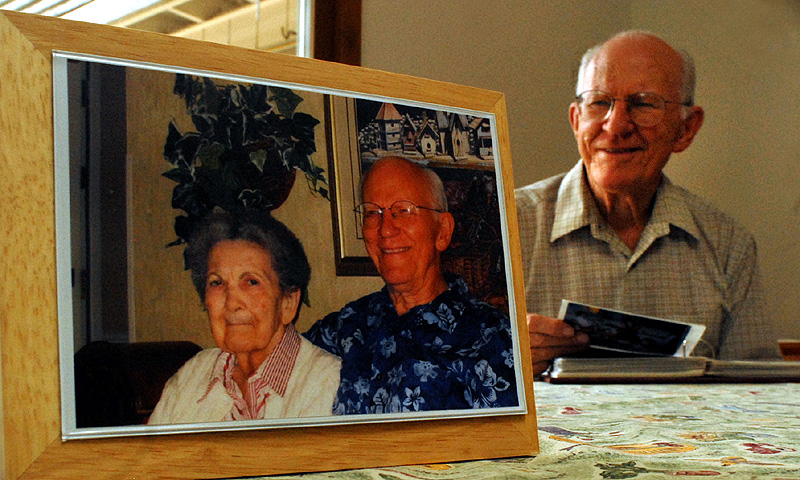
Earl Nehring looks toward the recent photo of him with his wife, Harriet, taken on their 50th wedding anniversary. Nehring cared for his wife, who has Alzheimer's disease, for nearly 10 years before she moved to an advanced care facility in Topeka. Nehring, one of 250,000 caregivers in Kansas, shares his experiences and finds support in a twice-monthly gathering of other caregivers at the Lawrence Senior Center.
It was 1995, just a year before he and his wife’s 40th wedding anniversary, when Nehring first noticed.
Harriet couldn’t remember everything, not the way she used to. Nehring watched her and took note of the little things – the forgetfulness.
Then, during the next few years, a family trip to Colorado and other vacations to Turkey and Costa Rica magnified the problem. Away from home, the confusion became obvious, Nehring said.
“She didn’t really enjoy those trips,” Nehring said.
Back home, Harriet became quieter by the day. She’d try to watch television, but often had a hard time following the plots of shows.
All the while, Nehring slowly began taking on his new job. With little discussion, Harriet stopped cooking and cleaning, leaving the work for her husband without much notice.
“It wasn’t a terrible burden as such,” he said. “You know it’s something you can’t do anything about. You just have to accept it.”
Had to get away
As her condition grew worse, Harriet would grow restless during the days. Nehring said he thought she knew something was wrong, but she couldn’t put her finger on it.
She just had to get away.
So Nehring would put her in the car and drive for hours. She was happy then, Nehring said, watching the Lawrence landscape pass by.
At home, caring for Harriet took more time with each passing day. Life reached a point when, every day, Nehring would help Harriet shower, eat, get dressed.
“I never felt like I was making any great sacrifice,” Nehring said. “But I couldn’t get anything else done. That’s the kind of thing that happens with caregivers.”
But then, Nehring couldn’t care for his wife anymore. Harriet stopped letting him, struggling almost daily.
“You just can’t let it go on,” he said.
After a doctor’s evaluation, he knew something had to be done.
Wedding vows
The day is burned into Nehring’s mind. Oct. 1, 2001. He put his wife into a care home in Topeka.
For months, Nehring adjusted to life without his wife at home. Leaving Topeka every day without her hurt, he said, the worst kind of hurt.
Eventually, life settled in. At first, Harriet would talk a little about family and friends. They’d drive to get ice cream. They’d drive just to drive.
They still do. But during the past few years, he said, he noticed he was the only one talking.
Now, during visits, he still chats about life and family. Every once in a while, a smile washes over Harriet’s face. Earl smiles back.
The support group helps, he said. It allows him to vent and let others know what’s going on in his life.
It’s important, he said, to share your feelings with people who understand the feelings.
“What I’ve had to do is make myself accept reality, and go on living,” Nehring said.
Fifty years ago this year, Earl and Harriet Nehring exchanged wedding vows: To have and to hold. In good times and in bad.
Now, Nehring looks back on the good times. He regrets that the disease had to take hold of her, he said, but nothing else.
November declared Family Caregiver Awareness Month
Gov. Kathleen Sebelius proclaimed November as Family Caregiver Awareness Month.
“Caring for an older person is demanding, both physically and emotionally,” said Kathy Greenlee, acting secretary of the Kansas Department on Aging in a press release. “Observance of this month is a way to recognize the importance and great value of caregivers’ services. It also helps raise awareness of the challenges caregivers face and how they can cope with those challenges.”
At the top of the list is the challenge for caregivers to take care of their own health. According to the Administration on Aging, caregivers are more at risk for infectious diseases, such as colds and flu, and chronic diseases, such as heart problems, diabetes and cancer. Depression is twice as common among caregivers as noncaregivers.
City Government

Developer seeks incentive from City of Lawrence to build 131 units of housing near Wakarusa and Queens

Lawrence city leaders will consider whether to keep Community Building open, make 2 other rec centers free to access
A STAR Bond application raises questions for city leaders about Costco and housing west of the SLT

Soccer gear honoring Lawrence history’s all-star team is now on sale as part of city’s public art exhibition
To honor public servants, Lawrence’s July 4 celebration will have a whole gallery of their photos on display; submissions open now