Secret getting out about scenic Kansas wetlands
Area looking to capitalize on recent attention
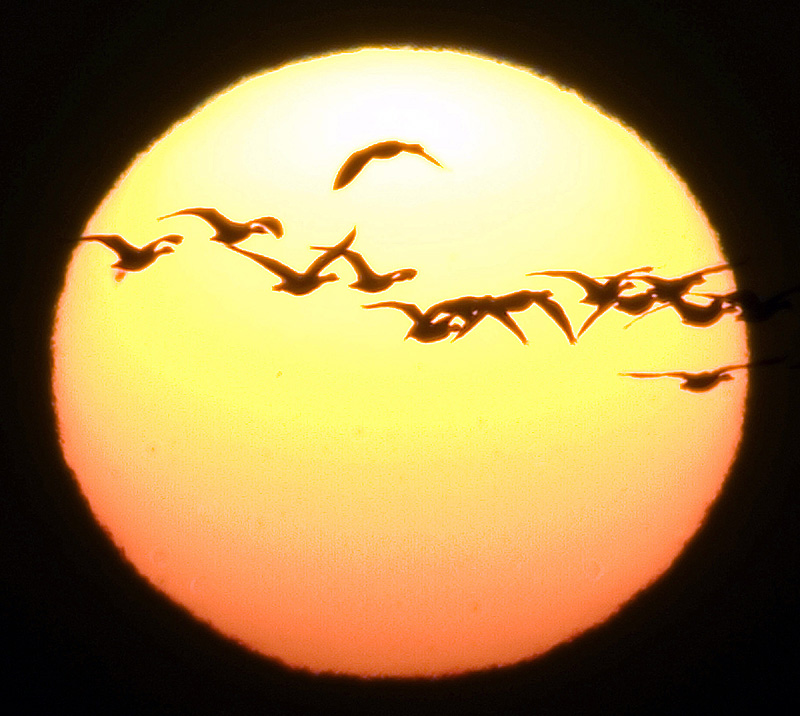
Snow geese glide past a setting sun thursday at the Quivira National Wildlife Refuge near Great Bend. Thousands of sandhill cranes, shorebirds, Canada geese, ducks, and other migratory birds pass through the refuge from September to December.
Great Bend ? Birders and wildlife watchers have long known central Kansas’ two wetlands areas as prime viewing territory.
Now, Cheyenne Bottoms and Quivira National Wildlife Refuge are getting unprecedented notice around the country thanks to a combination of circumstances.
The U.S. Department of Transportation last year designated the 76-mile route between the two areas as the National Wetlands and Wildfire Scenic Byway.
National magazines such as Birder’s World, Wild Bird and Midwest Living have recently mentioned the two wetlands as destination travel spots. And National Geographic will soon produce a new travel directory listing the route among the 290 best drives in the nation.
“The awareness has been raised,” said Cris Collier, president of the Great Bend Convention and Visitors Bureau. “We are looking at the Kansas wetlands complex and packaging it together so that it will have more appeal to people.”
In September, Barton County received a federal grant of nearly $134,000 to help pay for putting up 20 interpretive signs along the route. The county also plans to create a CD audio tour and produce brochures.
The full economic impact brought on by the national attention has yet to be felt, Collier said.
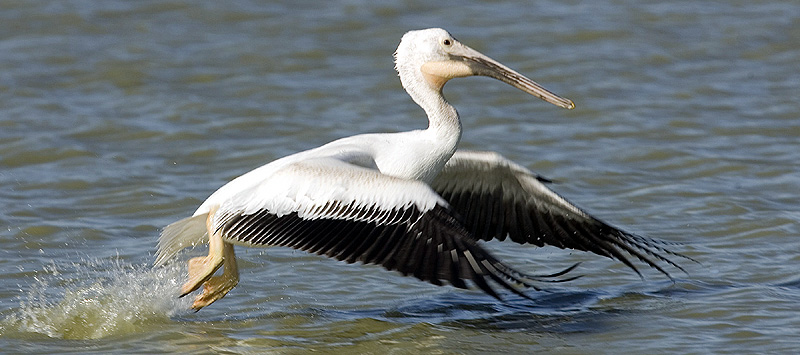
A pelican takes flight Thursday at the Quivira National Wildlife Refuge near Great Bend. The marshes have attracted thousands of migrating waterfowl. These marshes, together with a wide diversity of other habitats, provide food, cover and protection for wildlife.
By 2008, a $3.8 million Kansas Wetlands Education Center will be built at Cheyenne Bottoms.
Collier expects there will be outdoor travel packages linking the wetlands with the Sternberg Museum of Natural History in Hays and the Cimarron National Grassland in the southwest corner of the state.
Dave Hilley, manager of Quivira National Wildlife Refuge, said that the refuge already attracts 100,000 visitors a year.
They come to see the 300,000 sandhill cranes, 600,000 geese and 75,000 ducks.
Each year, the birds journey 7,000 miles from their wintering grounds in New Mexico, Texas and northern Mexico to Canada, Alaska and Siberia for the summer.
“I really feel people in the area and surrounding areas have no idea what a wonderful resource we have here,” said Shirley Radcliffe, of Hoisington, a native Kansan who is new to the area.
Cheryl Miller, a bird-watching enthusiast from Wichita, has visited the wetlands numerous times.
“And now the rest of the world seems to be catching on,” she said.
City Government
Developer seeks incentive from City of Lawrence to build 131 units of housing near Wakarusa and Queens

Lawrence city leaders will consider whether to keep Community Building open, make 2 other rec centers free to access
A STAR Bond application raises questions for city leaders about Costco and housing west of the SLT
Soccer gear honoring Lawrence history’s all-star team is now on sale as part of city’s public art exhibition
To honor public servants, Lawrence’s July 4 celebration will have a whole gallery of their photos on display; submissions open now