Downtown, diversity need work, experts say
Outsiders looking in praise Lawrence but say it could do better
A pair of Lawrence’s jewels – downtown and the community’s diversity – could use a little polishing, according to a group of outside planning experts who spent three days studying the city.
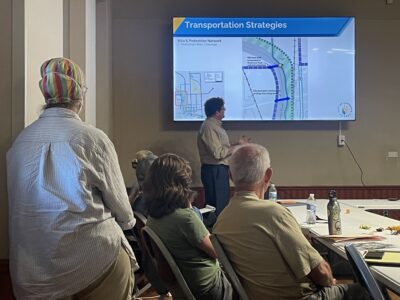
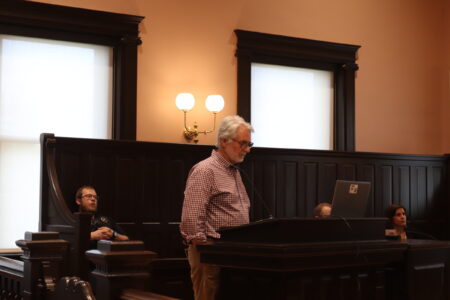
A six-member team from the American Institute of Architects praised Lawrence as a progressive community that has most of what it needs to be among the better cities in the country, as it delivered its findings to a crowd of about 100 people Friday at the Lawrence Arts Center.
“You have almost an embarrassment of riches when it comes to assets,” said William Gilchrist, the group’s leader and the director of planning, engineering and permits for Birmingham, Ala.
But there is some work to do. Reaching out to the city’s minority and ethnic groups should be among the top items the city seeks to do in the future.
“We have not seen the breadth of inclusion that we thought we might have seen at some of our sessions,” Gilchrist said.
Gilchrist said that was surprising given the large role that different races and ethnic groups – such as African Americans and American Indians – have played in the city’s history.
“There was a real question in our mind about who is missing at this table,” Gilchrist said. “There has to be a strong effort for inclusion in the future.”
The team was in town as part of a program designed to help cities evaluate how sustainable their practices are. Team members said that meant they looked at whether the community was promoting growth and development “not just for today, but for your grandchildren’s children.”
Watch 6News report
The group said it was clear that downtown Lawrence received a great deal of attention from city leaders, but they said it could benefit from even more activity.
“The world is changing, and the way people meet their needs are changing,” said Karina Ricks, a planner for Washington, D.C. “You have to adapt to the times and build a downtown for the future that also respects your history.”
Ricks said planners should look for ways to reconnect the downtown to the Kansas River, calling the Kaw a “huge asset.”
The community also needs to focus on adding more residential living opportunities to the downtown, which also would mean a change in the downtown’s retail mix.
“You don’t have to look at retail uses as destination or entertainment uses,” Ricks said. “Look at retail uses that fulfill daily needs. It’s OK to have a pharmacy, a grocery store, a dry cleaner. It is not just about antique shops.”
Parking issues also need to be discussed, she said. Ricks said she heard often about a shortage of downtown parking but said that “may be more of a perception than a reality.”
Other thoughts from the group included:
¢ Lawrence does have potential to be a player in the biosciences arena, especially if it works to capitalize off the reputation of Kansas University’s School of Pharmacy.
¢ Creating denser neighborhoods that have a mix of uses in them may be one way to create more affordable housing options. But the community also may want to start exploring “employer-assisted” housing programs through KU or other major employers.
¢ City planners should focus on ensuring that there are multiple modes of transportation for people. Building more sidewalks and bike paths, for example, will create more walkers and bicyclists, team members said. The city may want to change some of its policies as well, such as the one that states the city is responsible for street maintenance but property owners are responsible for sidewalk maintenance.
“It sets up an impression that roads are more important than sidewalks,” Ricks said.
¢ The community needs a better one-stop shop for people to find out about all the culturally and historically significant aspects of the community. The team said working to capitalize on the city’s history was a sound strategy.
¢ Work needs to continue to make the city’s planning and permitting process more consistent and predictable. The team also said the city’s permit department was understaffed for the amount work it is asked to do.
¢ Get past win-or-lose arguments such as growth or no-growth debates. Ricks said her impression was that the majority of the community was not interested in a no-growth philosophy.
“I don’t think you want to close the doors to anything new coming in, but what does come in has to be consistent with what Lawrence’s character is,” Ricks said.
City Commissioner Boog Highberger said he was pleased to hear the comments, and hopes that the group’s visit spurs the beginning of a process to create a broad vision for the community. He said he hoped that vision process could begin in the first half of 2007.
The team of architects will be presenting a formal written report to city commissioners in 45 to 60 days.
City Government
Developer seeks incentive from City of Lawrence to build 131 units of housing near Wakarusa and Queens

Lawrence city leaders will consider whether to keep Community Building open, make 2 other rec centers free to access
A STAR Bond application raises questions for city leaders about Costco and housing west of the SLT
Soccer gear honoring Lawrence history’s all-star team is now on sale as part of city’s public art exhibition
To honor public servants, Lawrence’s July 4 celebration will have a whole gallery of their photos on display; submissions open now