Analysis: U.S. cast wide net while fighting war on terror
San Juan, Puerto Rico ? New documents on the Guantanamo detainees suggest the Bush administration has cast a wide net in its war on terror. But the U.S. often has come up empty as American troops picked up suspects with descriptions as varied as a Kazakh apple seller and a Pakistani millionaire.
Evidence against the apple seller, for example, showed he had been captured by the Taliban and forced to work as a cook.
In fact, the man told his U.S. military tribunal, he was only a cook’s helper, and had never heard of al-Qaida or the Taliban until he was kidnapped and conscripted by Afghanistan’s former hardline Islamic regime.
These and other details emerging from about 5,000 pages of transcripts released Friday suggest the Bush administration has picked up any number of low-level suspects along with admitted al-Qaida and Taliban members and the rare high-value target.
Some detainees say they attended training camps U.S. authorities believe were run by al-Qaida or militants linked to the terror group. A few admit to meeting bin Laden.
Some were picked up after their names were found on lists at al-Qaida safe houses in Pakistan, or taken from the battlefields of Afghanistan shortly after U.S. troops invaded and helped drive out the Taliban.
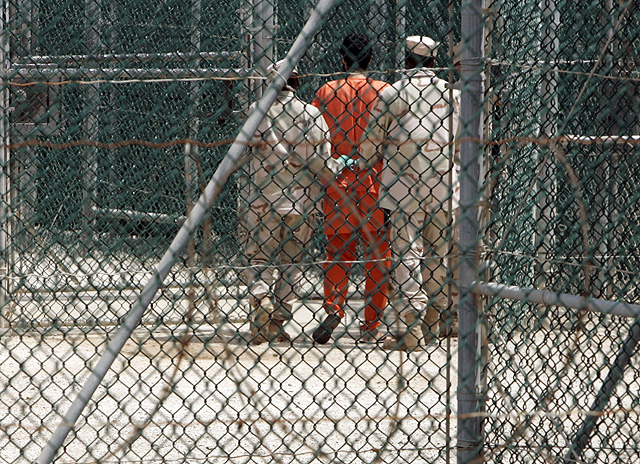
In this 2005 image reviewed by the U.S. Military, a detainee is escorted by guards at Guantanamo Bay Naval Base, Cuba. Offering a glimpse into Guantanamo Bay, the Pentagon has released the names and countries of many detainees who have been held at the isolated military prison for up to four years.
The evidence against others can seem flimsy. In at least one case, it appears to include only the fact that the suspect wore a Casio watch – a brand allegedly favored by terrorists for use as bomb timers.
It is impossible to gauge from the transcripts alone whether someone is improperly held at Guantanamo Bay, where the U.S. now holds about 490 detainees.
The Bush administration has kept almost all information about the detainees secret since opening the prison in 2002.
But the administration itself seems to have acknowledged that many suspects do not belong at Guantanamo. The military has stopped bringing new detainees to the prison and has transferred or released about 270. The Pentagon said it would reduce the detainee population by about 30 percent with more transfers and releases.
National

Man pleads guilty to killing a top Minnesota Democrat and her husband

New tornadoes outside Chicago as severe storms pummel the Midwest
Feds won’t seek death penalty in plea deal with man accused of killing top Minnesota Democrat
NASA unveils astronauts to test tech for future moon landing
Social Security’ fund faces shortfall one year earlier than expected
WASHINGTON (AP) — Social Security 's retirement trust fund is projected to face a funding shortfall in 2032, a ...