Tax board member under scrutiny
Relationship with firm raises concerns about impartiality
For more than two years, Tom Slack has been a lightning rod.
From first mention of his appointment to the Kansas Board of Tax Appeals, county officials and attorneys have voiced concerns about what they view as conflicts of interest.
And since then, critics say and records support, his performance on the board hasn’t eased their concerns. Among them:
¢ Slack continues to hear cases brought by the very attorneys who used political connections inside Gov. Kathleen Sebelius’ office to help him get appointed, despite county officials’ strongly voiced concerns about Slack’s relationship to the attorneys.
¢ Slack, at one point, continued to do work for at least one of those attorneys even while a member of the Board of Tax Appeals.
¢ Slack has refused to recuse himself from some cases or delayed his recusal even when asked to step down by the parties involved.
¢ His pro-property owner approach, stemming from his past as a for-pay property appraiser, led the board to repeatedly favor property owners regardless of the amount or kind of evidence they presented at hearings.
Critics say the allegations may constitute violations of the state’s Judicial Code of Conduct, which states administrative judges such as Slack should avoid even the appearance of a conflict of interest.
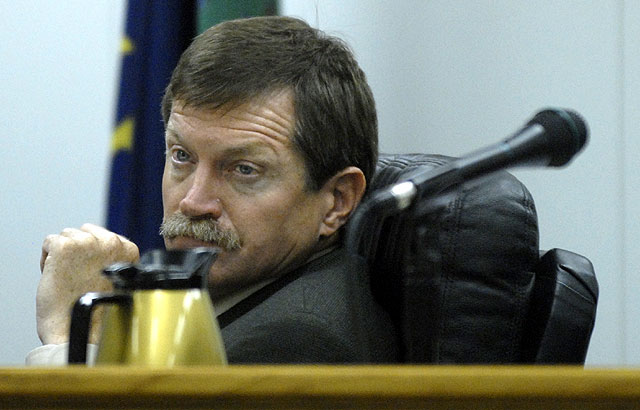
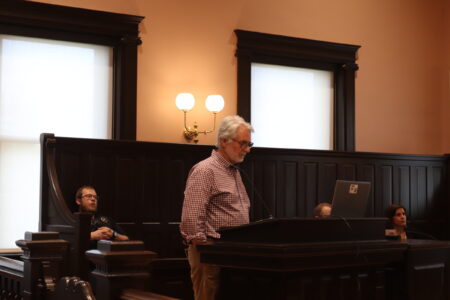
Board of Tax Appeals member Tom Slack listens during a hearing Thursday afternoon at the Docking State Office Building in Topeka.
“Such conduct poses a clear conflict of interest and, at minimum, gives the appearance of impropriety,” Topeka attorney and former BOTA member Lyn Goering wrote to the Senate in 2004. “It would also violate the Code of Judicial Conduct.”
Critics also say Slack’s rulings have lost revenue for schools and roads in Kansas counties and have cost other taxpayers by slanting property values in sometimes dramatic ways.
“Should the governor be concerned? Yes, probably,” said Tony Folsom, former BOTA executive director. “As general counsel to the board, that concerned me.”
Internal investigation
From first mention of his appointment, Sebelius’ office knew Slack had critics.
Matt All, chief counsel for the governor’s office, said the office has continued to field complaints.
“We are concerned,” All said. “We have been concerned for some time.”
Enough so that Sebelius’ office launched an internal investigation of Slack and his connections to the law firm of Neill, Terrill & Embree sometime within the last 18 months, All said.
“At this point, we have not received any evidence that there is an actual conflict of interest,” All said. “Our hands are tied here.”
State law says a BOTA member can only be removed for cause, and All said it is important Sebelius not meddle in the board’s operations. He said it would create potential for great mischief if a governor removed a BOTA member for anything other than misconduct. The board is meant to be an independent body, heedless of politics.
Slack said that no conflict of interest exists in cases where he hasn’t recused himself and that he decides cases according to precedents set by the Kansas Appeals and Supreme courts.
“The Judicial Code of Conduct requires that I participate,” Slack said. “I’m getting paid to hear every case I can hear.”
Backing Slack
In 2003, Secretary of Revenue Joan Wagnon called Linda Terrill – a partner in the law firm Neill, Terrill & Embree – to ask her opinion about who should fill a then-vacant BOTA seat. Terrill, who has contributed more than $5,000 to Sebelius’ political campaigns, said she didn’t hesitate.
“I recommended Tom Slack,” Terrill said.
She said she had known Slack for years, mainly because of the small number of people who work and take interest in the world of tax law, property valuations and intricate appraisal processes. Slack also appraised property and testified before BOTA on behalf of Terrill’s clients.
Terrill also had close relationships with officials in Sebelius’ office, including then-Appointments Secretary Shirley Allen, whom Terrill had known from Terrill’s days in state government, Terrill said.
Terrill and almost every other person interviewed by the Journal-World said Slack was more than qualified for the position, having been an appraiser, attorney and certified accountant more than 20 years.
How the Board of Tax Appeals works
¢ When taxing bodies, i.e. county appraisers, and property owners can’t agree on the value of property, they take cases before the board.
¢ Counties are typically represented by their counsel. Attorneys specializing in tax law often represent property owners.
¢ The board has three members: Chairwoman Rebecca Crotty, Tom Slack and J. Fred Kubik. This changed in mid-2003 when the board was reduced in size from five members.
¢ Using established standards, the board decides cases by hearing evidence from both sides and making a ruling – much like a judge deciding civil or criminal cases without a jury. Cases require a majority decision.
¢ Board members are not allowed to re-appraise properties – they simply rule on evidence. Appropriate board decisions include “Denial,” in favor of counties; “Granted,” in favor of taxpayers; or “Partial,” when the board finds the true value is higher than the property owner’s request but lower than the county’s appraisal.
¢ Board decisions can be appealed at the Kansas Court of Appeals and, if needed, the state Supreme Court.
But in October 2003, when Sebelius announced she had appointed Slack to fill an empty BOTA seat, some county appraisers and others began raising concerns about his pro-property owner history as an appraiser – and the appraisal work he had done for Terrill, whose firm regularly appears before the board.
Slack knew of possible opposition to his appointment. According to his questionnaire submitted to Sebelius’ office in August 2003, Slack mentioned people might attempt to “impugn or attack” his character or qualifications.
But even though he vowed to – and eventually did – recuse himself from cases where he had appraised a property in dispute, some county officials and attorneys viewed Slack’s relationship with Terrill and her law firm as a conflict of interest – enough so that some told lawmakers Slack shouldn’t be on the board.
In a letter to former state Sen. David Corbin, tax attorney Robert J. O’Connor of Wichita said because Slack had “what is or appears to be a particularly strong and close business/professional and political relationships” with attorneys from the firm, he couldn’t help but show bias in favor of clients the firm represented.
O’Connor told Corbin that, in his eyes, and possibly the eyes of the law, Slack would violate the Judicial Code of Conduct every time an attorney from Neill, Terrill & Embree appeared before the board.
‘Scorched earth’
When Terrill heard some county officials and attorneys had protested Slack’s appointment, she contacted Sebelius’ office to learn what she could to assure his appointment, she said.
Records from the Governor’s Office show Terrill on several occasions contacted Melissa Gregory, who had replaced Allen as Sebelius’ director of appointments; former Chief of Staff Joyce Allegrucci; and Jalynn Copp. In e-mails to the staffers, Terrill offered to do whatever she could to help Slack’s Senate confirmation, including offering ideas as to what Slack should tell the Senate to quash conflict-of-interest concerns.
Terrill suggested people who would write letters on Slack’s behalf and offered to lobby several senators about Slack’s appointment, records show.
“I would be happy to continue my scorched earth efforts,” Terrill wrote in an e-mail to Troy Findley, Sebelius’ chief of staff and former legislative liaison.
About a month later, the Senate confirmed Slack after he assured members he would not do appraisals in Kansas and would recuse himself from any case in which he had appraised the property.
Records show Slack has done at least one appraisal for Terrill’s firm since appointment to the board. Months after joining BOTA, Slack in 2004 appraised property in Platte County, Mo. In the same period, Linda Terrill had more than two dozen cases pending before BOTA.
Folsom, the board’s former executive director who left in October 2004, said he remembered discussions about Slack’s possible conflict of interest.
“I think once the announcement was made, there was some concern raised about his past work as a fee appraiser. They (county officials) questioned whether or not there’d be conflicts,” he said.
Folsom said he had his concerns, too.
“The main thing is if you think they can make an unbiased decision before the board,” Folsom said. “You have to have board members who are impartial … even the appearance of it.”
Recusals
Slack has removed himself from some cases but only when he had appraised the property before the board, concluding he couldn’t hear the case and simultaneously be an expert witness in it.
But he has continued to hear and rule on cases involving Terrill and her law firm, records show – even when asked to recuse himself because of perceived conflict.
For example, the issue came up when O’Connor asked Slack to recuse himself from a case involving Exxon-Mobil in 2004. Slack refused, though Linda Terrill was an attorney in the case.
Slack said in a BOTA filing he was born and raised in Kansas and has a number of relationships with people who testify or represent clients before the board.
“It would be inappropriate for me or for the other members to recuse from every matter in which they know the players,” Slack said in the filing.
But Greg McHenry, an associate appraiser for Riley County, said that in at least one case, Slack took time recusing himself from a case that he should have felt quickly obliged to.
In fact, Slack completed his appraisal for the property in question – a golf course near Manhattan – a day after he was appointed to the board.
McHenry said the county asked Slack to remove himself from the case because he did the appraisal in question. More than two months later, Slack stepped down, McHenry said.
“I don’t have confidence that he would have done that without some pressure,” McHenry said.
McHenry said he has asked the county’s attorney, Mike Montoya, if the county should ask Slack to recuse from several other cases involving Neill, Terrill & Embree.
The issue, McHenry said, is still up for debate.
“In my mind, if I were in his position, I would recuse myself,” McHenry said.
The perception
Slack told the Journal-World he has never viewed his ties to Terrill’s firm – which he said accounted for about 5 percent of his appraisal business over the course of eight years – as a conflict.
But now, Slack said, all of the fuss from county appraisers and attorneys are creating an appearance of a conflict of interest that never existed.
“The fact that it’s not true doesn’t matter anymore,” Slack said.
Current BOTA Executive Director Trevor Wohlford also said that he didn’t think Slack had any conflict of interest and that he didn’t disagree with any of the board’s decisions.
But since Sebelius appointed Slack to the board, county appraisers around the state say they’ve noticed a difference in the way the board decides cases.
Just a few years ago, board members often would side with county appraisers when property owners showed little or no evidence disputing the worth of their property.
The process then, appraisers say, kept property tax revenue coming in to support school districts, roads and other taxpayer-funded services. It also helped keep other taxpayers from making up the difference when other property owners paid less than they should have.
But since Slack’s appointment – specifically, since a 2004 case where the board changed the kinds of valuation evidence counties were required to show – property owners have won a large majority of cases even when presenting little evidence to dispute county claims, county officials say.
The 2004 case, Board of County Commissioners v. Jensen, was the first time the Kansas Court of Appeals ordered BOTA to use Uniform Standards of Professional Appraisal Practices, or USPAP.
Slack’s staunchest supporter says the counties’ complaints against him stem from his keen understanding of the new standards, which the counties have had difficulty mastering.
“Tom is just an appraiser that understands USPAP,” Terrill said. “The county appraisers just don’t want to do the effort.”
But the counties’ complaints have not been directed against other BOTA members. They say Slack essentially reappraises properties disputed at the board instead of relying solely on the evidence presented.
‘Frustrating’
Douglas County Appraiser Marion Johnson said that before Slack joined BOTA, the county was typically successful in about 80 percent of cases – mainly cases where property owners presented BOTA little evidence of a wrong appraisal.
Since then, Johnson said, Douglas County loses as many, if not more, cases as it once won.
“It is frustrating, I have to admit,” Johnson said.
Other counties reported similar experiences when BOTA decides a case.
“Since Tom Slack’s been there, it doesn’t matter,” Saline County appraiser Rod Broberg said. “We haven’t won a case.”
Broberg cited one specific case where the county considered selling a former school building in downtown Manhattan, Roosevelt Lincoln Middle School.
Private developer Pioneer President’s Place, a retirement home operator, offered to buy the land on the cheap – $2,500 for three-quarters of a city block near shopping, a hospital and courthouse in a high-priced, downtown district.
The county agreed to sell.
But, according to BOTA records, the county appraised the property at about $237,000 – its value for the land without the still-standing historic buildings. The county argued the appraisal was accurate and in line with other costly property downtown.
BOTA records show that property in the neighborhood typically sold for an average of $2.47 a square foot. County officials said that accepting the company’s asserted value for the property – the purchase price of $2,500 – would mean the property’s value was less than 2 cents per square foot.
Eventually, records show, the Board of Tax Appeals found that since another developer bid on the property, $2,500 was a “fair market value” – regardless what other property owners in the neighborhood had to pay for their land.
“That’s the real tragedy of what’s happening at the board,” Broberg said. “We’re really representing other taxpayers who are going to take up the slack if the value lowers.”
But Slack said he decides cases by the book, following precedents set by higher courts. He said there’s no simple way to explain how he decides cases – every one is different – but that he follows statutes governing the board.
Ongoing complaints
Since the governor’s office investigated Slack’s board conduct, at least one Kansas county has directly complained to the governor’s office, asking that the problems at BOTA be looked into.
In a June 5 letter to Sebelius, Russell County commissioners complained BOTA ruled in favor of a property owner who allegedly showed up with no information about his property, said the county’s valuation was “OK” and then guessed at what his land might have been worth.
“The Board has rendered several decisions that appear to be one-sided,” the letter said. “This appears to be the trend in several recent decisions.”
In the letter, the commissioners told Sebelius the appeals board should treat counties and taxpayers equally.
“It is not equal or fair to the rest of the Taxpayers in the State of Kansas as the Constitution states it shall be,” the letter said.
City Government
Developer seeks incentive from City of Lawrence to build 131 units of housing near Wakarusa and Queens

Lawrence city leaders will consider whether to keep Community Building open, make 2 other rec centers free to access
A STAR Bond application raises questions for city leaders about Costco and housing west of the SLT
Soccer gear honoring Lawrence history’s all-star team is now on sale as part of city’s public art exhibition
To honor public servants, Lawrence’s July 4 celebration will have a whole gallery of their photos on display; submissions open now