Archive for Monday, June 19, 2006
Researchers seek to find out how children learn words
KU studies may expand ‘limited knowledge’ in field
June 19, 2006
Advertisement
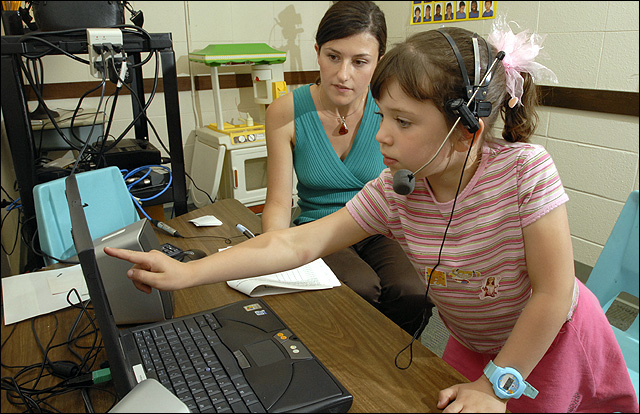
Tabitha Brandel shuffles in her tiny chair as weird pictures flash on the computer screen before her.
"We're going to play a game," the computer tells the 5-year-old. "Find the yame."
Brandel attempts to match the objects to their made-up names. Each round wins her a sticker.
The session is one of many headed by Kansas University researcher Holly Storkel, who is studying how children learn words.
The National Institutes of Health recently awarded Storkel, assistant professor of speech-language-hearing, a five-year, $1.75 million grant to develop a model for how children learn words.
"If we understand better how kids learn words, we can make assessments that are better," Storkel said. "It could also have implications for classroom instruction for all kids."
Storkel will look at how words, sounds and word meanings affect a child's ability to learn them.
Kansas University research assistant Andrea Giles watches as 5-year-old Tabitha Brandel tries to choose between objects on the computer screen that match the name of the object provided by a computer program Friday afternoon at Haworth Hall. The activity is part of a five-year research project aimed at better understanding how children learn words.
Research already has found that children learn uncommon sound combinations better than they learn common sound combinations, Storkel said.
"In order to learn a word, you have to recognize that you don't know it," she said. "You immediately recognize that this is something new, and you try to learn it."
When it comes to learning whole words and not just sound combinations, research has shown something different. Researchers have found that a word similar in sound and meaning to one a child already knows is easier to pick up.
Much research has focused on how many words children know by a particular age, without paying much attention to how the nature of the words affect a child's ability to learn them, said Hugh Catts, professor and chair of the department of speech-language-hearing.
"There's really limited knowledge in that area," Catts said. "Holly is the leading person in this area."
The recent session with Tabitha was one of about 50 that will be conducted during the summer.
Research assistant Andrea Giles guided Tabitha as she was introduced to new words. Words such as "mabe" or "heg" were made up for the exercise. Researchers will watch to see how Tabitha learns the words.
Top ads RSS
- Full Time Program Assistant in the Department of Medicinal Chemistry ...
- ECKAN is now hiring for a full-time Weatherization Outreach Inspector ...
- Frito Lay
- ADMINISTRATIVE ASSOCIATE University of Kansas School of Pharmacy - Pharmacology ...
- TELESALES REPRESENTATIVE T he World Company, a fast-paced, multi-media organization, ...
Marketplace
Arts & Entertainment · Bars · Theatres · Restaurants · Coffeehouses · Libraries · Antiques · Services
- Three detained after Sunday nightclub shooting July 5, 2009 · 34 comments
- Couple speak out on transgender issues July 5, 2009 · 22 comments
- Lawrence booms with festivities July 5, 2009 · 18 comments
- Tiller murder suspect advocates ‘justifiable killing’ via mail from jail July 5, 2009 · 11 comments
- U.S. must restore faith in monetary system July 5, 2009 · 6 comments
- Palin links her resignation to ‘higher calling’ July 5, 2009 · 17 comments
- Blog: Sarah Palin: With Interest July 4, 2009 · 123 comments
- New law: Left lane only for passing July 2, 2009 · 197 comments
- Obama embarks on mission to reshape U.S. image July 5, 2009 · 4 comments
- Palin to resign as Alaska governor July 3, 2009 · 131 comments
- A new reign: Lawrence landmark the Castle Tea Room open again after extensive renovations July 5, 2009
- U.S. must restore faith in monetary system July 5, 2009
- Lawrence booms with festivities July 5, 2009
- Couple speak out on transgender issues July 5, 2009
- Restaurant inspector stresses education July 5, 2009
- Police respond to shots fired at location between Baldwin City and Eudora July 4, 2009
- 1999 murder case won’t settle July 5, 2009
- School district needs to cut $500K more July 3, 2009
- City firm picked for Manhattan work July 2, 2009
- Mass St. momentum July 5, 2009


19 June 2006
at 5:33 a.m.
Suggest removal
Permalink
audvisartist (Anonymous) says…
How kids learn words is simply fascinating! I'm blown away every day because my 2-year old says something that just the day before he never would have even thought of! Or, what really gets me, is how he'll say a word that he's only heard when he was in his “baby babble” phase. For example, in Christmas of '04 he'd heard the word Santa Claus. No big deal… he never heard the word again (that I know of) and never said anything once he started speaking in a less “baby babble” manner. But then as soon as a commercial featuring Santa came on the TV during Christmas '05, he yelled out, “SANTA!!!!” These kids have a memory like a steel trap… it's mind blowing when you sit and think about it!
19 June 2006
at 5:49 a.m.
Suggest removal
Permalink
geekin_topekan (Anonymous) says…
“Puppy!” was the one that took me by surprise.
Out of the blue.We were walking to the park and a dog trotted past.To my knowledge we'd never actually stopped to pet a dog before this.Don't know where she picked it up,but she knew without a second thought.
19 June 2006
at 11:18 a.m.
Suggest removal
Permalink
Agnostick (Anonymous) says…
I wonder if they'll take sign language, and signing into consideration:
http://www.signingbaby.com/main/
We've used Joseph Garcia's “Sign With Your Baby” (never really looked at Acredolo & Goodwyn's “Baby Signs”) and feel like it's done wonders with our 14-month-old daughter. She definitely *understands* words, phrases, and questions. When it's almost 8pm and she's fussy, and we ask, “do you want a bath?” and make the sign for “bath”… she'll give the sign back to us, sometimes followed by “please”… and stand at the closed door to our bedroom, waiting to be let through to the bathroom.
The only downside to signing is that you get no “feedback” along the way. You show them the sign over and over and over and over, weeks on end. For weeks and weeks, baby only gives you this blank stare… and then, one day, BOOM! The hand comes out, opening and closing into a fist, asking for “milk.”
For anybody who has a baby now, or is going to have one sometime soon, I highly recommend using sign language. You'll be able to start communicating with your little one earlier, there's less frustration (well, over communicating, at least :p ), and there are supposedly big dividends down the road (brain more susceptible to learning music, 2nd or 3rd languages, etc.).
My email is open to anyone who might have more questions, but the two links above should provide an adequate starting point.
Agnostick
agnostick@excite.com
19 June 2006
at 10 p.m.
Suggest removal
Permalink
bearded_gnome (Anonymous) says…
Agnostick,
was undergrad at UCD, took two classes taught by Linda Acredolo. second, Dev Psych, she had her baby along most classes. she's a wonderful prof/great teacher in person!