Pregnancy boosts endangered rhino project
Cincinnati ? Emi the Sumatran rhino is pregnant again, and that’s big news for conservationists from Ohio to Indonesia who are trying to save the critically endangered species.
It is believed that fewer than 300 Sumatran rhinos survive in Southeast Asia. Emi is the only one to give birth twice in captivity; her first delivery in 2001 was the first by a Sumatran rhino bred in captivity since the 19th century.
The Cincinnati Zoo & Botanical Garden announced Saturday that Emi is 173 days into a 16-month pregnancy, adding hope to efforts to save the species.
“We have a long, long way to go, but we do see some glimmers of hope,” said Terri Roth, who heads the zoo’s Center for Conservation and Research of Endangered Wildlife.
The center has relied on close monitoring of hormone levels, use of ultrasound, and years of patient observation, and trial and error to learn how to successfully mate the Sumatran rhinos.
“The real significance is that it’s taken them a long time, but both through really great science and perseverance, they’ve got the technique down,” said John Lukas, president of the International Rhino Foundation, a conservation group based in Yulee, Fla. “The knowledge they’ve gained in Cincinnati is really critical.”
Oblivious to the historic nature of her condition, Emi contentedly chomped on handfuls of chopped bananas, apples, and sweet potatoes while undergoing an ultrasound. Scientists believe Emi will give birth to a male.
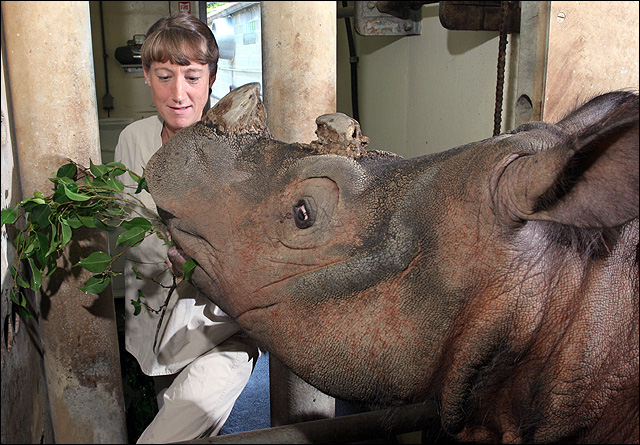
Dr. Terri Roth gives Emi, a pregnant Sumatran rhino at the Cincinnati Zoo, a branch of leaves to eat. Emi, who has given birth to two other calves in the past five years at the zoo, is pregnant again.
With big dark eyes, the snub-nosed, two-horned Sumatran rhinos, which stand 3- to 5-feet tall and weigh from 1,300 to 2,000 pounds, can be “like big puppy dogs,” said Roth, who’s been working with Emi and the male Ipuh for 10 years now.
The breeding program grew out of an international recognition in the early 1980s that the Sumatran rhinos were disappearing at a rapid pace, their rain forest habitat being lost to logging and other development while poachers hunted them for horns that can be sold for tens of thousands of dollars for medicinal uses.
But little was known about caring for the Sumatran rhinos in captivity, let alone their mating habits and reproductive cycles. Of seven rhinos brought to U.S. zoos, only three survived by 1995. With breeding efforts in Malaysia and Indonesia also stalled, Emi, who came to the Los Angeles Zoo in 1991 from Indonesia, was relocated again to join Ipuh here.
Because they are solitary animals, rhinos placed in couples are more likely to fight each other than to mate. With so few remaining in the world, it can be unnerving to watch them attack each other with their long sharp teeth, Roth said.
“They’re a very different species,” said Roth, who eventually was able to understand Emi’s ovulation and reproductive cycle for timing their encounters.
Since 1997, Emi has had five miscarriages then delivered two calves, a male named Andalas in 2001 and a female, named Suci, in 2004.
The zoo hopes to breed Emi, believed to be about 18 years old, at least four more times. Meanwhile, plans are in the works for her first offspring to go to Indonesia to get its breeding program moving. Andalas is at the Los Angeles Zoo, the only other U.S. zoo with a Sumatran rhino.
National

Man pleads guilty to killing a top Minnesota Democrat and her husband

New tornadoes outside Chicago as severe storms pummel the Midwest

Feds won’t seek death penalty in plea deal with man accused of killing top Minnesota Democrat

NASA unveils astronauts to test tech for future moon landing
Social Security’ fund faces shortfall one year earlier than expected
WASHINGTON (AP) — Social Security 's retirement trust fund is projected to face a funding shortfall in 2032, a ...