Navy develops smaller, faster ships
Bath, Maine ? Sailor, these are not your father’s warships.
The first of a new breed of Navy ship – faster and easier to maneuver – is expected to launch later this year to meet threats including modern-day pirates and terrorists who turn speedboats into suicide weapons.
The Littoral Combat Ship is powered by steerable waterjets, so it doesn’t need propellers or rudders. It’s designed to go more than 50 mph; traditional destroyers have had the same top speed – about 35 mph – since World War II.
The LCS has a shallow draft, and its waterjets let the ship zoom close to shore without getting stuck and to turn on a dime, allowing it to chase smaller boats. The name itself is taken from the coastal “littoral” waters in which the ship will operate.
The LCS will be more lightly armored than bigger ships, but its speed will give it a tactical advantage in combat, said Rear Adm. Charles Hamilton, program executive officer for ships, who’s overseeing the project from Washington.
The Navy envisions several of the ships working together on missions using unmanned vehicles, helicopters and other weapons, he said. An LCS will have a core crew of only 40 sailors, and berthing for up to 75, compared to 330 sailors aboard a destroyer.
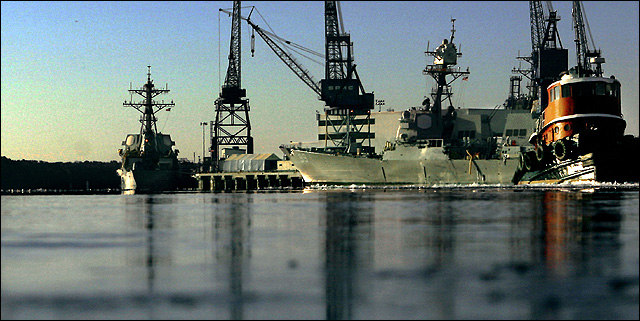
Navy ships are seen at the Bath Iron Works shipyard along the Kennebec River in Bath, Maine. The first of a new breed of Navy ship, faster and easier to maneuver, is expected to launch later this year to meet threats including modern-day pirates and terrorists who turn speedboats into suicide weapons.
The new warship was conceived six years ago and fast-tracked after the USS Cole bombing and the 9-11 attacks. The first of the new ships will be delivered in roughly half the 10 to 15 years it takes under traditional shipbuilding programs.
“That’s a miracle in Navy terms,” said Jay Korman, naval analyst at Washington-based consultants DFI Corporate Services.
Two versions are under construction. Lockheed Martin Corp. is leading the team building LCS-1, with partners Marinette Marine Corp. in Wisconsin and Bollinger Shipyards Inc. in Louisiana.
The Freedom ship due to launch this fall in Marinette, Wis., resembles a traditional frigate or destroyer but features a sleek, semi-planing hull, meaning the bow lifts at top speed, reducing resistance and making it faster.
The other LCS version by team leader Bath Iron Works, a subsidiary of General Dynamics Corp., resembles a futuristic catamaran. The aluminum “trimaran” Independence being built by Austal USA in Mobile, Ala., is loosely based on fast ferries developed in Australia.
Lockheed Martin’s LCS is 378 feet long, while General Dynamics’ trimaran is 418 feet. By comparison, the typical Arleigh Burke-class destroyer is 510 feet long, and the Zumwalt “stealth” destroyer being developed will be about 600 feet.
The Navy plans to build 55 of one or both models of the LCS to beef up a fleet that critics say was neglected even before the Iraq war.
National

Man pleads guilty to killing a top Minnesota Democrat and her husband
New tornadoes outside Chicago as severe storms pummel the Midwest
Feds won’t seek death penalty in plea deal with man accused of killing top Minnesota Democrat

NASA unveils astronauts to test tech for future moon landing
Social Security’ fund faces shortfall one year earlier than expected
WASHINGTON (AP) — Social Security 's retirement trust fund is projected to face a funding shortfall in 2032, a ...