Foreign governments keep hurricane registries
Atlanta ? Ryan Kittle and his wife were on the porch of their hurricane-flooded Mississippi home last September when they saw a van draped with the Union Jack make its way through the downed trees.
“My wife said, joking, ‘It’s for you’ – and they were!” the 24-year-old from Plymouth, England, recalled in a combination Southern drawl and British accent.
Kittle’s father back in England had been unable to contact him after Hurricane Katrina and desperately called an emergency hot line set up by the Foreign Office in London. British consular officials from Atlanta then drove out to search for Kittle and dozens of other British subjects reported missing after the hurricane.
Now, at the start of another hurricane season, foreign governments are compiling the names and addresses of their citizens living in the Southeastern United States in case their loved ones back home need to reach them after another disaster.
More than 13,000 people were reported missing after Hurricane Katrina struck Aug. 29 and Hurricane Rita hit a month later. Nearly 1,600 people from Louisiana died during Katrina or immediately after evacuating.
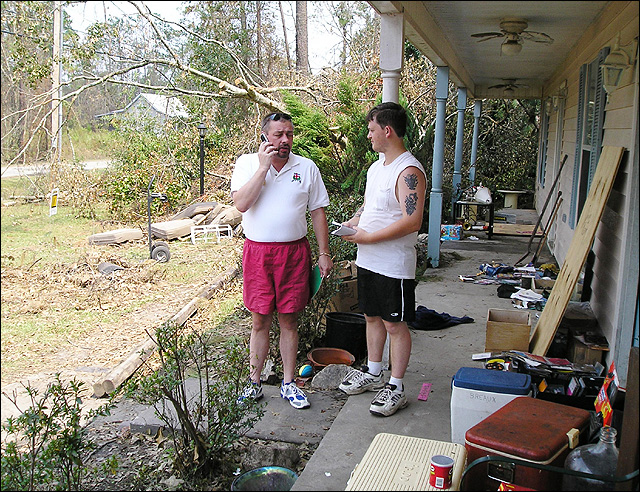
Jeff Wix, a British consular official based in Atlanta, left, contacts British national Ryan Kittle's father in the United Kingdom on a cell phone in the aftermath of Hurricane Katrina in this Sept. 5, 2005, file photo in Kiln, Miss. After going door to door to find their compatriots after the last hurricane season, many consulates are going all out trying to get their citizens to register online before the next hurricane hits.
The number of people still listed as missing by state and federal officials after hurricanes Katrina and Rita has fallen below 200, officials said Monday.
Hundreds of thousands of foreigners – many of them from Mexico, but also from countries such as England, Germany, France and Italy – are believed to be living in the nation’s Hurricane Alley.
Door-to-door searches
In the aftermath of Katrina, consular officials from Atlanta went knocking on doors along the Gulf Coast in search of foreigners whose worried relatives back home were unable to contact them.
“We went block by block, looking for people who looked Latino. We asked them if they were Mexican, if they needed anything and if they knew where other Mexicans were,” said Remedios Gomez-Arnau, the Mexican consul general in Atlanta, who opened a temporary consulate in Mobile, Ala., in the days after Katrina.
In a few cases, some foreigners who were hurt or had lost everything were sent back to their home countries by their consulates. Among them was a Frenchman who was returned to Paris after his restaurant in Gulfport, Miss., was wiped out, said French vice consul Aurelien Maillet.
The goal of the foreign governments is not to deliver food, water or other emergency supplies, but to offer the comfort of knowing someone back home cares.
“For many of them, what they wanted was to be reassured, to have contact with family in France,” said Sebastien Jaunatre, a French consular official who was told by bewildered National Guardsmen at a checkpoint on the Mississippi coast that a British convoy had gone through minutes before.
Volunteer efforts
Consular officials have been hitting the road over the past few months, meeting with expatriate community leaders, trying to establish a network of volunteers who can act as emergency liaisons, and inviting everybody to register with their consulates.
“Please, please register. Nothing bad is going to happen,” joked Gianfranco Colognato, Italy’s consul general in Miami, referring to many expatriates’ reluctance to deal with bureaucracy.
In most cases, people can register either online or at the consulates by providing an identity document and contact information for themselves and for relatives who can be reached in an emergency.
Some of the foreign countries are lining up volunteers in the U.S. who can provide local knowledge, such as directions when street signs have been blown away.
That could help them locate people like 67-year-old Kathleen Atwood of Lyman, Miss. Atwood had joked with her niece back in their native Belfast, Northern Ireland, that if Atwood did not call after Katrina hit, it meant the wind had carried her off.
Atwood, who came to the United States in 1960, could not get in touch with her worried relatives until, to her astonishment, the van with the British flag drove up a week later.
“The thing that mattered the most was to use our cellular and satellite phones to call home,” said Natalie Pawelski, the British vice consul who found Atwood and Kittle. “They were very touched. They didn’t think we’d care that much.”
National
Man pleads guilty to killing a top Minnesota Democrat and her husband
New tornadoes outside Chicago as severe storms pummel the Midwest
Feds won’t seek death penalty in plea deal with man accused of killing top Minnesota Democrat
NASA unveils astronauts to test tech for future moon landing
Social Security’ fund faces shortfall one year earlier than expected
WASHINGTON (AP) — Social Security 's retirement trust fund is projected to face a funding shortfall in 2032, a ...