Mass graves are likely evidence for another future Saddam trial
Baghdad, Iraq ? Two recently excavated mass graves containing the bodies of at least 38 people allegedly killed by Saddam Hussein’s regime following a 1991 Shiite uprising in southern Iraq likely will provide key evidence for a third war crimes trial against the deposed Iraqi president.
Skeletal remains were unceremoniously tangled together amid the dirt. Blindfolds and wrist ligatures were found on many of the remains. Some skulls contained jagged bullet holes that serve as evidence, according to forensic examiners, that the killers shot their victims from the rim of the grave.
The victims were mostly men age 20 to 35, according to forensic archaeologist Michael “Sonny” Trimble, 53, head of Iraq’s main Mass Graves Team, a group of about 17 expatriates. Most of the corpses lacked shoes, investigators said, a sign that they were hastily rounded up and transported to the site of their demise.
“They wanted to dispose of people and kill them very quickly,” said Trimble, of St. Louis. “These people did what all mass murderers do: They dig deep, they kill someone quickly, cover them up and then leave.”
Evidence at the site is expected to be used in a yet-to-be scheduled trial. Saddam is currently on trial for his alleged involvement in the killing of 148 Shiite residents of Dujail. He is then due to be tried for the Anfal military campaign involving the poison gassing of thousands of Kurds in northern Iraq.
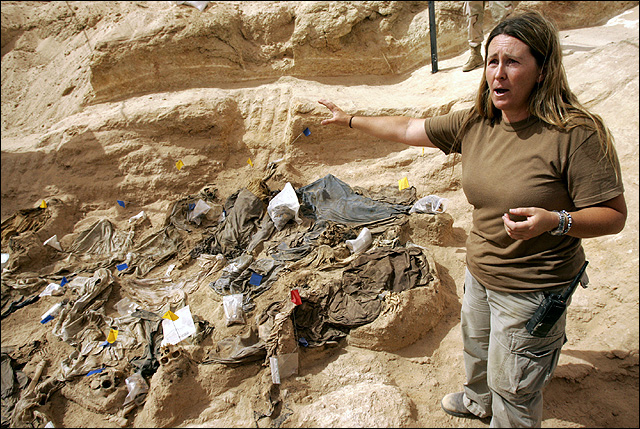
An unidentified Australian forensic expert stands near a mass grave containing human skeletons and clothes from people allegedly executed during the regime of former President Saddam Hussein and now unearthed in a shallow grave. U.S. forensic expert and project director Sonny Trimble said they have found 18 gravesites, with two of them already excavated so far, in the remote desert south of Baghdad.
The trip to the southern gravesite was arranged by U.S. and Iraqi officials investigating the estimated 100,000 to 180,000 victims of a government crackdown on the Shiite uprising following the withdrawal of U.S. and coalition troops after the 1991 Persian Gulf War.
Investigators plan to try at least 70 defendants in the case and already have questioned Saddam in the course of the probe. An international team of forensic workers began excavation of the bodies three weeks ago.
U.S. satellite pictures identified 200 possible hidden gravesites in Iraq, and investigators narrowed that list to 18 burial grounds
A team of about 120 forensic workers have set up a camp and marked bones, bone fragments, spent ammunition and skulls with blue, red and yellow flags.
Investigators said they had found more than 80 empty AK-47 cartridges among the bodies. The largest of the two mass graves is about 10 feet by 35 feet long and declines from ground level to about 5 feet at its deepest end.
National
Man pleads guilty to killing a top Minnesota Democrat and her husband
New tornadoes outside Chicago as severe storms pummel the Midwest
Feds won’t seek death penalty in plea deal with man accused of killing top Minnesota Democrat
NASA unveils astronauts to test tech for future moon landing
Social Security’ fund faces shortfall one year earlier than expected
WASHINGTON (AP) — Social Security 's retirement trust fund is projected to face a funding shortfall in 2032, a ...