More foreign companies buy national roads, bridges
Some welcome trend; others think taxpayers suffer
Washington ? Roads and bridges built by U.S. taxpayers are starting to be sold off, and so far foreign-owned companies are doing the buying.
On a single day in June, an Australian-Spanish partnership paid $3.8 billion to lease the Indiana Toll Road. An Australian company bought a 99-year lease on Virginia’s Pocahontas Parkway, and Texas officials decided to let a Spanish-American partnership build and run a toll road from Austin to Seguin for 50 years.
Few people know that the tolls from the U.S. side of the tunnel between Detroit and Windsor, Canada, go to a subsidiary of an Australian company – which also owns a bridge in Alabama.
Some experts welcome the trend. Robert Poole, transportation director for the conservative think tank Reason Foundation, said private investors can raise more money than politicians to build new roads because these owners are willing to raise tolls.
“They depoliticize the tolling decision,” Poole said. Besides, he said, foreign companies have purchased infrastructure in Europe for years; only now are U.S. companies beginning to get into the business of buying roads and bridges.
Gas taxes and user fees have fueled the expansion of the nation’s highway system. Thousands of miles of roads built since the 1950s changed the landscape, accelerating the growth of suburbia and creating a reliance on motor vehicles to move freight, get to work and take vacations.
The Bush administration’s plan to let a foreign company manage U.S. ports met a storm of protest in February. But plans to sell or lease highways to companies outside the United States have not met such resistance.
John Foote, senior fellow at Harvard’s Kennedy School of Government, said the government can take over a highway in an emergency. But he objects to selling roads to raise cash.
But that is just what Chicago has done.
Last year, the city sold a 99-year lease on the eight-mile Chicago Skyway for $1.83 billion. The buyer was the same consortium that leased the Indiana Toll Road – Macquarie Infrastructure Group of Sydney, Australia, and Cintra Concesiones de Infraestructuras de Transporte of Madrid, Spain.
Chicago used the money to pay off debt and fund road projects. Skyway tolls rose 50 cents, to $2.50; By 2017, they will reach $5.
The Indiana Toll Road lease is a better deal, Foote thinks, because the proceeds will pay for urgent projects such as road and bridge improvements.
That need is precisely why cities and states have begun to look to foreign investors.
Between 1980 and 2004, people drove 94 percent more highway miles, according to Federal Highway Administration statistics. But the number of new highway lane miles rose by only 6 percent.
Washington is not likely to produce more money to build roads. The federal highway fund – which will have a balance of about $16 billion by the end of 2006 – will run out in 2009 or 2010, according to White House and congressional estimates.
About half the states now let companies build and operate roads. Many changed their laws recently to do so.
So Illinois lawmakers are examining privatizing the Illinois Tollway, New Jersey lawmakers are considering selling 49 percent of the state’s two big toll roads and a gubernatorial candidate in Ohio wants to sell the turnpike.
Indiana Gov. Mitch Daniels, who championed his state’s toll road deal, now wants investors to build and operate a toll road from Indianapolis to Evansville.
Patrick Bauer, the Indiana House’s Democratic leader, says such deals are taxpayer rip-offs.
Bauer believes Macquarie-Cintra could make $133 billion over the 75-year life of the Indiana Toll Road lease – for which Indiana got $3.8 billion.
“In five, maybe 10 years, all that money is gone, and the tolls keep rising and the money keeps flowing into the foreign coffers,” Bauer said.
To encourage more domestic investment in highways, former Transportation Secretary Norman Y. Mineta made a pitch to Wall Street on May 23.
“The time is now for United States investors – including our financial, construction and engineering institutions – to get involved in transportation investments,” said Mineta, who left office July 7.
National

Authorities disrupt planned drone, gun attack on White House UFC cage-fight
Rain along the Gulf Coast could become the first named storm of the Atlantic hurricane season
MIAMI (AP) — A cluster of storms along the Gulf Coast could become the first named tropical storm of the 2026 ...
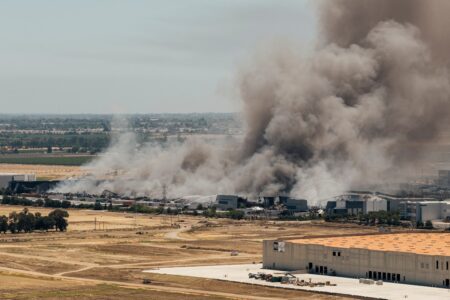
Unhealthy air quality in California city as huge warehouse fire burns for 3rd day
Judge orders Trump administration to restore National Park changes at sites that ‘disparaged’ US
Teens’ reading and math scores have stagnated, US test results show
WASHINGTON (AP) — Younger students have regained ground academically after the pandemic's disruptions while older ...