Doctors document brain regeneration
Car crash victim's nerve connections spontaneously regrew
Doctors have their first proof that a man who was barely conscious for nearly 20 years regained speech and movement because his brain spontaneously rewired itself by growing tiny new nerve connections to replace the ones sheared apart in a car crash.
Terry Wallis, 42, is one of the few people known to have recovered so dramatically so long after a serious brain injury. He still needs help eating and cannot walk, but his speech continues to improve and he can count to 25 without interruption.
Wallis’ sudden recovery happened three years ago at a rehabilitation center in Mountain View, Ark., but doctors said the same cannot be hoped for people in a persistent vegetative state, such as Terri Schiavo, the Florida woman who died last year after a fierce right-to-die court battle. Nor do they know how to make others with less serious damage, like Wallis, recover.
“Right now these cases are like winning the lottery,” said Dr. Ross Zafonte, rehabilitation chief at the University of Pittsburgh Medical Center, who was not involved in the research. “I wouldn’t want to overenthuse family members or folks who think now we have a cure for this.”
Wallis has complete amnesia about the two decades he spent barely conscious, but remembers his life before the injury.
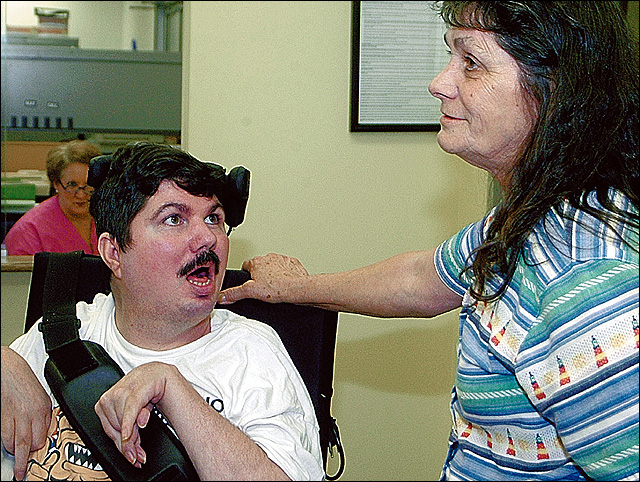
Terry Wallis, 42, of Big Flat, Ark., left, speaks with his mother, Angilee Wallis, in this June 8, 2005, file photo in Little Rock, Ark. Wallis, who was barely conscious for nearly 20 years after a car crash, regained speech and movement three years ago because his brain spontaneously rewired itself, doctors say they now can prove.
“He still thinks Ronald Reagan is president,” his father, Jerry, said in a statement, adding that until recently his son insisted he was 20 years old.
Advanced imaging
The research on Wallis, published Monday in the Journal of Clinical Investigation, was led by imaging expert Henning Voss and neurologist Dr. Nicholas Schiff at the Weill Medical College of Cornell University in New York City and included doctors at JFK Medical Center in Edison, N.J.
Wallis was 19 when he suffered a traumatic brain injury that left him briefly in a coma and then in a minimally conscious state, in which he was awake but uncommunicative other than occasional nods and grunts, for more than 19 years.
“The nerve fibers from the cells were severed, but the cells themselves remained intact,” unlike Schiavo, whose brain cells had died, said Dr. James Bernat, a neurologist at Dartmouth-Hitchcock Medical Center in New Hampshire, who is familiar with the research.
Nerve cells that have not died can form new connections; for example, nerves in the arms and legs can grow about an inch a month after they are severed or damaged. However, this happens far less often in the brain.
The new research suggests that instead of the sudden recovery Wallis seemed to make when he began speaking and moving three years ago, he actually may have been slowly recovering all along, as nerves in his brain formed new connections at a glacial pace until enough were present to make a network.
Researchers used a new type of brain imaging only available in research settings – not ordinary hospitals or rehabilitation centers – to establish the regrowth. It tracks the direction of water molecules in and around brain cells, an indicator of brain activity.
“It’s a roadmap of how the connections are running,” Schiff said.
Much more to learn
Doctors compared Wallis’ brain function to that of 20 healthy people and another minimally conscious patient who showed virtually no recovery for six years. All were imaged twice, 18 months apart.
In Wallis’ brain, “what we first see is how overwhelmingly severe this injury was,” with many abnormalities compared to the healthy people, Schiff said.
The second set of images showed changes from the first, strongly suggesting that new connections had formed. These correlated with areas of the brain that affect the ability to move and talk.
The other minimally conscious patient – a 24-year-old man who suffered a severe brain injury in a car accident when he was 18 – also had evidence of changes in nerve connections, but they were not organized in a way that made a difference in his ability to function.
“We’ll have to understand more about why recovery occurred” in Wallis’ case, Zafonte said. “The question is ‘why?’ It’s not just ‘wait.'”
Until that is known, imaging cannot be used to predict who will recover, or to help patients’ brains rewire, he said.
National
Man pleads guilty to killing a top Minnesota Democrat and her husband
New tornadoes outside Chicago as severe storms pummel the Midwest
Feds won’t seek death penalty in plea deal with man accused of killing top Minnesota Democrat
NASA unveils astronauts to test tech for future moon landing
Social Security’ fund faces shortfall one year earlier than expected
WASHINGTON (AP) — Social Security 's retirement trust fund is projected to face a funding shortfall in 2032, a ...