Area soldier’s widow donates his WWII diary to planned Army museum
A place for veterans' memories
The memories are all there, neatly typed in single space lines.
July 19, 1943
“Nothing happened this night except ‘Midnight Charlie’ who every once in a while came over and dropped his bombs. I spent a good 15 minutes in the closest foxhole around.”
Aug. 16, 1943
“We were alerted that a Japanese task force was headed for our island. I kept my eyes open all the time I was on guard duty but there was no attempt to invade our island.”
Dick Mulally was 84 when he died five years ago in a Topeka veterans nursing home. The diary he kept while serving in the Pacific with the U.S. Army Air Force during World War II and an autobiography he wrote later are among many of the war mementos his wife, Lauraine Mulally, has kept in folders and envelopes in her Lawrence apartment.
Now she wants the National Museum of the U.S. Army to have them.
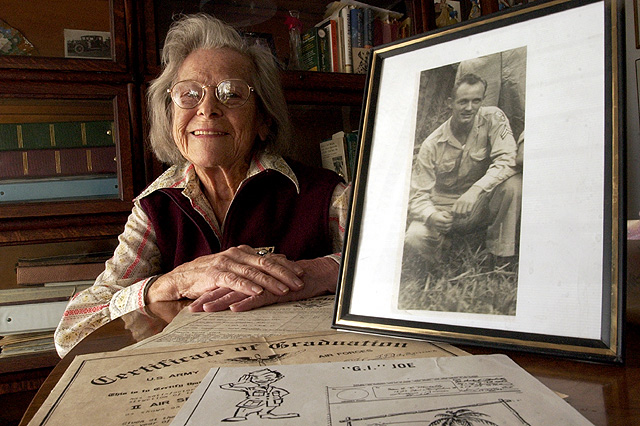
Lawrence resident Lauraine Mulally plans to donate a diary kept during World War II by her late husband Dick Mulally, at right, to the National Museum of the U.S. Army. Lauraine Mulally was prompted to donate her husband's records and memoirs when she responded to a nationwide request from the museum, which is scheduled to open in 2011 near Washington, D.C.
“It’s better to have them where people can see them instead of somewhere people can’t see them,” Lauraine Mulally, 85, said. “It’s for posterity and for people to learn from them.”
The Army museum to be built just outside Washington, D.C., isn’t scheduled to open until 2011. But Lauraine Mulally contributed some money and became a museum foundation member. She also wants to help the museum tell the Army’s story through the war memories of a soldier she met at a USO dance in Topeka and ultimately married.
“He was looking for a good dancer. I was too,” she said, smiling at the memory. “We were married two months before he went overseas.”
Emotional memories
Dick Mulally wrote the diary by hand and years later typed it up.

“He remembered all these things very clearly,” his wife said. “He was a little emotional. Sometimes he had to stop.”
Dick Mulally worked in the finance department for the 321st Air Services Group headquarters. He was stationed on several islands in the Pacific in campaigns against the Japanese. Though his job was non-combat, he still saw and experienced the horrors of war through bombing raids and seeing planes crash as they returned to base. Those experiences are noted in his diary.
July 23, 1943
“The bodies of the men from the crash were put in boxes. No one knew who they were because they were so burned that no one could identify any of them. I viewed the remains.”
Lauraine Mulally said it doesn’t bother her to read the diary. She knew a little bit about what was happening from the letters written home.
“I was glad to read what he did,” she said. “I knew he could take care of himself.”
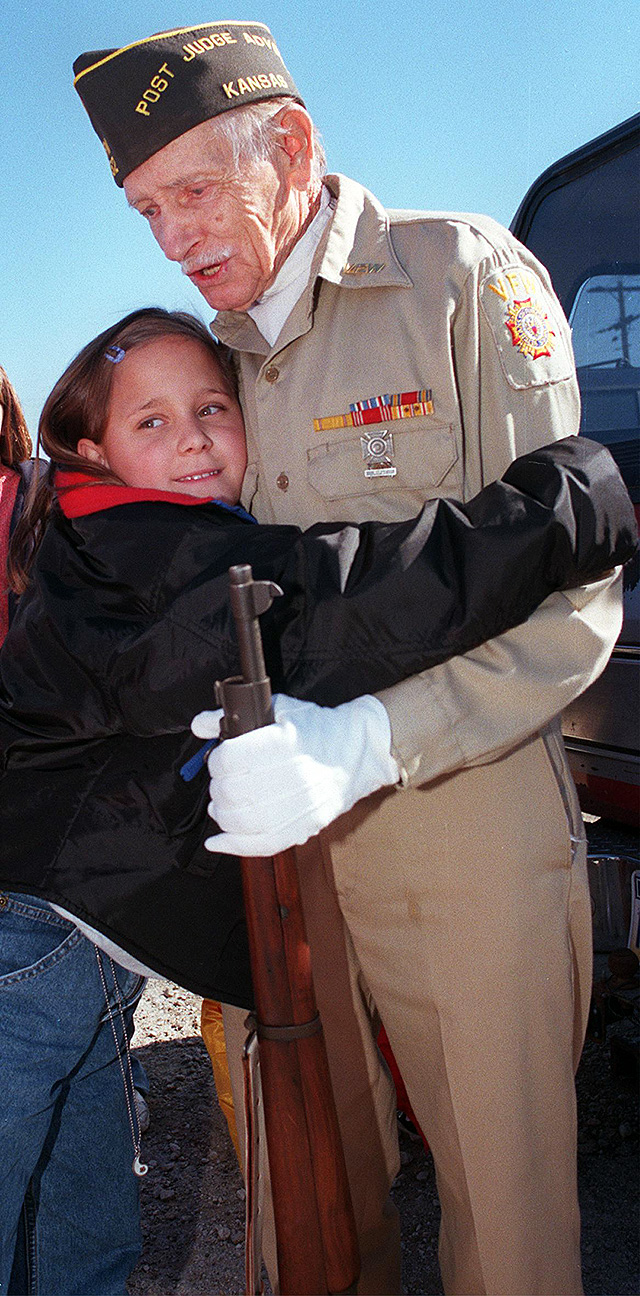
Shabrie Perico hugs her grandfather Dick Mulally in 1998 after a Veteran's Day ceremony in Lawrence. Mulally, who served in the Pacific with the U.S. Army Air Force during World War II, died in 2001.
Dick Mulally, a Brooklyn, N.Y., native, had already served four years in the Marine Corps Reserves before the war. He expected to be called back by the Marines when the war started but was grabbed by the Army instead. He told Army officials he had been a machine gunner as a Marine but, because he had been an accountant in New York, the Army put him to work handling unit financial matters. He worked on payrolls, vouchers and record-keeping.
Lauraine Mulally, a Lawrence native, also intends to send to the museum maps and photographs her husband had from the war. She has made copies of the autobiography and diary to give to her three children and grandchildren.
Her apartment walls and shelves are filled with family photographs, including one of her and Dick dancing in their younger years. There are photographs of her family, including two daughters and her now famous son, Alan Mulally, executive vice president of the Boeing Co. and president and CEO of Boeing Commercial Airplanes. Other photos include those of her and Dick in Civil War era attire when they participated as extras in the making of the movie “Ride With the Devil.”
“It’s been a lot of fun,” she said.
Museum planning
Planning and fundraising for the Army museum is still under way, said Steve McGeorge, one of the museum’s spokesmen and a retired Army major. Cost of the museum is estimated at more than $200 million. It will have at least 100,000 square feet of display space, he said. A museum collections support facility also is to be built with Army funds, he said. Ground probably won’t be broken for the museum until 2009.
“It’s a big, long project,” McGeorge said, who in 1994 earned a master’s degree in history from Kansas University before teaching a year at the Army’s Command and General Staff College at Fort Leavenworth.
The museum staff has not requested that people send items for the museum, but many calls are received about donations, including personal papers and documents, McGeorge said. Those items are considered.
“We have to be selective,” he said.
Preliminary planning for the museum includes building chronological exhibits that tell the Army’s story with additional displays showing the effect the Army has had on civilian life, McGeorge said.
“We’ve been working really hard to get a framework,” he said.
City Government

Developer seeks incentive from City of Lawrence to build 131 units of housing near Wakarusa and Queens

Lawrence city leaders will consider whether to keep Community Building open, make 2 other rec centers free to access
A STAR Bond application raises questions for city leaders about Costco and housing west of the SLT

Soccer gear honoring Lawrence history’s all-star team is now on sale as part of city’s public art exhibition
To honor public servants, Lawrence’s July 4 celebration will have a whole gallery of their photos on display; submissions open now