South student has last word
His secret: reading the dictionary
Up on stage at Southwest Junior High, kids are dropping by the wayside.
One at a time, they scoot up to the microphone, awkward, fiddling with their shirts.
Karen Cochran gives them a word to spell.
“Nodule,” Cochran says dryly.
Cochran runs the show here at the Douglas County Spelling Bee. Her title, oddly enough, is a made-up word: Pronouncer.
Her duties are as follows: Give the kids the word they have to spell, give them the definition or use it in a sentence if they ask, tell them if they are right or wrong.
But this isn’t about Cochran or even coordinator Deborah Summers. It’s about the kids. And now, on stage, one of the contestants is plugging along with “nodule.”
“N-o-d…g…” she says. Half the audience knows it’s over.
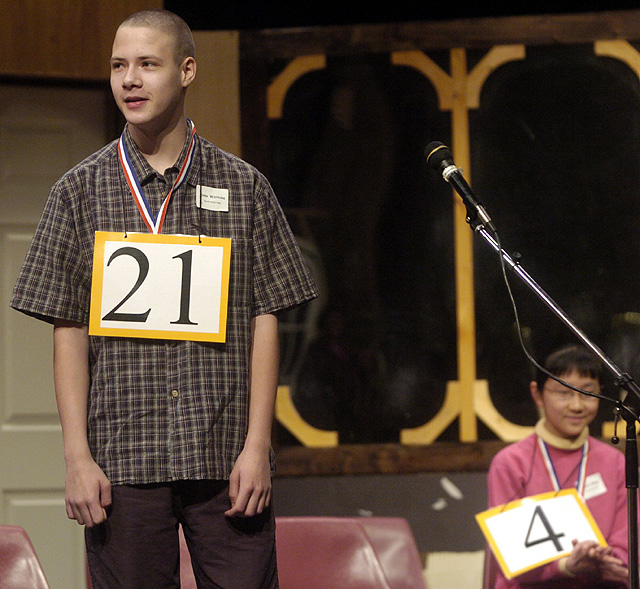
South Junior High School student Dino Watkins reacts after winning the Douglas County Spelling Bee on Saturday. Watkins spelled the word alpaca to capture the victory.
One by one, they wander to the side of the stage.
The third round has just ended, and only a handful of the original 28 contestants remain. Cochran calls for a 10-minute break, and the auditorium empties.
“Obviously, some kids are out,” coordinator Summers says backstage, where the judges and others are swilling coffee and noshing.
The whole shebang will hinge on what comes next: the somewhat brutal fourth round where the words get harder and only the county’s best spellers will survive.
“We’re going to go until the end, now,” Summers says.
Final contenders
Dino Watkins, a tall seventh-grader from South Junior High, is still in the running. Watkins will have to overcome a field of kids who, for the most part, have been involved in school spelling bees for years.
Watkins’ first spelling bee was earlier this year, at his school. He didn’t train particularly hard. All he did was go up there and win the whole thing.
“It wasn’t too complicated,” Watkins says – not cocky, just stating the facts.
See, Watkins has this reading habit, he says. It all started on a family road trip to Nebraska on the way to a funeral. Watkins wanted something to read, so his mom suggested he try this book: the dictionary.
He knocked out A through K in one sitting. He’s been picking away at it ever since, taking in every word, its definition, its spelling.
Then there’s Becca O’Brien, a smart eighth-grader from Central Junior High. She’s been in spelling bees for two years now, practicing with a combination of a little spelling and a lot of reading.
But the star of the show here is Nathan Ramsdell, a fourth-grade T.E.A.C.H. student who has made it to the final round.
All day, judges say he’s been entertaining them, a super-confident kid who can really spell.
Next round
As the 10 minutes wrap up, the contestants file back in and take seats in the plastic chairs on stage.
“There’s about to be some drama,” Cochran says, settling into her podium.
First up is Meixi Wang, a sixth-grader from Hillcrest. In a pink sweater with a yellow turtleneck, she walks up to the mic and handles the round’s first word: Concentrate.
Her delivery is smooth and crisp. She carefully pronounces every letter, more like a seasoned spelling bee vet than a kid stumbling their way through their first time on stage.
“I don’t have big expectations for myself,” she’d say later.
But so far, she’s been performing big. So has Ramsdell, the kid whose feet dangle from his chair, who walks up to the mic, bends it down, and smiles waiting for the next word.
“Refuge,” Cochran says. Ramsdell goes through the motions, asking for the definition and all that.
But it’s all for show. He nails it and sits back down, ready to give a thumbs-up to other kids when they spell their words right.
On the other end of the stage, Watkins seems cool and steady. He says he’s nervous, but every word that comes his way he spells quickly.
As the round gets harder, some of the other 10 kids bow to the words. The word “fatigues” gets one, and she walks off stage. Then Ramsdell comes back up, smiling and ready.
“Dispel,” Cochran says. She gives the definition and uses it in a sentence, but again, Ramsdell seems like he’s going through the motions.
“D-i-s-p-e-l…l?” he asks. He added an “L”, a tough mistake, but a fatal one. Cochran spells it for him, and Ramsdell quietly walks off.
Three contestants left
Eventually, the field is whittled down to three contestants: Wang, Watkins and O’Brien.
This is the drama Cochran talked about. The words now are tough, longer with tricky spellings.
O’Brian makes a quick mistake – she can’t believe it, she says later – and now it’s down to two contestants.
“Germinate” is the word. Wang gets up first. She’s careful, listening closely to the definition, its usage.
Then, she spells away: “J…” she starts.
Watkins can’t help it. From his seat, he cracks a smile. He knows it’s his now.
Cochran apologizes to Wang and tells her she missed it.
“I wasn’t expecting to go so far,” she’d say later. “I just wanted to last through the first round.”
She certainly did, and if Watkins misses this word, she’ll still be alive.
But just as he has all day, he walks up and buries it. He spells one more word right, and it’s over.
“He’s the man,” Cochran announces.
Indeed, he is. The crowd applauds, and Summers walks on stage and hands him his trophy.
He gets an odd trophy – it has some kind of a raindrop or something on top of it – but Watkins doesn’t mind.
It’s going up on a bookshelf at home, and the tall seventh-grader will take his hot streak to Topeka next month for the state spelling championship.
“I just spelled my best,” he says, “and hoped I would win.”
City Government

Developer seeks incentive from City of Lawrence to build 131 units of housing near Wakarusa and Queens

Lawrence city leaders will consider whether to keep Community Building open, make 2 other rec centers free to access
A STAR Bond application raises questions for city leaders about Costco and housing west of the SLT
Soccer gear honoring Lawrence history’s all-star team is now on sale as part of city’s public art exhibition
To honor public servants, Lawrence’s July 4 celebration will have a whole gallery of their photos on display; submissions open now