Falling equipment costs could open door to more house arrests
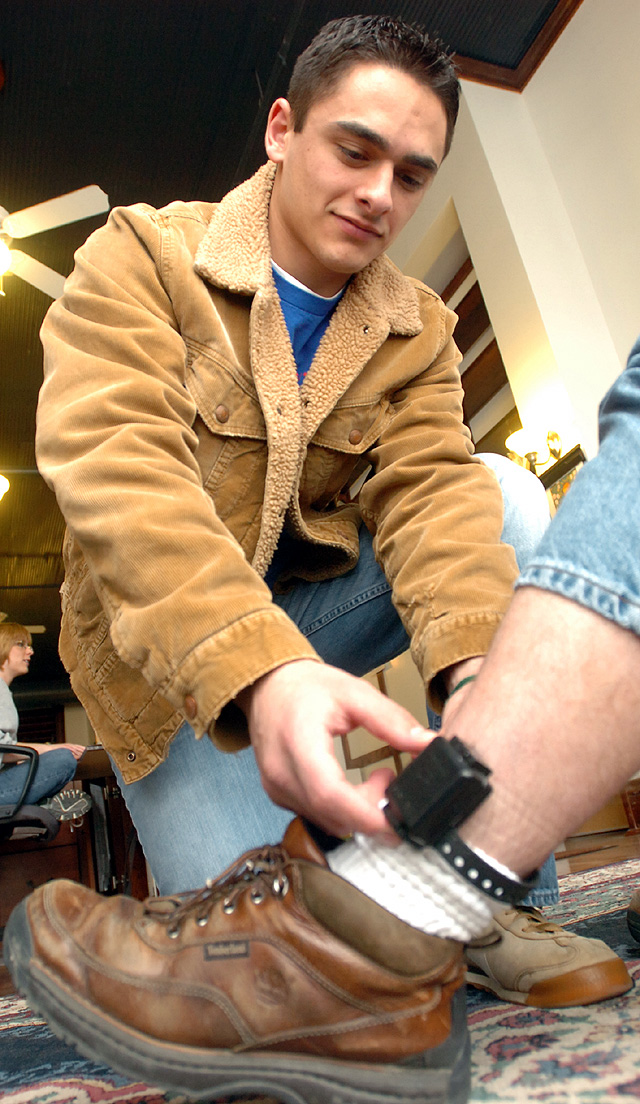
Brock Robson, a field tecnician for Viking Offender Management demonstrates the installation of a monitoring bracelet used for people under house arrest. The bracelet keeps track of the accused as part of some bond agreements.
It costs $90 a day to house a criminal in jail. It costs roughly $20 to put him on house arrest.
Still, house arrest is a tool that’s been used sparingly in Douglas County in recent years. The county doesn’t own or rent any electronic monitoring equipment, and the only time it’s used is when defendants arrange for it and have the money to pay for it.
But with the jail nearly full – and with the gadgets used to track people becoming more affordable – some say house arrest is a tool Douglas County can’t afford to ignore.
“There’s very few counties that are utilizing it to the point that they could and should,” said Loren Thormodsgard, owner of a Topeka company that provides electronic monitoring. “When you’re talking about jails that are overcrowded and people that are in jail for offenses that do not represent a danger to the public, it’s ludicrous to start talking about building more jail cells when you can very cheaply have people on electronic monitoring, and in some cases you can make people pay for it themselves.”
Shannon Murphy, deputy director of Douglas County’s Community Corrections department, estimated that at any given time, about a dozen adults in the county were on house arrest using electronic monitoring. By comparison, Johnson County – with a population about five times that of Douglas County’s – has an average of 120 to 130 people on house arrest per day.
Two commonly used items are GPS-monitoring ankle bracelets, which track people’s movements throughout the day, and mobile blood-alcohol testing units, which capture an image of the person as he or she gives a breath test at required times.
A few years ago, the county’s probation office gave up electronic monitoring because it had become too expensive to use, Murphy said. But with the cost of the equipment coming down, that picture may be changing.

The bracelets used by Viking Offender Management use a base station that monitors the person weating the bracelet and allerts authorities when the person has fled.
“In appropriate cases, we could use it in lieu of placing someone in jail, either pre-conviction or post-conviction,” said Robert Fairchild, chief judge of Douglas County District Court. “That may be a cost-saving idea.”
The Douglas County Jail has capacity for 196 inmates and an average daily population of around 160. About three weeks ago, the jail had its highest-ever population with 182 inmates, Undersheriff Ken Massey said.
He said when a group of consultants come to town next month to talk about space constraints at the jail, electronic monitoring will be one topic on the agenda.
“It would just cut down on our numbers,” Massey said. “I don’t know how drastically it would, depending on what kind of criteria we set up. At this point, any little bit will help.”
City Government

Developer seeks incentive from City of Lawrence to build 131 units of housing near Wakarusa and Queens

Lawrence city leaders will consider whether to keep Community Building open, make 2 other rec centers free to access
A STAR Bond application raises questions for city leaders about Costco and housing west of the SLT

Soccer gear honoring Lawrence history’s all-star team is now on sale as part of city’s public art exhibition

To honor public servants, Lawrence’s July 4 celebration will have a whole gallery of their photos on display; submissions open now