Air ambulances may face stricter rules after crashes
Keeping the life-savers safe
When he’s confronted with a terrible accident where time can make the difference between life and death, Jim Murray is grateful he can call on a medical helicopter for help.
After all, a trip to the University of Kansas Hospital from Lawrence is 45 minutes on the road – and just 15 minutes by air.
“Tremendously valuable,” said Murray, a division chief for Lawrence-Douglas County Fire & Medical. “Without a doubt, when time from incident scene to hospital to trauma center is valuable, it’s the only way to go.”
But flying an “air ambulance” is one of the trickier jobs in aviation.
There’s the challenge of flying a helicopter packed to the gills with people and medical equipment. The frequent nighttime missions. And the unusual landing locations.
“It’s more dangerous to land on a county road than at the airport,” said Greg Hildenbrand, director of Life Star, which has a medical helicopter based at Lawrence Municipal Airport.
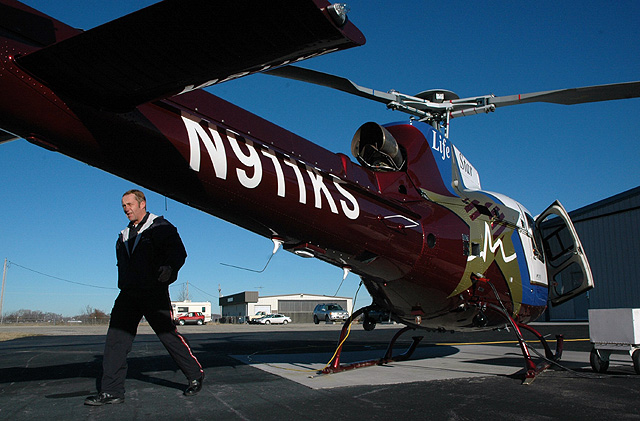
LIfe Star chief pilot Adrian Horne inspects the Life Star helicopter as he begins his 12-hour shift at the Life Star station at the Lawrence Municipal Airport. The emergency medical helicopter is checked at the start of each pilot's shift and after each flight. The number of accidents involving air ambulances has prompted the National Transportation Safety Administration to recommend more safety rules for medical helicopters.
Those challenges have combined to create 55 deaths in air ambulance flights nationwide in the past three years, including a February 2004 crash near Dodge City that killed a pilot, flight paramedic and flight nurse.
That record has prompted the National Transportation Safety Administration to recommend a more stringent set of safety rules for medical helicopters. The Federal Aviation Administration has 90 days to respond.
“Both the FAA and NTSB have seen a rise in the number of accidents in the last few years,” said Alison Duquette, an FAA spokeswoman. “When we see a safety trend we want to ensure safety.”
Rapid growth
The industry has grown rapidly in recent years. There are now 650 “medevac” helicopters operating nationwide.
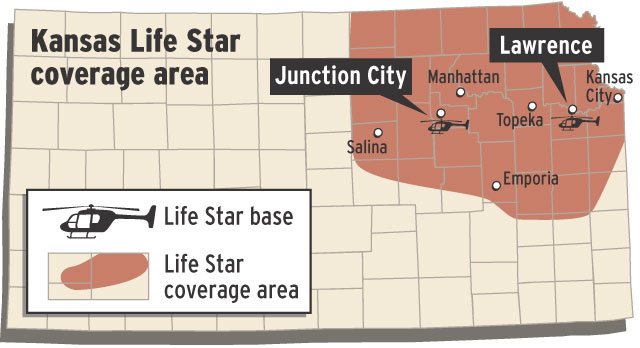
“Ten years ago, in Kansas, there were two helicopters. Now there’s 10,” Hildenbrand said.
The proposed rules would require pilots to get more rest and ground their helicopters during adverse weather. The rules would also require flight crews to complete a “flight risk evaluation” – evaluating weather, rest and other factors – to weigh the danger of a particular flight.
Also proposed by NTSB: improved technology on helicopters to help pilots navigate tricky terrain, though that technology hasn’t been created yet, and improved emergency dispatch systems.
Lawrence is served by Life Star, as well as LifeFlight Eagle, based in Kansas City, Mo., and LifeNet, an Olathe firm.
LifeNet officials deferred comment, but Life Star and LifeFlight officials said they had both established the risk evaluation programs, and that local dispatchers and emergency services were aware of their safety needs.
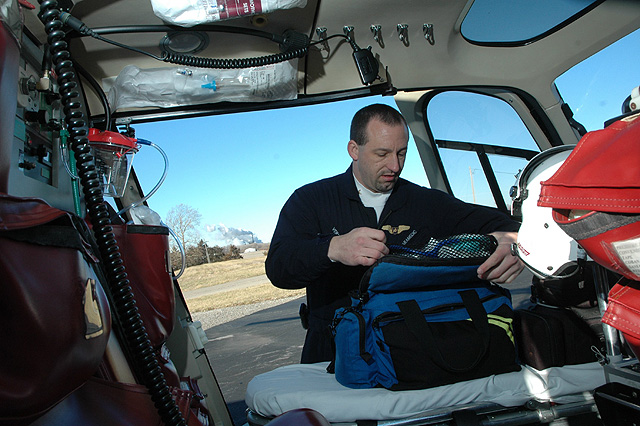
LIfe Star flight paramedic Vernon Peters checks over his supplies and equipment on board the Life Star helicopter. The emergency medical and transport helicopter is stationed at the Lawrence Municipal Airport.
But they disagreed on the need for new, stricter rules.
“The industry needs to be made safer,” Hildenbrand said.
“The industry has been pushing a long time to just about adopt everything the NTSB is talking about, but to do it on a nonregulatory level,” said Chuck Walter, director of program operations for LifeFlight Eagle.
The FAA appears more interested in the second path. Duquette said the agency has made strong recommendations to air ambulance operators, and that changing rules would take “a long time.”
The recommendations are “taken very seriously in the industry,” she said. “We feel we’ve put out a lot of excellent advisory material.”
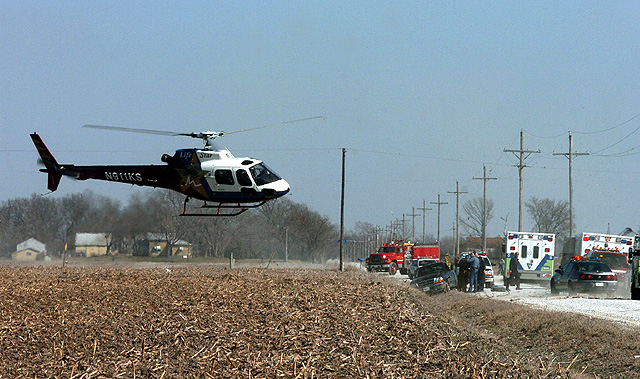
The Life Star helicopter responds to the scene of a one-vehicle rollover accident east of Lawrence in March 2005.
Both the air ambulance operators and local emergency officials said that flight safety was their top priority – so much that they’ll call off a potentially life-saving flight rather than put more lives at undue risk.
“The pilot is never given the condition of the patient,” Walker said. “We don’t want that clouding his judgment.”
Murray agreed.
“If the pilot thinks, ‘Not good enough for me,’ they can elect to land somewhere else,” he said. “That’s no problem … safety is really of paramount importance to everybody.”

Safety considerations
Life Star air ambulance service runs 500 rescue missions a year out of its Lawrence base. Greg Hildenbrand, Life Star’s director, said these are safety steps his company takes:
¢ Though federal regulations allow helicopters to fly with clouds as low as 500 feet and visibility of one mile, Life Star requires cloud “ceilings” of 1,000 feet, with two miles of visibility in the daytime.
¢ Though a “flight risk evaluation program” isn’t mandatory, Life Star implemented its own effort last fall – requiring flight crews to evaluate the safety of a particular flight based on a series of factors, including the number of flights already flown on a shift, the weather and familiarity with the landing zone.
¢ Though many rural areas require that tracking of ambulance flights be handed from one county’s dispatch center to the next as the helicopter crosses county lines, Life Star is dispatched for the entire flight from a central center at Forbes Field in Topeka – reducing the risk that officials on the ground will lose track of the helicopter.
City Government

Developer seeks incentive from City of Lawrence to build 131 units of housing near Wakarusa and Queens

Lawrence city leaders will consider whether to keep Community Building open, make 2 other rec centers free to access

A STAR Bond application raises questions for city leaders about Costco and housing west of the SLT

Soccer gear honoring Lawrence history’s all-star team is now on sale as part of city’s public art exhibition
To honor public servants, Lawrence’s July 4 celebration will have a whole gallery of their photos on display; submissions open now