As stormy weather brews in Douglas County volunteers keep eyes on sky
You can’t stop it and you can’t change it, but you can watch it.
And because May and June are the peak times for tornadoes in Kansas, it pays to keep an eye on the sky.
“It’s always been of interest to me,” said Mark Cairns, one of about 30 volunteers trained to watch for violent storms for Douglas County Emergency Management.
The volunteers make up a group called Skywarn, and members scatter to key locations in the county when bad weather threatens.
Cairns said he became interested in weather when he was a trainer for Kansas University athletics. Trainers let coaches know when it is a good idea to pull teams off practice fields because of approaching storms.
A few months ago Cairns became a duty officer for Emergency Management, which means he often works in the emergency operations center gathering information reported by storm watchers in the field and keeping track of reports from the National Weather Service. He still likes to go out on storm watches when he can.
“It’s something as a volunteer I can give back to the people of Douglas County,” he said.
‘Weather junky’
Bob Newton understands why Cairns doesn’t want to stop being a storm watcher. Newton did it for years before becoming a paid staff member with Emergency Management. He also is a duty officer and serves as public information officer when a disaster strikes, just as it did on May 8, 2003, when a tornado struck southwestern Lawrence.
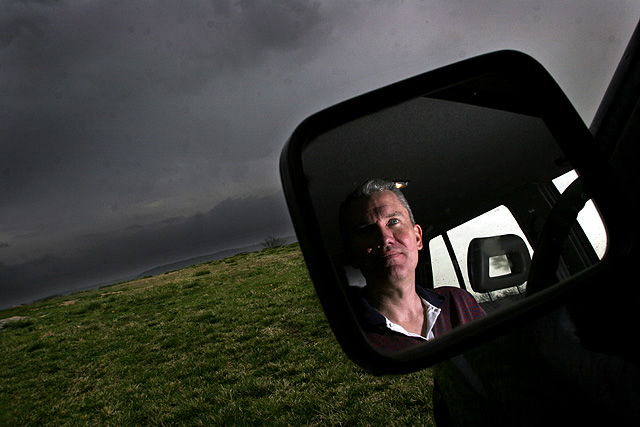
Mark Cairns, a duty officer for Douglas County Emergency Management, watches the sky for tornadic activity in early April at Miller Mart, 23rd Street and Wakarusa Drive.
“I’m definitely a severe weather junky,” Newton said. “It’s interesting to see how nature puts this stuff together.”
The tornado incident three years ago turned out to be a textbook example of how storm spotters can warn the public, Newton said. Spotters were in position and ready after getting reports of a tornado moving northeast in Osage County. Warning sirens sounded the first time about 20 minutes before it reached Lawrence, he said.
“Our spotters tracked that tornado as it entered the county,” Newton said. “We watched it as it came all the way toward Lawrence. The spotters were handing it off from one to the other.”
The tornado struck an apartment complex and several houses, causing about $6 million damage, but there were no serious injuries.
The situation was different the morning of March 12 when a microburst caught Lawrence by surprise, Cairns said. Storms were moving toward the county but there were no tornado watches or warnings, said Cairns, who was in the operations center at the time.
Cairns said he had just gotten off the phone with the weather service when he received a call from a Lawrence Police officer who reported a funnel cloud at 15th Street and Kasold Drive. Warning sirens were sounded.
“Thank goodness he saw that,” Cairns said of the officer. “We were able to warn a few people. Unfortunately it was one of those things that just caught us. Weather will do that every once in a while.”
A microburst can cause some air to circulate similar to a tornado, Cairns said.
Training required
Newton began his storm watching more than 20 years ago as a broadcaster with KLWN radio. He reported on storms for the station. He also attended annual storm spotting classes conducted by the weather service.
Rainy day
As heavy showers moved through the area, 0.96 inches of rain had fallen as of 9:45 p.m. Saturday at Lawrence Memorial Airport.
Today’s forecast calls for some clearing of the clouds in the morning with about a 50 percent rain chance this afternoon, according to the National Weather Service in Topeka.
“It’s not going to be like it has been these last couple of days,” meteorologist Jennifer Stark said and predicted less than an inch would fall today.
“To be honest, I didn’t have the training that spotters have now,” Newton said. “They are very well trained and formally trained. There is much more meteorology involved.”
Storm spotters are now required by the county to receive training on storm spotting policies and procedures, storm spotting exercises and go through a weather service class. They must pass a test given by Emergency Management. There also is an annual re-authorization requirement.
Wayne Deaver spent a few years as a storm spotter in Sedgwick County before moving to Lawrence, where he joined Skywarn about 18 months ago. When storms threaten, spotters go to certain locations based on where the storms are approaching, he said. Although he has seen several tornadoes, Deaver said he has never been caught by one.
“Part of it is just knowing where you are and what your situation is,” he said. “You always know your surroundings, what roads you are on and the quickest way out.”
Skywarn is an example of how storm spotting has evolved over the past 15 to 20 years, Newton said. Before Skywarn, early storm spotters were Citizens Band radio enthusiasts.
“It was a bunch of guys who liked to talk on the radio, and weather gave them something to talk about,” Newton said. “Now it’s a group of people who are interested in weather, and the radio is a tool that they use to communicate information back to Emergency Management.”
City Government
City leaders approve incentive for 131-unit housing development near Wakarusa and Queens
Developer seeks incentive from City of Lawrence to build 131 units of housing near Wakarusa and Queens

Lawrence city leaders will consider whether to keep Community Building open, make 2 other rec centers free to access
A STAR Bond application raises questions for city leaders about Costco and housing west of the SLT

Soccer gear honoring Lawrence history’s all-star team is now on sale as part of city’s public art exhibition