City, KU to discuss bus system cooperation
The door to merge the city’s public transit system with the Kansas University bus system has opened again.
City commissioners tonight will hear from both KU officials and their own public transit administrator about ways the two systems – the city-owned T and KU on Wheels – could work together more closely.
Cliff Galante, the city’s public transit administrator, said the possibilities include joint bus passes that could be used on both systems, a reworking of routes to reduce duplication, and operational changes that could allow both systems to take advantage of economies of scale.
“This would allow us to leverage our resources much better,” Galante said. “Does it make sense to have two bus garages when you could have one? Does it make sense to have two systems in place for oversight, when you could have one?”
Questions like those may lead to an even bigger question that community members and commissioners alike have asked: Does the community really need two bus systems?
Both sides said discussions may lead to the possibility of merging the two systems, but probably not right away.
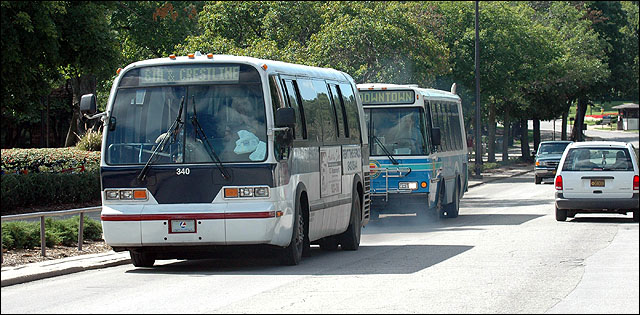
A KU on Wheels bus, left, and a Lawrence Transit bus both leave a stop in front of Budig Hall on Jayhawk Boulevard on the Kansas University campus. The city and KU are once again considering how the two bus services might work more closely together.
“We haven’t been given a mandate to merge,” said Danny Kaiser, assistant dean of students who chairs a public transit group appointed by KU Provost David Shulenburger. “I think what we’ve been asked to do is see how closely we can move these two systems together.”
The T is run by the city and KU on Wheels is operated by a nonprofit board of KU students. This summer there had been talk of creating a public transit authority that would run one new system that served both campus and the community. But Kaiser’s group stopped short of making that recommendation, in part because there was concern by KU students that they would lose too much control over how a new system would operate.
Galante said he thinks the idea is still one to consider.
“I think the goal is to maybe someday have a single transit authority, but I think it is a matter of doing it more in a phased approach,” Galante said.
KU officials are open to working with the city because the university system needs to access dollars from the Federal Transit Authority to buy new buses for the campus system. The city already receives about $1 million a year from FTA, and federal officials have said it is unlikely that they would fund a system that duplicates the services of the T.
City officials have long been interested in working more closely with KU on Wheels because KU students are frequent users of public transportation. Kaiser said one possibility may be to convert KU on Wheels into a system that operates primarily on campus, while the T could be used to bring students and faculty that live in the community onto campus.
Galante said the city is open to talking about all possibilities.
“The task I’ve been given is to grow the system, and here is a real opportunity to do that,” Galante said.
City commissioners meet at 6:35 p.m. tonight at City Hall, Sixth and Massachusetts streets.
City Government
Developer seeks incentive from City of Lawrence to build 131 units of housing near Wakarusa and Queens

Lawrence city leaders will consider whether to keep Community Building open, make 2 other rec centers free to access
A STAR Bond application raises questions for city leaders about Costco and housing west of the SLT
Soccer gear honoring Lawrence history’s all-star team is now on sale as part of city’s public art exhibition
To honor public servants, Lawrence’s July 4 celebration will have a whole gallery of their photos on display; submissions open now