Sewer woes could cost us
Reservations persist about prime ground
New concerns over the city’s sewer system likely will produce a multimillion-dollar debate within City Hall. But everyone agrees this much is not debatable: Raw sewage flowing into basements is no good.
That scenario – where basement drains start oozing the most unpleasant of materials – is what city leaders are trying to prevent by putting up caution flags about the city’s sewer system in northwest Lawrence.
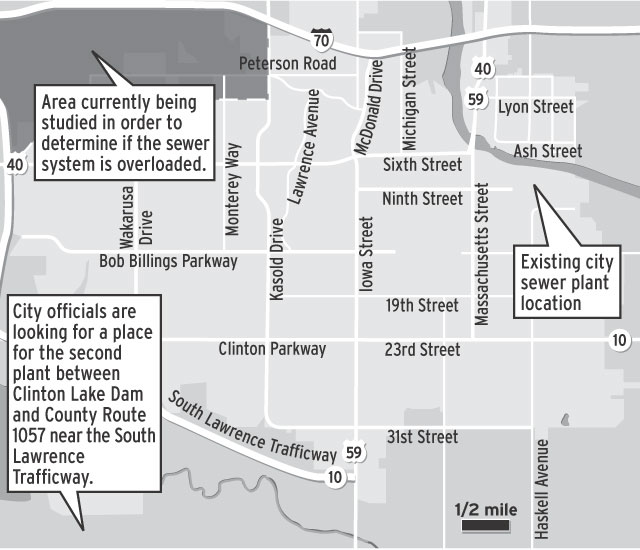
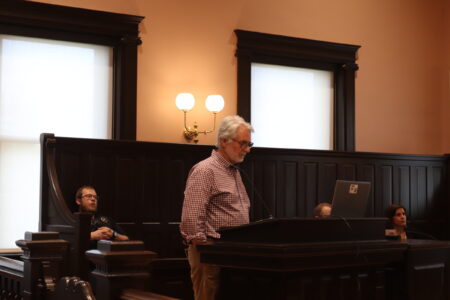
It is what led officials from the city’s utilities department to tell members of the Lawrence-Douglas County Planning Commission this week that they have reservations about allowing building permits on thousands of acres of prime development ground west of the Kasold Drive and Peterson Road intersection.
“Nobody wants to put things into pipes if it won’t come out the other end,” Planning Commissioner David Burress said. “Nobody wants to have pipes back up.”
But stopping it from happening could end up being costly to all city residents, or particularly painful to area builders. Or, maybe both.
Paying the bill
City officials aren’t entirely sure yet that they have a problem. They’ve hired an engineering firm for approximately $15,000 to study the northwest area’s sewer system and determine whether it is receiving more sewage than it is designed to handle.
But managers in the utility department have seen enough signs to suggest a problem. A sewage pump station near Sixth and Kentucky streets overflowed and dumped raw sewage into the Kansas River during a recent rain storm.
“I hope we have been overly conservative here and that the study shows there is a lot of room left in the system,” said Dave Wagner, the city’s assistant director of utilities that oversees the sewer system. “But I think what the indices are pointing to is that there is probably a problem.”
If that’s the case, everyone in the city – whether they have basements or not – probably should care. The city report is not expected to be done until late December, which means new projects likely won’t be able to receive building permits until at least then. But city officials have said it could be even longer because if the report finds problems, those will need to be fixed before building permits are issued. Some in the development community have predicted it could be a year or more before new projects can receive permits.
Considering that the building industry is generally considered one of the larger industries in the community, the slowdown could have ripple effects in the community’s economy.
“If we are not allowed to pull building permits, it is going to affect every part of the economy,” City Commissioner Mike Amyx said.
But there could be more direct impacts on residents’ pocketbooks. City officials don’t know yet how much it would cost to improve the area’s system, but they’ve said it would be millions of dollars. Possible fixes would include enlarging pump stations, adding new lines and enlarging existing ones. Many of the projects already are part of the city’s long-range plans, but may have to be moved ahead by several years.
The issue likely will raise the question of who should pay for the fixes: the public at large or developers?
“I know there will be a lot of pressure for the problem to be fixed with public money, but I’m not sure that is wise,” said Mayor Boog Highberger.
If developers are asked to pay for the system improvements, that is certain to create a fierce debate at City Hall because builders don’t feel they’ve done anything wrong.
“This northwest area is where the city has planned for growth,” said Bobbie Flory, executive director of the Lawrence Home Builders Assn. “The city has said, ‘Come on out here. This is where we want you to be.’ Now it looks like they may be leaving some of those people with outrageous expenses.”
The blame game
Whether developers are asked to pay for a fix could depend on whether it is determined that city officials made serious errors in projecting how much growth the city’s system could handle.
A major sewer master plan by Black & Veatch engineers was conducted in 2003. It spelled out what the city needed to do to keep the system running smoothly through 2010. It did not anticipate the city needing to make major improvements this soon.
That’s because the study did not anticipate as much growth in the area as has occurred. Utility engineers earlier this year began reviewing building permit data and found that some areas of the northwest already had as many new residents as projected for 2010. Wagner said that’s what led his department to become concerned about issuing new permits.
But Burress said the whole scenario created questions, such as why weren’t the growth projections in the Black & Veatch report more accurate, and why weren’t city officials paying closer attention to how many residents were being added to the area?
“I have to say that I think this entirely was on City Hall,” Burress said. “What went wrong? That needs to be investigated. We need to know how we could mess up so bad. This all should have been flagged sometime back. It was just way too last-minute.”
City leaders, though, aren’t conceding that city staff members erred. City Manager Mike Wildgen said he always expects changes will need to be made to master plans.
“This is not a static document,” Wildgen said. “It isn’t set in stone. Things change.”
Wildgen said keeping up with growth is a difficult task for any utility, not just the city’s sewer utility. He said he believed city staffers had worked the issue properly.
“The department hasn’t been sitting there doing nothing,” Wildgen said. “There is a lot of variability in these issues. A lot of people want to fault the Census numbers, but we work with the numbers that we think are the best available.
“We’re trying to do this in the most professional manner possible and with the most modern methods available. We’re not using 1950s methods.”
Amyx said city commissioners would want to dig deeper into the issue.
“We need to get to the bottom of this,” Amyx said.
Beginning of problems?
Whatever the reason for the missed projection, Flory said builders were worried that the city would find similar problems in other areas of town.
“There are concerns that there’s going to be a citywide building permit moratorium,” Flory said. “There are definite concerns about what will happen in other parts of the city.”
Wildgen, though, said his staff had not found any evidence to suggest a citywide building permit moratorium would be necessary.
The city also is relying heavily on growth projections in the Black & Veatch study to determine when a second sewer treatment plant is needed. The study says a new plant on the Wakarusa River is needed by 2011 in order for the city to keep up with projected growth. City commissioners have started the process to have the plant finished by 2011. If new projections show the plant is needed a bit sooner, it would be difficult for the city to speed up design and construction of the massive $76 million project.
But Wildgen said he hadn’t been presented with any evidence that says the plant will be needed before 2011.
“The treatment plant has not been the discussion point in all of this,” Wildgen said.
City Government
Developer seeks incentive from City of Lawrence to build 131 units of housing near Wakarusa and Queens

Lawrence city leaders will consider whether to keep Community Building open, make 2 other rec centers free to access
A STAR Bond application raises questions for city leaders about Costco and housing west of the SLT

Soccer gear honoring Lawrence history’s all-star team is now on sale as part of city’s public art exhibition
To honor public servants, Lawrence’s July 4 celebration will have a whole gallery of their photos on display; submissions open now