Unregistered offenders face crackdown
Convict says homelessness complicates compliance
Linda Leewright was hitchhiking from New Mexico to Indiana earlier this month with her husband, Dyall, when a state trooper stopped them in Hays to check their identification.
The officer wanted to make sure neither of them was wanted. To their surprise, Dyall Leewright turned up with an outstanding arrest warrant from Douglas County.
The charge: failing to keep police informed of his address.
“The trooper said ‘failure to register,’ and I said ‘register to vote?'” Linda Leewright said.
Dyall Leewright is one of five people charged in Douglas County District Court since August with violating Kansas’ offender-registration law, which is a low-level felony. That’s an unusually high number, given that no one was charged with the crime in Douglas County the first seven months of the year. Prosecutors say the increase is related to a recent Kansas Bureau of Investigation report that found the state had lost track of 13 percent of people on the registry.
Now, instead of heading to Indiana as they say they’d planned, the Leewrights are temporary Lawrence residents: He’s in the Douglas County Jail and she’s ringing bells for the Salvation Army and staying at a local homeless shelter.
Dyall Leewright, who has a 1996 conviction in Oregon for statutory rape, says it’s all the result of a misunderstanding. He insists that, before he left Lawrence in spring 2004 and moved to Colorado, he notified authorities he was leaving, both in writing and by phone. But he admits that could be difficult to prove.
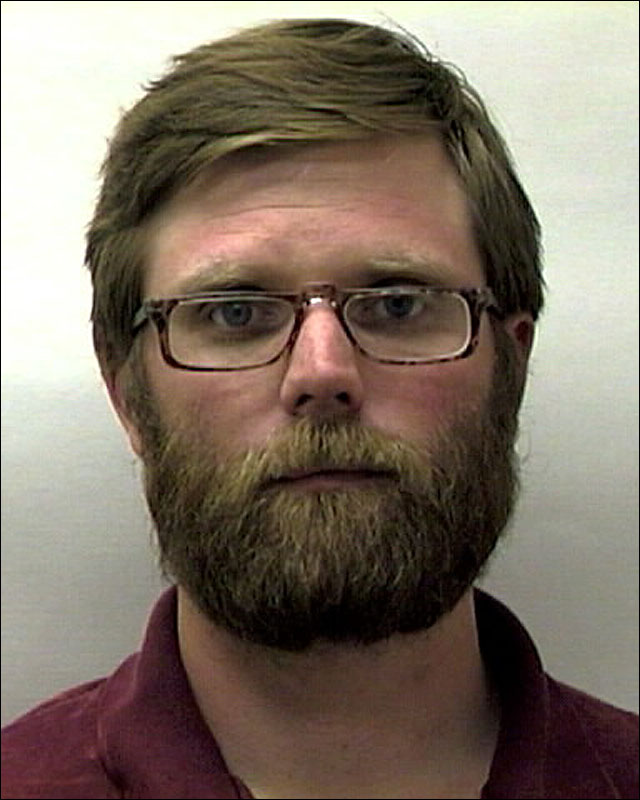
Dyall Leewright
“Being homeless, it’s not like I carry a filing cabinet,” he said Wednesday as he sat in a visitation room in a special-management wing of the jail.
About the registry
Kansas’ offender registry, available online at www.kansas.gov/kbi, consists of people convicted of sex crimes and some violent felonies, such as manslaughter and kidnapping, after 1994.
They must confirm their address every 90 days, notify police within 10 days of moving into a community, and tell police and the KBI if they move out of the state.
For many crimes, people are required to register for only 10 years, which means Leewright is a year or so away from not having to register at all.
This summer, after the report that found gaps in the registry was published, the KBI directed sheriff’s departments statewide to conduct more in-depth audits of the offenders in their counties, said Lt. Doug Woods, a spokesman for the Douglas County Sheriff’s Office.
Woods said the department “got more aggressive,” assigning one deputy to check frequently on the 60-some offenders in Douglas County to make sure they’re complying with the law.
“It’s a system that takes a lot of support. For it to be effective, you’ve got to spend a lot of time monitoring these people,” Douglas County Dist. Atty. Charles Branson said. “It’s almost like they’re on ‘probation lite’ is what it boils down to.”
Transient worker

A disclaimer on the registry site says the information may not be accurate. Branson said a major issue with the law was that it relied on offenders to supply information.
“It’s a state law you have to change your driver’s license 10 days after you move, but how many people do that?” Branson asked.
As Dyall Leewright’s case shows, problems also can arise when people move frequently or out of state.
“If you’re homeless, there’s a real good chance you’ll be charged with a violation,” Branson said.
Leewright was convicted of third-degree rape in Linn County, Ore., in 1996 for having sex with a 15-year-old girl, which he said happened while he was following the Grateful Dead. He served a brief jail sentence, but a judge set him free on probation, according to the county’s records.
In 1998, he was convicted of aggravated battery in Saline County, and he first registered as an offender in Kansas in November 2001 after he was released on parole from Kansas’ prison system.
He registered as an offender in Douglas County in February 2004, but he soon stopped responding to letters from the KBI. In October, Branson’s office issued a warrant for his arrest.
Facts disputed
Leewright, however, says that when he left Lawrence in spring 2004 to move to Fort Collins, Colo., he called the sheriff’s office and left a message with a detective saying he was leaving. He also notified the KBI by mail, he said.
“I figure when you send a letter to someone, they get it,” he said.
Leewright said that when he arrived in Colorado, he went to the local police department and tried to register there. But they told him he didn’t have to register because his case was more than seven years old, he said.
Leewright was being held in a special-management unit at the Douglas County Jail last week with bond set at $2,000. On Monday, Judge Jack Murphy denied a request by his court-appointed attorney, Ben Casad, to let him out of jail on his own recognizance.
His next court date will be Dec. 19.
Leewright, an Orthodox Jew, also has filed a handwritten lawsuit in District Court against the Douglas County Sheriff’s Office, alleging jail officers won’t let him have items including an Orthodox Jewish Bible, a prayer shawl and a yarmulke.
“Never have I been to a place where the word of God is denied to a Jew,” he said.
Undersheriff Ken Massey said jail officers have been trying to accommodate him, including making special trips to Lee’s Summit, Mo., to pick up Kosher meals. Massey said jail officers were working on finding a proper Bible, and that he planned to meet face-to-face with Leewright in coming days to hear his other requests.
City Government
Developer seeks incentive from City of Lawrence to build 131 units of housing near Wakarusa and Queens

Lawrence city leaders will consider whether to keep Community Building open, make 2 other rec centers free to access
A STAR Bond application raises questions for city leaders about Costco and housing west of the SLT
Soccer gear honoring Lawrence history’s all-star team is now on sale as part of city’s public art exhibition
To honor public servants, Lawrence’s July 4 celebration will have a whole gallery of their photos on display; submissions open now