They’re hot
Toplikar: Energy costs boost demand for wood burning stoves
As I backed out my garage, a guy with an orange hard hat came walking up.
“I want to talk to you about your trees,” he said. “Do you have a minute?”
Uh-oh.
As my dog barked at him, he pointed at the powerlines that traveled through the treetops along my block.
After about 20 minutes, I learned I was going to lose 11 trees that had grown into the lines, creating a fire hazard and the potential for outages during storms.
Yes, I hated to see them go. The trees held memories of my kids climbing in their branches or setting up sidewalk Kool-Aid stands in their shade.
But the power company’s guy left me with an interesting thought.
“You’ll have lots of firewood.”
Wood stoves booming
With lots of firewood coming, I wondered if I could use it to cut down on my heating bills this winter.
Turns out I’m not alone.
Since reports recently came out about natural gas rates increasing by 50 percent to 70 percent this winter, the interest in wood heating is booming, according to a downtown Lawrence shop that sells various wood stoves.
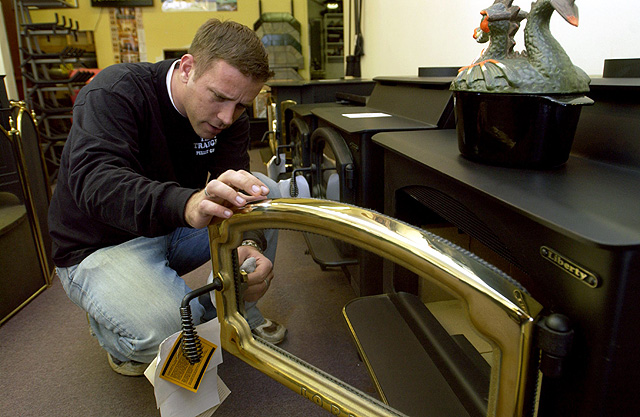
Alex Wigginton, manager of Swims & Sweeps Inc., 1033 Vt., wipes down the front of a display fireplace Tuesday in the store. Wigginton said sales of wood burning stoves were up 120 percent in October, compared with sales during the same period a year ago.
“We’ve seen a massive rush towards them. As a matter of fact, this is probably our best year in, oh, five to seven years, for sales,” said Alex Wigginton, manager of Swims & Sweeps Inc., 1033 Vt.
Wigginton said the business saw a 120 percent increase last month in orders for wood stoves and fireplace inserts.
“Our store right now is booked out until after Christmas for installations,” he said.
Improving efficiency
I told him I had a masonry fireplace and wondered if there was a way to improve its heat output.
“The basic masonry fireplace that most of us have is the least efficient way to burn wood,” Wigginton said. “Those are usually rated at 15 percent efficiency; 85 percent of everything is going up the flue instead of out in the room.”
He told me if I wanted want real efficiency, I needed to get a wood pellet stove or a corn stove (about 85 percent efficient), a free-standing wood stove or a wood stove fireplace insert (about 60 to 70 percent efficient).
The technology for them has been developing for more than 200 years.

Audio
- Alex Wigginton, manager of Swims & Sweeps Inc., 1033 Vt., on the cost of a wood stove: fireplace insert
- On recouping the cost
- On growing interest in wood heat
- Stove technology: catalytic and non-catalytic stoves
- Alison Davis, spokesperson for the EPA Office of Air Quality, Planning and Standards in Research Park Triangle, N.C., on recommendations on wood stoves
Links
“If you realize that Benjamin Franklin is the inventor of the first wood stove, you know that it’s been a while in the making,” Wigginton said.
And stoves have come a long way from the big steel box that Ben built.
Catalytic or ‘not-cat’
Wigginton said there are two types of wood stoves – ones with catalytic combustion chambers and ones without.
Catalytic combusters work like the catalytic converters on auto engines. A catalytic combustion chamber is made up of a coated ceramic honeycomb that heats up and burns the smoke gasses and particles from the wood fire.
The biggest problem with them is that the catalytic combuster degrades with use. Wigginton said they often need to be replaced every three years.
Catalytic models are 70 to 72 percent efficient, Wigginton said.
Many consumers are going with more modern, EPA-certified “non-cat” wood stoves, which are about 65 percent efficient, he said.
Recouping the cost
Wigginton said wood stoves are made of steel, cast iron and soapstone. While steel stoves heat up and cool down rapidly, a soapstone stove holds its heat longer.
Cast iron has some properties of both, he said.
Wood stoves are sold as free-standing models or as fireplace inserts, he said.
EPA practical tips for building a fire
Once your certified stove is properly installed, building an effective fire requires good firewood (using the right wood in the right amount) and good fire building practices. The following practical steps will help you obtain the best efficiency from your wood stove.
¢ Season wood outdoors through the hot, dry summer for at least 6 months before burning it. Properly seasoned wood is darker, has cracks in the end grain, and sounds hollow when smacked against another piece of wood.
¢ Store wood outdoors, stacked neatly off the ground with the top covered.
¢ Burn only dry, well-seasoned wood that has been split properly.
¢ Start fires with clean newspaper and dry kindling.
¢ Burn hot, bright fires.
¢ Let the fire burn down to coals, then rake the coals toward the air inlet (and wood stove door), creating a mound. Do not spread the coals flat.
¢ Reload your wood stove by adding at least three pieces of wood each time, on and behind the mound of hot coals. Avoid adding one log at a time.
¢ Use smaller fires in milder weather.
He estimated that with installation, a fireplace liner, a top plate, a collar, a cap for the top as insulation, it could cost about $3,000 for a wood stove insert into a fireplace.
But even at that price, depending on how high natural gas prices rise, a wood stove could pay for itself in three to five years, he said.
Burning clean
I also checked in with the Environmental Protection Agency – if I was going to burn the wood, I’d prefer to do it as cleanly as possible.
“If you’re going to use a wood stove, make sure it’s an EPA-certified stove,” said Alison Davis, a spokeswoman for the EPA’s Office of Air Quality, Planning and Standards.
Most wood stoves that were manufactured in the United States after 1992 are certified, she said.
The reason that older stoves should be replaced is because the EPA certified stoves are roughly 70 percent cleaner on average, in terms of producing pollution, she said.
While an older stove might put out 30 to 50 grams of particulate emission in an hour, an EPA certified model would put out 2 to 7 grams during that time.
Fireplace tips
If you’re just going to use a fireplace, there are ways to hold down the pollution, the EPA says:
¢ Use hardwoods, like hickory and oak.
¢ Split and age firewood for about six months; seasoned wood burns hotter, reduces smoke and cuts down on the amount of wood you need to burn.
¢ Burn small, hot fires to get the most heat and reduce fuel consumption.
¢ Don’t let the fire smolder overnight – it does little for heating and can increase air pollution, such as CO2.
A warm hearth
The saws had buzzed under the powerlines for a few days. And judging by the piles of wood left behind, there would be many warm fire-lit nights ahead.
“That’s a nice fire,” my wife said, coming into the darkened family room.
I remembered what I had been told about heating efficiency and most of the heat going up the chimney.
But I didn’t really mind.
A toasty ambiance was filling the room as the fire crackled with a mix of old logs and some of the new non-seasoned wood.
We sat silently, watching the flickering embers dance upward, drawing our eyes up to the high school graduation pictures of our four kids on the mantle.
Our dog stretched out on the carpet and curled up near us.
The trees were gone. But at least this was still a way to enjoy them.
City Government
Developer seeks incentive from City of Lawrence to build 131 units of housing near Wakarusa and Queens

Lawrence city leaders will consider whether to keep Community Building open, make 2 other rec centers free to access

A STAR Bond application raises questions for city leaders about Costco and housing west of the SLT

Soccer gear honoring Lawrence history’s all-star team is now on sale as part of city’s public art exhibition
To honor public servants, Lawrence’s July 4 celebration will have a whole gallery of their photos on display; submissions open now