

Medicaid recipients wary of proposed reductions
Congress plans to reduce Medicaid spending by $10 billion over the next five years.
For Kansas, that will likely mean a $73 million cut that many fear will lead to hundreds of disabled and elderly being denied services that help them live in community settings – tiny apartments, mostly – rather than nursing homes.
“I feel like my house is on fire and I’m standing here with a garden hose in my hand,” said Shannon Jones, executive director of the Statewide Independent Living Council of Kansas and an advocate for people with disabilities. “We’re going to have a hard time holding on to what we’ve got. It’s very frightening.”
Though the cut is not expected to be felt until 2007, it has set the stage for an especially contentious debate between Gov. Kathleen Sebelius, who’s made health care a top priority of her administration, and conservative legislators intent on curbing state spending.
“We have some (Medicaid) waivers that are out of control,” said Rep. Brenda Landwehr, R-Wichita, chairwoman of the House subcommittee that oversees welfare spending.
“We’ve got people who are being paid to help an elderly person buy groceries even though that person has a son or a daughter living in town who are perfectly capable of doing it,” Landwehr said.
“And we’ve got (Area Agencies on Aging) advising senior citizens on how to spend down their assets so they can be on Medicaid; instead of that money being spent on their care, they’re buying new cars – even though they’ll never drive again – for their kids, to get their assets down to where they’re poor enough to be on Medicaid.”
A spokesman for the state’s agencies on aging denied Landwehr’s allegations.
“Absolutely not true,” said Jim Beckwith, a past president of the Kansas Association of Area Agencies on Aging. “I guarantee it’s not happening in my area, and I know of no area where it is happening.”
The agencies, he said, actively oppose hiding assets because “every day, we’re the ones who work with people who are truly in need, and we know the only way we can serve more people is to keep costs down.”
Beckwith is currently executive director at the Northeast Kansas Area Agency on Aging, based in Hiawatha.
Still, Landwehr and others on the House Appropriations Committee are renewing efforts to rein in Medicaid spending.
“We’ve tried some things in the past, but we couldn’t get 63 votes,” she said, referring to the number of votes needed to pass a bill in the 125-member House. “We may try them again.”
History of increases
In Kansas, 8 percent and 12 percent annual increases in Medicaid spending have been commonplace.
A mix of state and federal funds, Medicaid accounts for roughly one-fourth of the state budget. It’s second only to education’s 64 percent.
Records show that Medicaid pays for one out of every three births in the state. Fifty-five percent of the state’s 22,000 nursing home residents are on Medicaid.
A year ago, Medicaid spending in Kansas topped $1.8 billion. It’s expected to reach $2.2 billion in the current fiscal year, which ends June 30.
In the fiscal year that begins July 1, Medicaid spending is expected to top $2.4 billion.
“That’s not sustainable long-term,” said Scott Brunner, director of medical policy at the state Department of Social and Rehabilitation Services.
Brunner and others attributed the growth to:
¢ Routine medical inflation.
¢ Increases in prescription drug costs.
¢ More elderly outliving their savings.
¢ Medical and technological advances that allow more people with physical and mental disabilities to live longer.
¢ Increasing numbers of low-wage workers – women, mostly – whose employers do not offer health insurance and who are poor enough to qualify for Medicaid. Their children, too, are eligible.
“What happened was when the economy went in the toilet a few years back, people started losing their jobs and after about a year we started seeing dramatic increases in (Medicaid) enrollment,” said Bob Day, Gov. Kathleen Sebelius’ top health care adviser.
“Those increases have continued because, frankly, the economy has yet to come back to where it was,” Day said. “It’s a shock we’re all still suffering from. This is going on everywhere.”
Overhaul factors
Day said the debate over how to go about reining in Medicaid costs would be framed by two factors:
¢ Sixty percent of the state’s Medicaid budget comes from the federal government, which, in turn, determines how it can and cannot be spent.
It’s the federal government that will figure out which parts of the Medicaid budget will be most affected by the upcoming cuts.
¢ Some parts of the Medicaid budget – payments to nursing homes, hospitals and doctors, for example – are protected by mandates. Others are not.
Services that help the elderly and disabled steer clear of nursing homes are not protected.
These services are especially vulnerable, Day said, because while the elderly and disabled make up 30 percent of the state’s Medicaid recipients, they account for 58 percent of the spending.
“It’s become very clear – and I don’t mean this in a moral-judgment sort of way – that the disabled are an expensive group to serve. They have a lot of health care needs that are long-term in nature,” Day said.
Day said Sebelius will not propose cuts in Medicaid spending in fiscal year 2007. Instead, the governor’s office is backing National Governors Assn. efforts to have a say in how the federal cuts are implemented.
State reform efforts
At the same time, Day said, Sebelius is looking for ways to increase efficiency within the current system.
“There’s not a lot of fat to be cut on the service and eligibility end of things. There really isn’t,” he said. “But let me remind you that 30 percent of your health care dollar still goes to cover administrative costs.”
Day said he’s been amazed by how many doctors’ billing systems, for example, are not computerized.
“It’s almost all paper driven; it’s like a step back in time,” he said. “There are doctor’s offices in the state – if you can believe this – that are not Internet-connected.”
Day said the governor’s expects the newly formed Health Policy Authority to play a major role in the state’s Medicaid reform efforts.
“Until there’s truly a national debate on health care, we’re not going to ‘solve’ Medicaid; we can’t because the feds are the ones calling the shots, not the states,” Day said. “And you’re not going to ‘solve’ anything with cuts because the people affected by those cuts are still going to show up in the emergency room as uncompensated care, which as we all know only drives up everybody else’s costs,” Day said.
The answer, Day said, is to find ways to increase efficiency.
“That’s exactly what the authority is set up to do,” Day said.
Day said he doubted that families suspected by Landwehr and others of milking Medicaid had much impact on the system’s costs.
“That’s not where the money is,” he said.
State Government
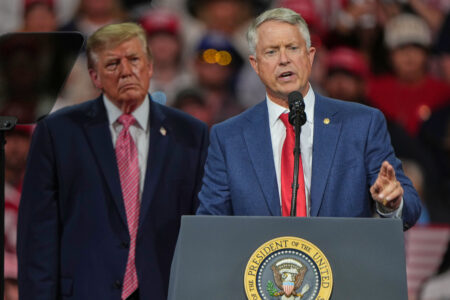
GOP’s highest profile figures are on rescue mission in once-reliable Kansas

In debate, Marshall says the Ukraine war, not the Iran war, has caused high diesel prices
Candidates lean on their prominent supporters in District 2 race
TOPEKA — Democrat Don Coover and Republican Derek Schmidt stood with partisan allies as their congressional race ...
Funding for new Chiefs stadium moves forward, setting sales tax revenue district
TOPEKA — State officials answered a key question this week underpinning the complex financing of the Kansas City ...
Voters Guide: A look at the candidates seeking to become Kansas Insurance Commissioner
The Kansas Department of Insurance regulates insurance companies that sell policies in Kansas. Voters will decide ...
Voters Guide: A look at the candidates seeking the job of Kansas State Treasurer
In the Nov. 3 election, Republican Kansas Treasurer Steven Johnson faces two challengers for his job as the chief ...