Down syndrome counseling prompts bill calling for more positive support
The first thing Julie Grace heard eight years ago, when her daughter was born, were two ominous syllables from the doctor’s mouth:
“Uh-oh.”
“Not what you want to hear when you just have a baby,” said Grace, a Lawrence resident. “He said, ‘I think this baby has Down syndrome.'”
Grace’s daughter, Alissa Murray, does indeed have the syndrome. Today, Alissa is a friendly blonde second-grader at Prairie Park School, living in a small east Lawrence apartment with her mom and older brother.
But had Grace listened to doctors in the first hours after Alissa’s birth, the girl might not be living with her family now — instead, she might be in a group home, or adopted by some other family.
“We had some doctors say that there are institutions, and that they’ve got waiting lists for people to adopt Down syndrome kids,” Grace said. “Honestly, I was mad. It seemed like they wanted me to give up any type of responsibility … it was very negative, very depressing.”
The advent of better prenatal screening for Down syndrome and other conditions means that parents like Grace now often get the news before their child is ever born. A new study suggests those parents often get the same kind of “depressing” advice that Grace received.
That trend has sparked an unlikely partnership in Congress, where Sens. Sam Brownback and Edward Kennedy — hardly ideological soulmates — are cosponsoring a bill to require and pay for positive counseling when doctors make early diagnoses of such conditions.
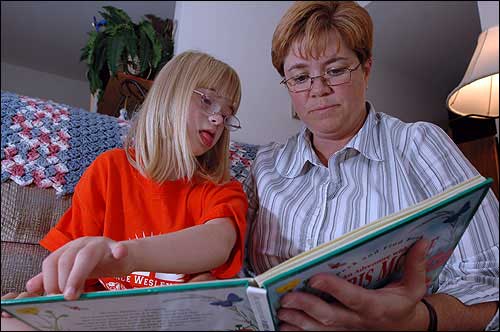
Alissa Murray, 8, who was born with Down syndrome, reads a book Wednesday with her mother, Julie Grace. Sen. Sam Brownback is sponsoring a bill to provide more positive counseling for parents of children with the syndrome.
“We don’t want a world where parents feel driven to justify their children’s existence,” Brownback, a Kansas Republican, said in a statement announcing the bill in March. “We need to link parents with these programs so that they are equipped with all the information they need to hopefully make a life-affirming choice.”
Hardships emphasized
Negative depictions of Down syndrome by health professionals who do prenatal screening are common, according to a survey of nearly 3,000 parents of children with the condition, published earlier this year in the American Journal of Obstetrics and Gynecology. A majority reported that the obstetricians who gave them the diagnosis had focused on the hardships ahead and ignored “the positive potential of people with Down syndrome.”
“In many cases the doctors were insensitive or just plain rude,” said the author, Harvard medical student Brian G. Skotko, whose 24-year-old sister has Down syndrome, which occurs in about one in 1,000 newborns.
Dr. Timothy Bennett, an associate professor of maternal-fetal medicine at University of Kansas Hospital, said doctors were getting better about offering positive counseling to such parents, but that hasn’t always been the case.

 Prenatally diagnosed Down syndrome and health care providers (pdf)
“My gut instinct is we’ve traditionally responded to Down syndrome in a very negative way,” Bennett said. “We used to call them a ‘mongoloid child,’ and what a terrible name.”
In previous decades, he said, Down syndrome children often were born with heart and intestinal problems that led to short and painful lives. Medical advances have made it possible to fix those problems, he said, and more children are entering adulthood.
That, Bennett said, is leading to better advice to parents.
“I think we know a lot more about Down’s children as they go into adulthood,” he said. “We can be a little more positive about their life experience.”
But many parents choose to have an abortion instead. Brownback’s office provided the Journal-World with a study, published by the American College of Obstetricians and Gynecologists, which stated that more than 80 percent of Down syndrome pregnancies were terminated during the 1980s and 1990s.
‘We were there’
| Down syndrome is a genetic disorder, caused by the presence of an extra chromosome, which results in physical and mental abnormalities.Most people with Down syndrome have IQs in the mild to moderate range of mental retardation, but there are wide variations in mental ability, behavior and developmental progress.— Sources: U.S. Department of Health and Human Services and National Down Syndrome Society |
Brownback said in March that such trends were a “new eugenics.”
“Once you go down the path of valuing some lives more than others, of saying that people with disabilities don’t have the same dignity and right to live as others, there are very few means that don’t justify the so-called ‘worthy end’ of a disability-free society,” he said.
Bennett said doctors were careful how they approach the subject with expectant mothers.
“We counsel women before we do diagnostic tests,” he said. “Anywhere I’ve ever been, we counsel women very carefully about whether they want to look for Down syndrome, and what their options are if we find them.”
One option, Bennett said, is ending the pregnancy.
“We let them know that’s one option, but we don’t encourage that,” Bennett said.
But doctors also let patients know about “positive” options, such as support groups that reach out to parents of Down syndrome children.
“There’s lots of support we can connect them with,” Bennett said.
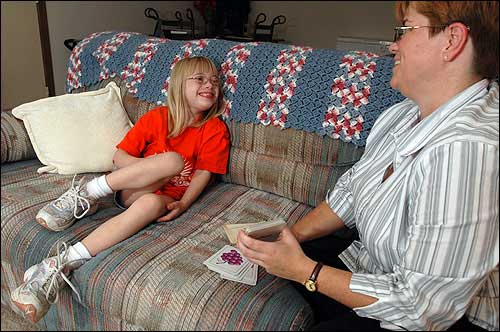
Alissa Murray, 8, who was born with Down syndrome, and her mother, Julie Grace, play with flashcards Wednesday.
The Brownback-Kennedy bill — Kennedy, though pro-choice, has a sister with Down syndrome — would allocate $25 million to provide more complete information about conditions such as Down syndrome, including data on life expectancy and how to reach parents who are raising children with congenital syndromes or diseases.
Grace said she would be willing to pitch in, and that she wished she had received better counseling when Alissa was born.
“Ever since she was born, I’ve told my doctors or anybody that I’ve ever talked with (that) I would be so willing to go speak to mothers in hospitals, new mothers, and bring Alissa with me, to say, ‘We were there,'” Grace said.
Her message?
“This my child,” Grace said. “She’s smart, she’s healthy, and she’s beautiful.”
— J-W wire services contributed to this article.
City Government

Developer seeks incentive from City of Lawrence to build 131 units of housing near Wakarusa and Queens

Lawrence city leaders will consider whether to keep Community Building open, make 2 other rec centers free to access
A STAR Bond application raises questions for city leaders about Costco and housing west of the SLT
Soccer gear honoring Lawrence history’s all-star team is now on sale as part of city’s public art exhibition
To honor public servants, Lawrence’s July 4 celebration will have a whole gallery of their photos on display; submissions open now