LMH: Demand insufficient to staff inpatient mental health unit
Dr. Pir Shah makes the nearly 90-minute drive from Osawatomie State Hospital to Lawrence Memorial Hospital about five times per week.
As a part-time psychiatrist at LMH, Shah has to make the bulk of his living at the Osawatomie State Hospital, even though he says he’d like to work full-time in Lawrence to be closer to his children at Kansas University.
But don’t count Shah among the voices crying out for LMH to reopen its inpatient mental health unit. He said the unit, which was closed last May, probably couldn’t attract the needed number of psychiatrists, psychiatric nurses and other professionals needed to make it successful. He also questioned whether it would really be what patients would want.
“If you just have the one unit, you can’t attract enough personnel,” Shah said. “Plus, patients need to know that they’re just not coming in to get a Band-Aid.”
Gene Meyer, president and chief executive of LMH, said that might be a point that is escaping many community members who are calling for the reopening of the unit, the final remnants of which were closed last May.
But that isn’t stopping calls to reopen the unit. Among the voices: the CEO of Bert Nash Community Mental Health Center.
Meyer said if the hospital reopened its inpatient unit it likely would be destined to struggle to maintain quality staff members because the demand for inpatient services simply is not large enough to justify the unit.
“It is not a matter of (financial) resources,” Meyer said. “It is a matter of community demand that allows us to offer a quality program. I hope people understand that LMH will not offer a program unless it is a quality program. That is our responsibility to the community. Anything else is irresponsible.”
But David Johnson, chief executive of the Bert Nash Community Mental Health Center, believes he has a partial solution to the psychiatrist issue. The center, which provides only outpatient care, is hiring a new psychiatrist to begin work this summer. Johnson said he would like the hospital to review the feasibility of hiring its own full-time psychiatrist to staff a reopened inpatient unit, while Bert Nash’s four psychiatrists could be used to supplement that doctor’s call loads on evenings and weekends.
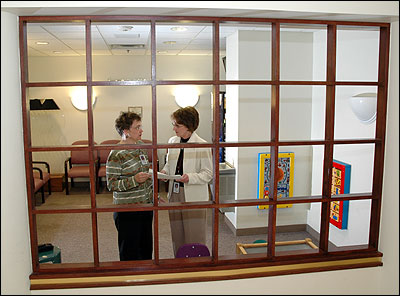
Lawrence Memorial Hospital's Paula Dupigny-Leigh, registered nurse and coordinator of the psychiatric consultation team, and Joan Harvey, director of emergency services, are shown last week in the LMH emergency waiting room. The hospital, which plans to convert a waiting room into a mental health stabilization service, continues to face questions about closing its inpatient mental health care unit.
Meyer, though, has rejected the idea because he said Bert Nash previously had failed to provide psychiatrists to staff the inpatient unit when it was in desperate need of physicians. Meyer said that failing was a major reason the unit was closed.
“That is rubbish,” Meyer said of Johnson’s suggestion. “We hired a full-time psychiatrist willing to do inpatient care, and their guys still dumped on us.”
Bygones
Johnson agrees that Bert Nash’s inability to supply psychiatrists to the unit was a major factor in its closing. The unit closed after the number of psychiatrists staffing the unit shrunk from three to one. Johnson said Bert Nash psychiatrists weren’t able to staff the unit because they were swamped with outpatient work.
But Johnson said the addition of a new psychiatrist should help, and the hospital should let bygones be bygones.
“The critical issues here are current issues as opposed to past issues,” Johnson said.
Meyer, though, said even if Bert Nash would help staff a new unit, it still would struggle to be a quality unit because of low demand for inpatient services.

 Woman’s psychiatric battles used to help others (05-05-05)
According to a new report by LMH, the hospital’s emergency department saw 900 patients in 2004 who were diagnosed with some sort of mental health issue. Most were able to be treated through outpatient care, but doctors ended up transferring 333 of the 900 patients to out-of-town inpatient mental health units.
That puts Lawrence near the statewide average, according to numbers from the Center for Mental Health Services, which found that 400 out of every 100,000 residents in Kansas in 2002 received treatment at an inpatient mental health facility.
Lawrence’s numbers, Meyer said, would not be an attractive enough situation to keep psychiatrists and staff members for the long term.
“When there is not the right demand for a service that keeps a staff enthused, educated and energized, you’ll lose them,” Meyer said.
Research wanted
Other administrators in the mental health field agreed. Renee Hanrahan, vice president of marketing for Prairie View Inc. — which operates a 38-bed inpatient unit in Newton — said psychiatrists wanted to stay busy.
“Unless they are in a position to do major research on top of seeing real patients, they can become very bored with seeing too few people,” Hanrahan said. “They went through a lot of school. They want to use their skills. They don’t want to wait until the next patient comes along.”
But if Lawrence is committed to once again having an inpatient unit there are models that may work for the city, Shah said. He said a community like Newton is able to have an inpatient facility, in part, because it is able to combine inpatient and outpatient services under one roof. Stormont-Vail West in Topeka is another example of a facility that does that.
He said Lawrence leaders should explore building a new facility that would be separate from the hospital but would involve a partnership between LMH, Bert Nash and possibly another funder like the city or county.
“It is my opinion that you could not attract people without a large, comprehensive program,” said Shah, who currently only sees patients at LMH who have been admitted for a physical reason but also have a mental health issue. “I think that would be a very good idea, though. I would certainly be willing to be a major part of that. Attracting psychiatrists wouldn’t be a problem in that case.”
Money needed
But Shah said the facility would take a major financial commitment from stakeholders. Johnson said he thought the community ought to at least find out how much money it would take to create such a center.
“If we had the resources, we would be more than interested in that,” Johnson said.
Johnson said his board of directors had written a letter to LMH officials inquiring whether LMH would help Bert Nash study the issue. Meyer said his board would review the request but it was too early to say whether the hospital would participate in the study.
Shah said he hoped city leaders would continue exploring options because he knows patients would benefit from having a quality inpatient unit in the community.
“It is a very important issue,” Shah said. “You and I wouldn’t want our grandmothers or our sons 100 miles away from us if they were put in a hospital. The same is true for everyone else in the community.”
City Government

Developer seeks incentive from City of Lawrence to build 131 units of housing near Wakarusa and Queens

Lawrence city leaders will consider whether to keep Community Building open, make 2 other rec centers free to access
A STAR Bond application raises questions for city leaders about Costco and housing west of the SLT

Soccer gear honoring Lawrence history’s all-star team is now on sale as part of city’s public art exhibition
To honor public servants, Lawrence’s July 4 celebration will have a whole gallery of their photos on display; submissions open now