New water line sparks dispute
Residents say plan too costly, endangers woods
It’s a fight that involves engineering, the love of nature and the ability of government to take private property.
David Millstein and his wife, Susan, live in the rolling, wooded hills north of Baldwin on the east side of East 1750 Road. Their property borders a nature preserve maintained by Baker University.
They are fighting a plan by Rural Water District No. 4 to run a 6-inch water line along the western edge of their property. District officials say the construction is part of a needed upgrade that will make line maintenance easier and, ultimately, cheaper. But, they cannot say precisely how much installing the new line will cost.
Millstein and others say the district’s plan to dig across rough ground and through beautiful trees is needlessly expensive and defies a more practical solution to the district’s need for a bigger line.
“That’s virgin, hardwood forest sitting on top of sandstone and limestone outcroppings. It’s full of ravines and washes.” Millstein said, raising his hands in disbelief. “This is totally inane!”
Water district officials say they must install a new line because the 3-inch pipe through which water is now delivered to the Millsteins and about 20 neighbors doesn’t meet state water-pressure standards.
“The smaller the line, the lower the pressure,” said district administrator Scott Schultz.
Maintenance concern
The existing line runs through an open, nearly treeless field less than a half-mile from the Millsteins’ property.
If the district truly needs to install a 6-inch line, Millstein said, there’s nothing to stop it from simply replacing the 3-inch line, following the current line’s path.
“That would make sense,” he said.
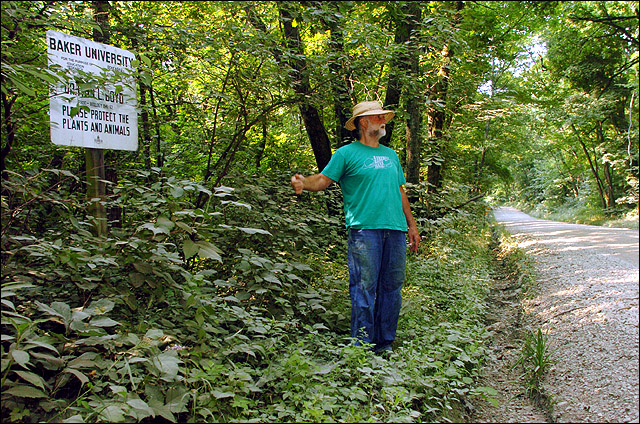
David Millstein surveys a stretch of virgin forest, owned by Baker University, which lies alongside his home north of Baldwin. Millstein is concerned about a plan by the water district to cut through the timber and lay a new water line instead of replacing the existing line, which currently runs through a pasture.
But Schultz said the line needed to be moved alongside a public roadway for easier monitoring and maintenance.
“Rural water districts in the past have sometimes laid lines across fields in order to save on short-term installation costs,” he said. “But these lines cannot be readily maintained.”
Schultz said the district’s seven-member board had studied the issue and approved installing the new line.
“You’ve got to think about the future,” said board member Bill Winegar. “This is a systems upgrade.”
Board members are elected to staggered three-year terms during the board’s annual meeting in January. Voting is limited to the district’s 1,050 metered customers who are able to attend the meeting.
Winegar and Schultz said every effort has been, and will be, made to least disrupt the Millsteins.
“We don’t to want disrupt anyone any more than we have to,” said Winegar, who is also the public works director in Baldwin.
Schultz said the district had agreed to lay the pipeline several feet off the roadway in an attempt to preserve the canopy created by the area’s overhanging tree limbs.
And, he said, workers will only take out as many trees as needed to move the trench-digging equipment in and out of the area.
“It won’t be a 30-foot swath,” he said, noting it more than likely would be eight to 10 feet in width.
Schultz said the new water line’s costs were unclear, but that it is part of a $630,000 project which includes building a new pump station and installing or replacing 5 miles of water lines throughout the district.
The portion of the project affecting the Millsteins’ property involves laying about 2,000 feet of pipe, he said.
Baldwin growth issues
Millstein says he’s being railroaded.
“They’re doing this because they can,” he said. “It’s become almost a Machiavellian-type thing – they have absolute power, so they can do whatever they want.”
Millstein, who owns several downtown Lawrence properties – including those that house Liberty Hall, 642 Mass., The Casbah, 803 Mass., and Sunflower Outdoor & Bike Shop, 802 Mass. – said he would fight condemnation.
“We’re already talking to a bulldog lawyer,” he said. “But you know what? This isn’t about the money, it’s about making sense. If they really needed to do this and if there really wasn’t another way, I’d say ‘Sure, go ahead.’ But that’s not what’s going on here,” he said.
In April, several of the district’s patrons accused Schultz and the board of promoting growth and self-interest rather than remaining neutral in the ongoing debate over how to control suburban sprawl in Douglas County.
The Millsteins’ dispute, they say, is more of the same.
“What’s really going on here is the district doesn’t want to lay a new line through the open field because it’s right of the edge of Baldwin and, in a few years, could very easily be annexed,” said Richard Morantz, who lives on 80 acres near the Millsteins.
“They don’t want to replace the line because they may end up losing it,” he said. “They’d rather run it along (East 1750 Road) for the potential for growth.”
Schultz says that’s not true. “This is not about growth,” he said. “It’s about meeting state standards.”
Schultz said plans call for the new line being installed by Aug. 31.
What is eminent domain?
In Kansas, rural water districts have eminent-domain powers, allowing them to condemn property for the public good.
Condemnations are subject to an appeals process that’s limited to whether the affected property is within the district and whether the “taking is necessary for a lawful purpose,” said Gary Hanson, a Topeka attorney who specializes in eminent-domain law.
The court, Hanson said, will not rule on a project’s merits or efficiencies; instead, that’s left up to the district’s board of directors.
After condemnation, three court-appointed appraisers determine how much a landowner should be paid for the use of his or her land. These decisions, too, may be appealed.
At this point, Hanson said, landowners have the right to present their case to a jury.
“There’s a long list of factors the jury can consider – aesthetics, for example,” he said.
Kansas law allows water districts to take over a property before compensation has been determined.
Most rural water districts try to avoid these confrontations because there’s no way to predict a jury’s decision, said Elmer Ronnebaum, general manager at the Kansas Rural Water Assn.
“Legal expenses have to be considered,” Ronnebaum said. “By the time a district gets through paying its attorneys and expert witnesses, it could very easily end up spending more than what it could have bought the property for in the first place.”
Ronnebaum said he was not in position to take sides with either Rural Water District No. 4 or the Millsteins.
“It’s true that running lines along roadways is the preferred practice,” he said. “But it’s also true that when everything – including public relations – gets worked into the equation, upgrading an existing line may be the way to go.”
City Government
Developer seeks incentive from City of Lawrence to build 131 units of housing near Wakarusa and Queens

Lawrence city leaders will consider whether to keep Community Building open, make 2 other rec centers free to access
A STAR Bond application raises questions for city leaders about Costco and housing west of the SLT

Soccer gear honoring Lawrence history’s all-star team is now on sale as part of city’s public art exhibition
To honor public servants, Lawrence’s July 4 celebration will have a whole gallery of their photos on display; submissions open now