In Atlanta, battle against panhandlers takes on racial tone
Atlanta ? A proposed ordinance to bar panhandlers from accosting people in Atlanta’s tourist section has run headlong into the politics of race in this city of the New South that likes to portray itself as having moved beyond black and white.
Hoping to boost convention business and tidy up downtown, the City Council is considering a measure to prevent visitors from being hit up for money by homeless people around Olympic Centennial park, CNN Center and some of the South’s finest restaurants.
But most of the panhandlers are black. And earlier this week, the council sent the proposal back to committee after activists likened the ban to the “Negro removal” policy that they say white downtown business elites pursued in the 1950s.
“This is a mean-spirited continuation of what they call the ‘sanitation’ of Peachtree Street,” said Joe Beasley, a 68-year-old Atlanta native who heads the regional office of the Rainbow/PUSH Coalition. “The white folks, their position was that black people were bad for commerce, and if you were black, you just didn’t go on Peachtree Street unless you were cleaning up or something.”
But in the self-proclaimed “City Too Busy to Hate,” the panhandling ban’s sponsor – who is himself black – said it has nothing to do with race and everything to do with business.
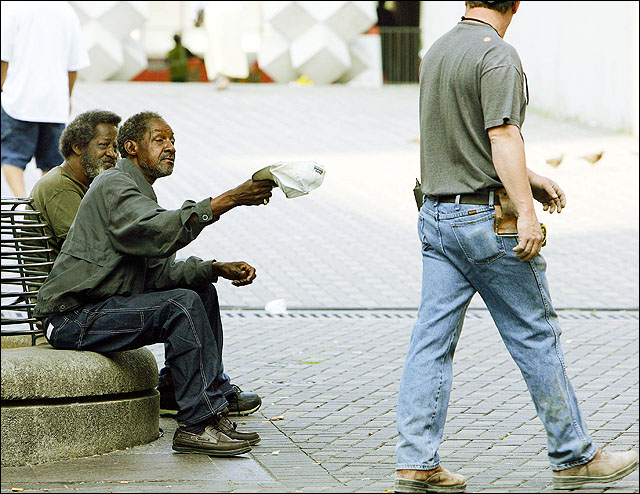
James Robert holds his hat out to a passerby as friend James Bennett, left, looks on in downtown Atlanta on Wednesday. The city council, hoping to put a shine on downtown, is considering a panhandling ban that supporters say will boost sagging convention business and spiff up the city in advance of a new aquarium attraction opening this fall.
“Our No. 1 industry in Atlanta is tourism and conventions. If we don’t do something, we run the risk of our downtown becoming a ghost town after dark,” said Councilman H. Lamar Willis.
The Rev. Murphy Davis, a white woman who runs Open Door Community to assist the homeless, dismissed the argument that the panhandling ban cannot be racist because it is backed by black council members and the black mayor, Shirley Franklin, in a city of 425,000 that is more than 60 percent black.
“The white business interests still run this city,” Davis said.
Downtown business owners back the ordinance, complaining that some streets and parks are so overrun with beggars that customers won’t visit.
“My own wife doesn’t come down here,” said Alex Nader, owner of European Kitchen Express, which overlooks Peachtree Street and a park. “We’ve had panhandlers come inside and actually solicit money from people who are eating.”
Under the ordinance, beggars could still sit on sidewalks with signs asking for money, but they could not approach people for money downtown. In other parts of the city, panhandling would still be allowed, except within 15 feet of ATMs, bus and train stations and public toilets.
The ordinance also makes it a crime for panhandlers to make a “false or misleading” solicitation, such as faking a medical condition or pretending to be from out of town.
National

Authorities disrupt planned drone, gun attack on White House UFC cage-fight
Rain along the Gulf Coast could become the first named storm of the Atlantic hurricane season
MIAMI (AP) — A cluster of storms along the Gulf Coast could become the first named tropical storm of the 2026 ...

Unhealthy air quality in California city as huge warehouse fire burns for 3rd day
Judge orders Trump administration to restore National Park changes at sites that ‘disparaged’ US
Teens’ reading and math scores have stagnated, US test results show
WASHINGTON (AP) — Younger students have regained ground academically after the pandemic's disruptions while older ...